
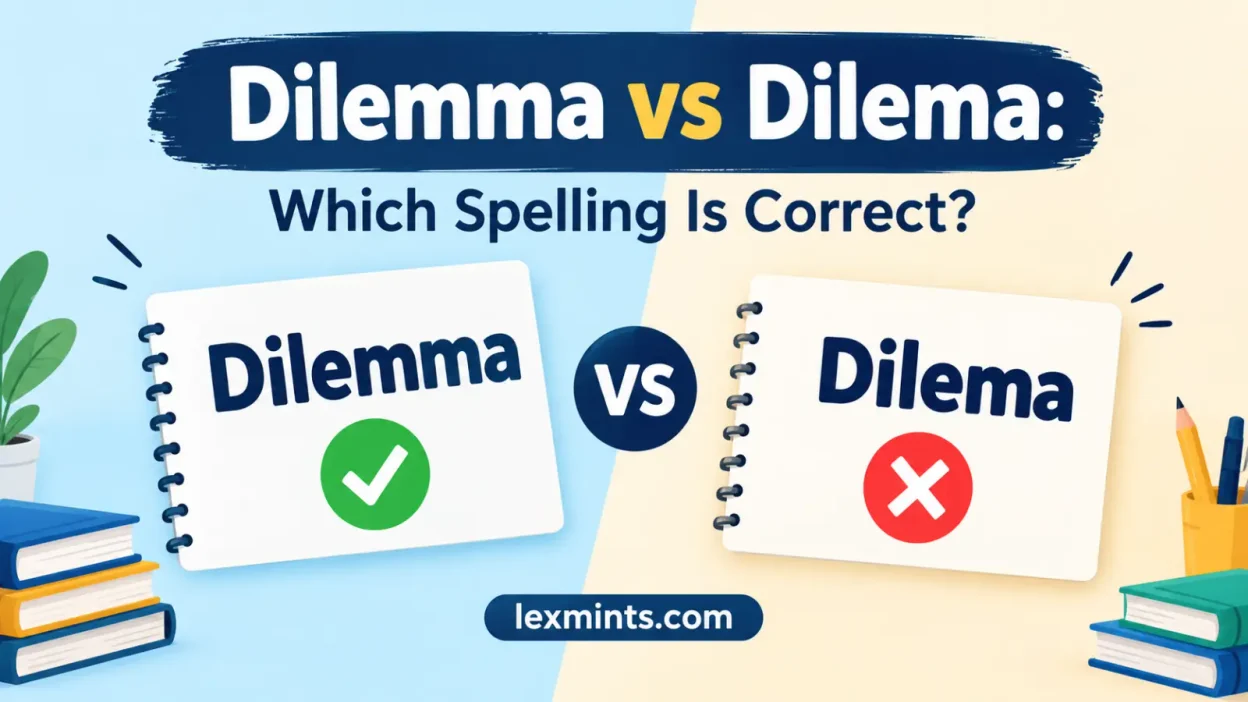
If you have ever hesitated between dilemma and dilema, you are not alone. These two spellings look almost identical, but only one is correct in standard English.
The correct spelling is dilemma — with two m’s.
Dilema is a misspelling and should not be used in standard American English.
The word dilemma refers to a difficult situation in which someone must choose between two or more options, especially when none of the choices seems ideal. It can describe everyday decisions, serious personal situations, business choices, ethical questions, and many other circumstances.
For example:
I faced a difficult dilemma when I had to choose between accepting a new job and staying close to my family.
In this article, we will explain the difference between dilemma vs dilema, why the incorrect spelling is so common, how to remember the correct spelling, and how to use dilemma naturally in sentences.
Dilemma vs Dilema: The Quick Answer
The correct spelling is dilemma.
- Dilemma ✅ Correct
- Dilema ❌ Incorrect
The most important thing to remember is that dilemma has two m’s.
The correct word is pronounced approximately di-LEM-uh in American English.
Correct:
She was in a dilemma about whether to accept the offer.
Incorrect:
She was in a dilema about whether to accept the offer.
The second sentence contains a spelling error because dilema is not the standard English spelling.
If you are writing an essay, email, article, school assignment, business document, or professional communication, always use dilemma.
What Does Dilemma Mean?
A dilemma is a difficult situation that requires a choice between competing options.
Usually, a dilemma exists because the available choices involve some kind of disadvantage, conflict, uncertainty, or consequence. You may want two different things at the same time, or you may have to choose between options that are both difficult.
For example:
Maria faced a dilemma: should she take the promotion or remain in her current position?
Both options may have advantages and disadvantages. The promotion could provide more money and career growth, while staying in the current position might provide a better work-life balance.
That conflict creates a dilemma.
The word can be used in many different contexts.
Personal dilemma
I was faced with a dilemma about whether to move to another city.
Professional dilemma
The manager faced a dilemma when two qualified employees applied for the same position.
Ethical dilemma
The doctor faced an ethical dilemma involving patient privacy.
Everyday dilemma
Choosing between pizza and tacos was a delicious dilemma.
A dilemma does not always have to be extremely serious. The word can describe anything from an important moral decision to a relatively minor choice.
Why Is Dilema Incorrect?
Dilema is incorrect because the standard English spelling contains two consecutive m’s: dilemma.
The spelling dilema is usually the result of leaving out one of the m’s.
This kind of spelling mistake is understandable because English contains many words in which a single consonant appears between vowels. When people hear or pronounce dilemma, they may not immediately remember that the written form contains mm.
Compare the two forms:
dilemma
D I L E M M A
dilema
D I L E M A
The difference is only one letter, but that missing m makes the second spelling incorrect in standard English.
When proofreading your writing, pay special attention to the middle of the word:
dile + mm + a
That double m is essential.
Why Do People Confuse Dilemma and Dilema?
There are several reasons people may accidentally write dilema instead of dilemma.
The pronunciation can be misleading
In normal speech, the two m’s are not necessarily emphasized separately. When you hear the word, it may sound as though it contains only one m.
As a result, someone who has learned the word primarily through speech may spell it incorrectly.
English spelling is not always predictable
English has many words whose spelling cannot be perfectly predicted from pronunciation.
For example:
- accommodation
- necessary
- committee
- occurrence
- recommend
- embarrassment
- dilemma
Words containing repeated consonants often require memorization.
The incorrect spelling looks natural
Because dilema differs from dilemma by only one letter, it can look believable at first glance.
This is especially true when reading quickly or typing without proofreading.
Typing mistakes are common
People often omit repeated letters while typing. Someone may know that dilemma is correct but accidentally type dilema because the second m is skipped.
Spell-checking software can help catch this error, but it is still useful to know the correct spelling yourself.
The Correct Spelling: Dilemma
The standard spelling is:
Dilemma
It contains two m’s.
A simple way to break it down visually is:
D I L E M M A
The double m occurs immediately before the final a.
Here are some examples:
He found himself in a difficult dilemma.
The company faced a financial dilemma.
She was caught in a dilemma between her career and her personal life.
We need to find a solution to this dilemma.
Choosing the right candidate created a difficult dilemma for the committee.
In each example, dilemma is spelled with two m’s.
Dilemma in American English
In American English, dilemma is the standard spelling.
It is commonly used in formal and informal writing, including:
- Academic writing
- Business communication
- News articles
- Essays
- Fiction
- Everyday conversation
- Professional reports
- Ethical discussions
For a US audience, there is no reason to replace dilemma with another spelling.
If you are writing for school or work in the United States, use dilemma.
The spelling does not change simply because the word is being used in a casual sentence.
For example:
I have a dilemma.
is correctly spelled just like:
The committee is facing a serious ethical dilemma.
Both use dilemma.
Dilemma vs Dilema Examples
Seeing the correct spelling in context is one of the easiest ways to remember it.
Example 1: Personal decision
I have a dilemma about whether to move closer to my workplace.
Example 2: Career decision
She faced a dilemma when she received two excellent job offers.
Example 3: Family situation
He was in a difficult dilemma because both choices could affect his family.
Example 4: Business decision
The company faced a dilemma after demand for its products suddenly decreased.
Example 5: Ethical situation
The journalist faced an ethical dilemma about whether to publish confidential information.
Example 6: Academic writing
The novel explores the moral dilemma faced by its main character.
Example 7: Everyday choice
I had a dilemma about which restaurant to choose for dinner.
Example 8: Multiple choices
The committee faced a difficult dilemma because every proposed solution had disadvantages.
Notice that the spelling remains dilemma in every context.
Common Incorrect Uses of Dilema
The most common mistake is simply dropping one of the m’s.
Incorrect:
The student faced a serious dilema.
Correct:
The student faced a serious dilemma.
Another common mistake is using dilema in formal writing because the writer has seen the misspelling elsewhere.
For example:
Incorrect:
This creates an interesting dilema for the organization.
Correct:
This creates an interesting dilemma for the organization.
If you are unsure, remember: dilemma = double m.
How to Remember the Spelling of Dilemma
A useful memory trick is:
Dilemma has a double M because the decision can make you say “Hmm…”
Think of this:
“Hmm… What should I choose?”
A difficult dilemma can make you think “Hmm.”
The word contains MM, just like the sound:
dile + MM + a
Another simple trick is to associate dilemma with other familiar words that contain double consonants.
For example:
- dilemma
- dilemma
- dilemma
Write it several times while focusing on the middle:
dilemma
The visual pattern becomes easier to recognize.
You can also remember:
Dilemma = two M’s
This is probably the simplest spelling rule for the word.
Is Dilemma Always About Two Choices?
Traditionally, the word dilemma is strongly associated with a choice between two difficult alternatives. However, modern English can use dilemma more broadly for a difficult situation involving competing choices or possible courses of action.
For example:
The company faced a dilemma over how to reduce costs without lowering employee morale.
This does not necessarily mean there are exactly two options. The central idea is the conflict between competing choices.
The important feature of a dilemma is that the decision is difficult because the available options create problems, trade-offs, or unwanted consequences.
Therefore, you can use dilemma when describing complex decisions in everyday life, business, education, politics, ethics, and personal relationships.
Dilemma vs Difficult Decision
Although dilemma and difficult decision are related, they are not always identical.
A difficult decision may involve several complicated factors, but a dilemma usually suggests a conflict between competing options.
For example:
Choosing a new phone was a difficult decision.
This may simply mean that there were many models to compare.
But:
I faced a dilemma about whether to accept the job or remain near my family.
This suggests a deeper conflict between two desirable or undesirable outcomes.
In other words, every dilemma involves a decision, but not every difficult decision is necessarily described as a dilemma.
Dilemma in Ethical Situations
One of the most common contexts for the word dilemma is ethics.
An ethical dilemma occurs when a person must choose between competing moral considerations.
For example:
The employee faced an ethical dilemma when asked to hide important information from a customer.
The person may feel obligated to follow an employer’s instructions but also believe that honesty toward the customer is important.
Another example is:
The researcher faced an ethical dilemma about how to protect participants while completing the study.
Ethical dilemmas are often discussed in philosophy, medicine, law, education, journalism, business, and technology.
In these contexts, the word dilemma emphasizes that the decision is not simple because different values or responsibilities are in conflict.
Dilemma in Everyday Conversation
Although dilemma can sound formal, it is also perfectly natural in casual conversation.
For example:
I have a dilemma. Should I stay home tonight or go out with my friends?
Or:
I can’t decide which movie to watch. It’s a real dilemma.
The word can even be used humorously:
My biggest dilemma today is whether to order coffee or tea.
This shows that dilemma does not always describe a life-changing crisis. Context determines how serious the situation is.
Dilemma as a Noun
Dilemma is a noun.
It names a difficult situation or choice.
Common expressions include:
- a difficult dilemma
- a serious dilemma
- an ethical dilemma
- a moral dilemma
- a personal dilemma
- a political dilemma
- a financial dilemma
- face a dilemma
- be in a dilemma
- create a dilemma
- resolve a dilemma
- solve a dilemma
Examples:
The decision put her in a difficult dilemma.
The company is facing a financial dilemma.
He struggled to resolve his moral dilemma.
The new policy created an unexpected dilemma.
Using the word as a noun helps you describe a situation rather than an action.
What Is the Plural of Dilemma?
The standard plural form is dilemmas.
For example:
The characters in the novel face several difficult dilemmas.
The singular form is:
dilemma
The plural form is:
dilemmas
You do not need to add another special ending.
Examples:
One dilemma can be difficult to solve.
Several dilemmas can arise during a complex negotiation.
The spelling remains easy to recognize because the double m stays in the singular form, while the plural simply adds s.
Dilemma vs Dilema: A Simple Comparison
| Word | Correct? | Meaning |
|---|---|---|
| dilemma | ✅ Yes | A difficult situation involving competing choices |
| dilema | ❌ No | Misspelling of dilemma |
The difference is simple:
Dilemma = correct
Dilema = incorrect
If you see dilema in a piece of writing, it should normally be corrected to dilemma.
Common Collocations With Dilemma
Learning common word combinations can make your English sound more natural.
Here are some common collocations:
Face a dilemma
The manager had to face a difficult dilemma.
Be in a dilemma
She was in a dilemma about what to do next.
Ethical dilemma
The situation presented an ethical dilemma.
Moral dilemma
The character experiences a serious moral dilemma.
Difficult dilemma
They found themselves in a difficult dilemma.
Financial dilemma
The organization faced a financial dilemma.
Resolve a dilemma
The committee met to resolve the dilemma.
Create a dilemma
The unexpected change created a new dilemma.
These expressions are useful in both everyday and formal English.
FAQs
Is it dilemma or dilema?
Dilemma is the correct spelling. Dilema is a misspelling and should not be used in standard English.
What does the word dilemma mean?
A dilemma is a difficult situation in which someone has to choose between two or more options, especially when each choice has disadvantages or unwanted consequences.
Why do people spell dilemma as dilema?
People often write dilema because the second m is easy to miss when spelling the word from its pronunciation. Remember that dilemma always has two m’s.
How do you spell dilemma correctly?
The correct spelling is d-i-l-e-m-m-a: dilemma. A simple memory trick is: “Dilemma has double M.”
What is an example of dilemma in a sentence?
Here is a simple example: “She faced a difficult dilemma when she had to choose between accepting the new job and staying close to her family.”
Conclusion
When choosing between dilemma vs dilema, there is a clear answer:
Dilemma is the correct spelling.
Dilema is a misspelling.
The word dilemma refers to a difficult situation in which someone must make a choice, often between competing options that have significant disadvantages or consequences.
The easiest way to remember the spelling is:
Dilemma has two M’s.
If you are writing an essay, article, email, report, or professional document, always use dilemma.
Quick reminder
- ✅ dilemma — correct
- ❌ dilema — incorrect
- dilemma — noun
- dilemmas — plural
- dilemma contains two m’s
So, the next time you are unsure whether to write dilemma or dilema, choose the version with the double m.
Dilemma is the correct standard English spelling.


