
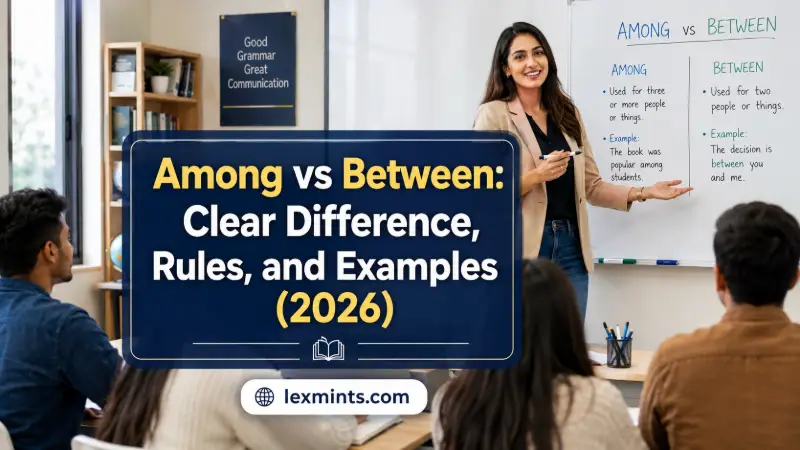
Among and between are both common English prepositions that show relationships, but they are not always used in the same situations. Many writers learn a simple rule that “between” is for two things and “among” is for three or more things. While this rule works in many basic cases, real English usage is more flexible.
The main difference depends on the type of relationship being described. Use between when you focus on separate relationships, individual choices, or specific connections. Use among when something exists within a group, community, or collection without focusing on individual pairings.
Understanding this difference helps you write clearer sentences in school, work, conversations, and professional communication.
Quick Answer
Use between when you talk about a relationship involving separate people, places, things, or choices.
Use among when you describe something happening inside a group or shared situation.
Examples:
- The agreement was made between the two companies.
- She felt comfortable among her friends.
The number of items alone does not always decide the choice. The meaning and relationship matter most.
Why People Confuse Them
People often confuse among and between because both words describe connections or positions involving multiple things.
A common grammar shortcut says:
- Between = two things
- Among = three or more things
This guideline helps beginners, but it does not cover every situation. English speakers often use between with more than two items when they mean separate relationships.
Example:
- The teacher divided the work among the students.
- The negotiations between the three countries continued.
In the second sentence, between works because the focus is on individual relationships among the countries.
The key question is not only “How many things are involved?” but also “Am I describing a group or separate connections?”
Key Differences At A Glance
| Feature | Among | Between |
|---|---|---|
| Main idea | Inside a group or surrounded by several things | A connection involving separate people or things |
| Common use | Groups, shared situations, distribution | Choices, agreements, relationships |
| Focus | Collective setting | Individual relationships |
| Example | She found support among her coworkers. | The deal was between two companies. |
Additional comparison:
| Context | Best Choice | Why |
|---|---|---|
| Sharing items with a group | Among | Shows distribution inside a group |
| Comparing two options | Between | Shows a choice separating options |
| Formal agreement | Between | Highlights separate parties |
| Being part of a crowd | Among | Shows position inside a group |
Meaning and Usage Difference
Among
Among means being in the middle of, surrounded by, or included within a group of people or things.
Examples:
- He walked among the trees.
- She was popular among her classmates.
- The rumor spread among employees.
The word emphasizes a shared environment or group setting.
Between
Between shows a relationship, separation, choice, or connection involving distinct people or things.
Examples:
- Choose between coffee and tea.
- The friendship between the two neighbors grew stronger.
- The road runs between the buildings.
The word highlights separate points or relationships.
Although between often appears with two items, it can also describe multiple separate relationships.
Example:
- The agreement between the five organizations created new opportunities.
Here, each organization has a distinct relationship with the others.
Tone, Context, and Formality
Both among and between are standard words used in everyday and formal American English.
Among often appears when writers want to emphasize community, groups, or shared experiences.
Examples:
- There was excitement among the fans.
- The idea became common among professionals.
Between often sounds more specific because it identifies clear boundaries or individual connections.
Examples:
- The contract between the partners was signed.
- The difference between the two plans is clear.
Neither word is more formal than the other. The correct choice depends on the relationship being described.
Which One Should You Use?
Choose among when the subject exists inside a group or when something is shared by several members.
Use among for:
- groups of people
- crowds
- communities
- shared feelings
- distribution
Examples:
- The message spread among voters.
- Divide the snacks among the children.
Choose between when you compare, connect, or separate specific things.
Use between for:
- choices
- agreements
- comparisons
- relationships
Examples:
- I cannot decide between these two laptops.
- The relationship between the teams improved.
A useful test:
Ask whether you see a group environment or separate connections. A group suggests among; distinct relationships suggest between.
When One Choice Sounds Wrong
Some sentences sound incorrect because the word does not match the relationship.
Incorrect:
- She shared the information between the group members.
Better:
- She shared the information among the group members.
The first sentence focuses on a group receiving something, so among fits better.
Another example:
Incorrect:
- The decision was made among the two managers.
Better:
- The decision was made between the two managers.
Because the sentence describes a specific relationship between two people, between works naturally.
However, using between with more than two items is not automatically wrong.
Example:
- The competition between three schools was intense.
This works because the schools represent separate competitors.
Common Mistakes (and Quick Fixes)
Mistake 1: Always using “between” for two items only
Many learners think between cannot describe more than two things.
Wrong idea:
- Between must always involve exactly two items.
Correction:
- Between can describe multiple separate relationships.
Example:
- The partnership between several companies expanded.
Mistake 2: Using “among” for direct comparisons
Wrong:
- Decide among these two choices.
Better:
- Decide between these two choices.
A direct choice usually needs between.
Mistake 3: Using “between” when something belongs to a group
Wrong:
- She felt comfortable between her friends.
Better:
- She felt comfortable among her friends.
The sentence describes being part of a group, so among fits.
Everyday Examples
Among examples:
- The puppy ran among the children.
- She found her keys among the books.
- The news became popular among teenagers.
- He felt relaxed among close friends.
Between examples:
- The store is between the bank and the restaurant.
- We must choose between two options.
- The conversation between the coworkers was friendly.
- There is a strong connection between the teams.
These examples show that the choice depends on meaning, not only the number of items.
Dictionary-Style Word Details
Verb
Among: Not commonly used as a verb in standard US English. It functions mainly as a preposition.
Between: Not commonly used as a verb in standard US English. It functions mainly as a preposition and can also appear in fixed expressions.
Noun
Among: Not commonly used as a noun in standard US English.
Between: Not commonly used as a noun in standard US English.
Both words mainly work as prepositions rather than independent nouns.
Synonyms
Among:
- Closest plain alternatives: in, within, surrounded by
Between:
- Closest plain alternatives: in the middle of, separating, connecting, involving
Exact synonyms depend on the sentence because these words describe relationships rather than simple objects.
Example Sentences
Among:
- The singer was among the guests at the event.
- The plant grew among the flowers.
Between:
- The agreement between the companies lasted five years.
- She stood between the two doors.
Word History
Both among and between are established English prepositions with long histories of use. Their meanings developed around ideas of position, relationships, and connection. Modern usage focuses on the relationship a speaker wants to describe rather than a strict number rule.
Phrases Containing
Among:
- among friends
- among others
- among the crowd
Between:
- between you and me
- between the lines
- between two points
These phrases show the typical meanings of each word in everyday English.
FAQs
Is among or between correct for three things?
Both can be correct with three things, depending on meaning. Use among when the items form a group or shared setting. Use between when you describe separate relationships or comparisons involving distinct items.
Can between be used with more than two people?
Yes, between can describe more than two people or groups when each relationship remains separate and identifiable. The idea of individual connections matters more than the number of participants.
Is among only used for groups?
Yes, among usually describes something located within or shared by a group. It focuses on the collective environment rather than individual connections between specific members.
Should I say choose among or choose between?
Both can work, but they create slightly different meanings. Use choose between when selecting from distinct options. Use choose among when choosing within a larger group or collection.
Is between more formal than among?
No, neither word is automatically more formal. Both appear in casual conversations, academic writing, and professional communication. The correct choice depends on the relationship you want to express.
What is the easiest way to remember among and between?
Remember the focus. Among points to being inside a group, while between points to separate connections, choices, or boundaries. Check the relationship before choosing the word.
Conclusion
The difference between among and between depends on the relationship being described. Among works best when something exists inside a group or shared environment. Between works best when you focus on separate connections, choices, or relationships.