
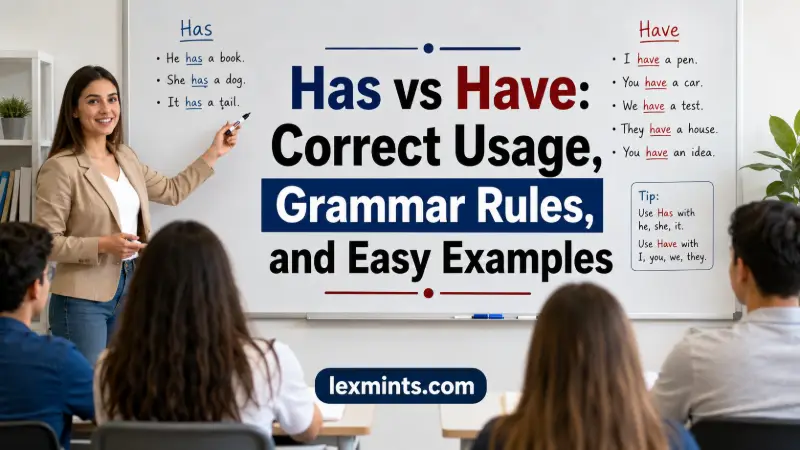
Choosing between has and have is mainly a subject-verb agreement question. Both are present forms of the same verb, but they appear with different subjects and in different sentence structures.
The safest rule is more precise than “singular takes has, plural takes have.” Use has with a third-person singular subject such as he, she, it, Maria, or the phone. Use have with I, you, we, they and plural nouns.
The same pattern matters when these words show possession, describe experiences, or help form the present perfect. Questions and negatives add one important twist: after does, use have, not has.
Quick Answer
Use has with third-person singular subjects: he, she, it, or one named person or thing.
Use have with I, you, we, they and plural subjects.
- She has a new laptop.
- I have a new laptop.
- The store has two entrances.
- The stores have two entrances.
In questions and negatives with does, use the base form have: “Does he have time?” and “She doesn’t have time.”
Why People Confuse Them
The confusion comes from the fact that has and have usually express the same basic ideas. Both can show possession, relationships, characteristics, experiences, or completed actions. The difference is normally grammatical rather than a change in meaning.
A simple “singular versus plural” shortcut can also cause mistakes. I is singular, but English uses I have, not I has. You can refer to one person or several people, but it still takes have.
Questions create another common trap. A learner may correctly write “She has a car” and then incorrectly change it to “Does she has a car?” Once does appears, the next verb stays in its base form: “Does she have a car?”
Key Differences At A Glance
- has: third-person singular present form; used with he, she, it, and singular third-person nouns.
- have: present form used with I, you, we, they, and plural nouns.
- Both: can work as main verbs or as helping verbs.
- Neither: is more formal or more polite than the other.
- After does or a modal: use have, as in “Does she have…?” or “She will have…?”
Meaning and Usage Difference
As main verbs, has and have can express possession or a similar relationship.
“Daniel has a key” means the key is in Daniel’s possession. “Daniel and Priya have a key” expresses the same basic relationship, but the plural subject requires have.
They can also describe characteristics or experiences:
- The apartment has a balcony.
- The apartments have balconies.
- She has a headache.
- We have a problem.
Both forms also work as helping verbs in the present perfect. The subject still decides which form appears:
- He has finished the assignment.
- They have finished the assignment.
The meaning of the completed action comes from the full verb phrase. The choice between has and have still follows subject agreement.
Tone, Context, and Formality
There is no general tone or formality difference between has and have. Standard American English uses both in casual conversation, school writing, workplace communication, and formal prose.
The choice depends on grammar, not politeness. “The manager has approved it” is not more formal than “The managers have approved it.” The subjects simply require different verb forms.
Context can make the choice harder when the subject is separated from the verb by extra words. In “The box of old photos has been moved,” the subject is box, not photos, so has agrees with the singular head noun.
Which One Should You Use?
Find the true subject first. Then match the verb to that subject.
| Context | Best Choice | Why |
|---|---|---|
| He, she, or it | has | Third-person singular subject |
| One named person | has | A single name is normally third-person singular |
| One singular thing | has | Singular third-person noun |
| I | have | First-person singular uses have |
| You | have | Second person uses have whether singular or plural |
| We or they | have | These pronouns take have |
| Two or more people/things | have | Plural subject |
| After does | have | The following verb stays in the base form |
| After will, can, should, or must | have | A modal is followed by the base form |
When a long phrase appears between the subject and verb, ignore the distracting noun and identify what the sentence is really about. “The list of required documents has changed” uses has because list is singular.
When One Choice Sounds Wrong
Use have, not has, after do or does in questions and negatives.
Correct: “Does Ava have the address?”
Wrong: “Does Ava has the address?”
Correct: “He doesn’t have a reservation.”
Wrong: “He doesn’t has a reservation.”
Use have after modal verbs:
Correct: “She will have more time tomorrow.”
Wrong: “She will has more time tomorrow.”
Correct: “The device should have enough storage.”
Wrong: “The device should has enough storage.”
With a normal present-tense statement and no such helper before it, a third-person singular subject takes has: “Ava has the address.”
Common Mistakes (and Quick Fixes)
Mistake: “I has a question.”
Fix: “I have a question.”
Mistake: “The students has a deadline.”
Fix: “The students have a deadline.”
Mistake: “My brother have a new job.”
Fix: “My brother has a new job.”
Mistake: “Does the store has parking?”
Fix: “Does the store have parking?”
Mistake: “Everyone have a ticket.”
Fix: “Everyone has a ticket” when making a statement.
Mistake: Letting a nearby plural noun control the verb.
Fix: Match the verb to the true subject: “The schedule of events has changed.”
Everyday Examples
Here are natural examples of both forms in modern American English:
- Mia has a dentist appointment this afternoon.
- I have a video call at 3:00.
- The coffee shop has free Wi-Fi.
- Those apartments have large kitchens.
- Our teacher has posted the assignment.
- We have already submitted our work.
- Does your phone have enough battery?
- The new policy has created several questions.
- My coworkers have lunch around noon.
- Every applicant has the same deadline.
Notice that meaning alone does not decide the form. The subject and sentence structure do.
Dictionary-Style Word Details
Verb
has: A present form of have used with third-person singular subjects. It can work as a main verb (“She has a car”) or a helping verb (“She has finished”).
have: The base and present form used with I, you, we, they, plural nouns, and after structures that require the base form (“Does she have…?” “She will have…”)
Noun
has: Not commonly used as a noun in standard American English.
have: Can function as a noun in the expression the haves and have-nots, where haves refers to people with substantial material resources. In ordinary has vs have questions, however, have is usually a verb.
Synonyms
No single synonym replaces has or have in every use.
has: Closest plain alternatives for possession include owns and possesses, depending on context.
have: Closest plain alternatives for possession include own and possess, depending on context.
These alternatives do not replace has or have when the words function as helping verbs.
Example Sentences
has:
- The clinic has an opening at 10:30.
- Noah has completed the form.
- Each room has a smoke detector.
have:
- I have your receipt.
- The neighbors have two dogs.
- You have made a strong point.
Word History
have: The verb traces back to Old English habban and has remained a core English verb through later stages of the language.
has: Dictionaries treat has as the present third-person singular form of have. For this comparison, the important point is grammatical: both belong to the same verb rather than being unrelated words.
Phrases Containing
has: has to, has been, has got, has had
have: have to, have been, have got, have had
The same subject rule still applies when these forms begin a longer verb phrase: “She has been working” but “They have been working.”
FAQs
Is has or have correct with a person’s name?
Use has with one named person because a single name is normally third-person singular. “Jordan has a meeting at noon” is correct. Use have when two or more names form a plural subject: “Jordan and Mia have a meeting at noon.”
Do I use has or have after does?
Use have after does. The word does already carries the third-person singular marking, so the following verb stays in its base form. Write “Does she have time?” and “He doesn’t have a ticket,” not “does she has” or “doesn’t has.”
Should I say everyone has or everyone have?
Use has with everyone in a statement. Everyone is grammatically singular, so “Everyone has a seat” is correct. In the command “Everyone, have a seat,” have is also correct because the sentence is an imperative addressed to the group.
Is it there has been or there have been?
Both can be correct, depending on what follows. Use “there has been” before a singular idea, as in “There has been one change.” Use “there have been” before a plural subject, as in “There have been several changes.”
Can has and have both form the present perfect?
Yes. Both work as helping verbs in the present perfect, but subject agreement still controls the choice. Say “She has finished the report” and “They have finished the report.” The past participle stays the same; only has or have changes.
Are has and have different in formal and informal English?
No. The basic choice between has and have is grammatical, not a formality choice. Formal and casual American English follow the same subject-agreement pattern. Contractions may change the tone of a sentence, but they do not change which underlying form is required.
Conclusion
The has vs have choice becomes easier when you focus on the subject and sentence structure.
Use has with third-person singular subjects such as he, she, it, one person’s name, or one singular thing. Use have with I, you, we, they and plural subjects.
Remember the important base-form rule too: after does and modal verbs, use have. Once you identify the true subject and check whether another verb already controls the structure, the correct choice is usually clear.


[…] are natural examples using the correct […]