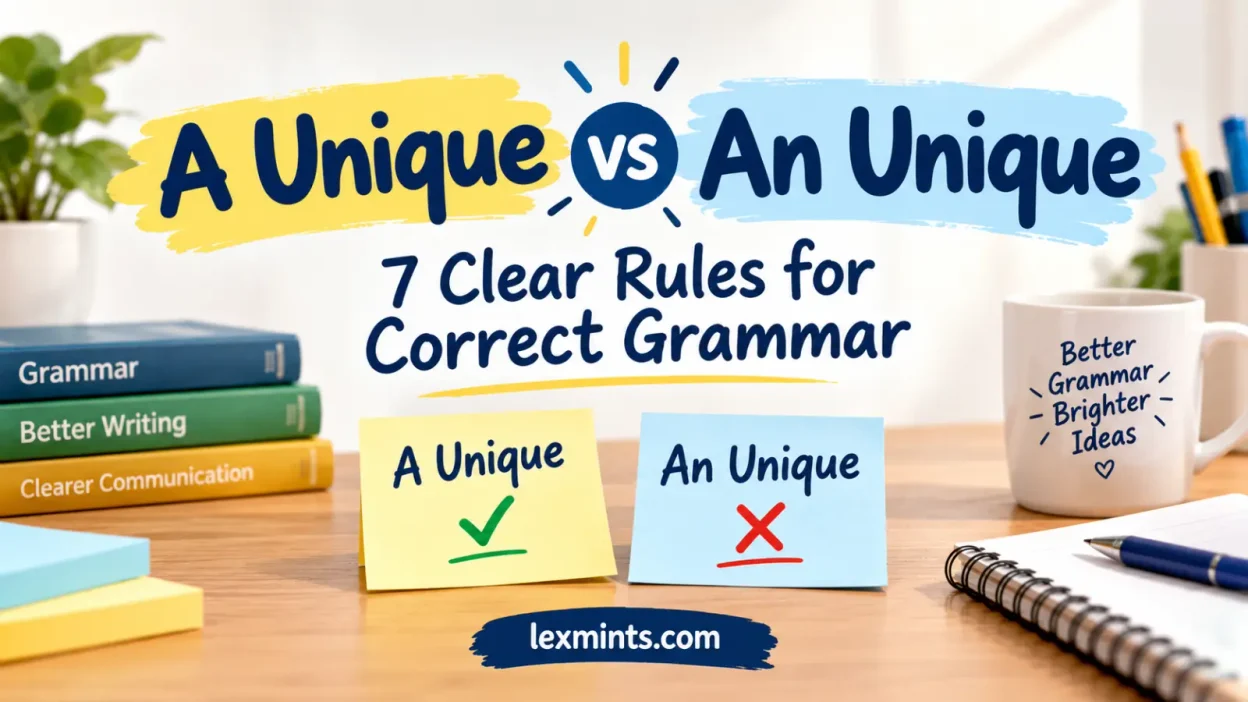
Choosing between a and an can seem easy until a word begins with a vowel letter but sounds like it starts with a consonant. The phrase a unique opportunity is a common example of this situation.
The correct phrase in standard American English is “a unique,” not “an unique.” Although unique starts with the letter u, its opening sound is similar to the “y” in you. That sound determines which article belongs before it.
This rule is useful in everyday conversations, school assignments, professional emails, and other forms of writing. Once you understand the difference between a written letter and a spoken sound, choosing the right article becomes much easier.
Quick Answer
Use a unique because unique begins with a consonant-like “y” sound.
- Correct: We discovered a unique solution.
- Incorrect in standard modern American English: We discovered an unique solution.
The same rule applies to words such as university, useful, user, and unicorn when they begin with the “you” sound.
Remember this simple principle: Choose a or an according to the first sound of the next word, not just its first letter.
What Is Correct?
The correct choice is a unique. In ordinary American English, unique is pronounced approximately “yoo-NEEK.” Its opening sound functions like a consonant, so it takes a.
Consider these sentences:
- The restaurant offers a unique dining experience.
- She developed a unique approach to the project.
- Every student brings a unique perspective to the discussion.
- We found a unique opportunity to improve the service.
In each example, a comes immediately before unique. The article does not change simply because the noun or sentence is different.
The phrase an unique is sometimes encountered in older material or unusual usage, but it is not the standard choice for contemporary American writing. For everyday communication, schoolwork, and professional documents, use a unique.
The Core Grammar Rule
The indefinite articles a and an are used before singular countable nouns and noun phrases. Their selection depends on the opening sound of the word that immediately follows them.
Use a before a consonant sound:
- a book
- a car
- a university
- a useful suggestion
- a unique design
Use an before a vowel sound:
- an apple
- an email
- an office
- an unusual result
- an excellent idea
The important difference is between spelling and pronunciation. English does not require an before every word that starts with the letters a, e, i, o, or u.
For example, unusual begins with a vowel sound, so we say an unusual result. However, unique begins with a “y” sound, so we say a unique result.
The rule remains the same in both cases. Only the opening sound changes.
When Each Form Is Correct
For this particular comparison, a unique is the standard form, while an unique is generally nonstandard in contemporary American English.
| Form or Pattern | Best Use | Why |
|---|---|---|
| a unique idea | Standard American English | Unique begins with a “y” sound. |
| an unique idea | Generally avoid | An normally precedes a vowel sound. |
| an unusual idea | Standard American English | Unusual begins with a vowel sound. |
| a useful idea | Standard American English | Useful begins with a “y” sound. |
| a one-of-a-kind idea | Standard American English | One begins with a “w” sound. |
You can also place other words between an article and unique. The article must agree with the first sound of the word immediately following it.
For example:
- She proposed a truly unique solution.
- We experienced a very unique situation.
- The team created a remarkably unique design.
In all three sentences, the article a appears before truly, very, or remarkably, not directly before unique. Each of those words begins with a consonant sound.
This detail matters because the article is not selected by looking ahead to any later word in the sentence. It is selected according to the word that follows the article.
A Unique vs An Unique: Which Is Correct?
A Unique vs An Unique — the correct phrase in standard American English is “a unique,” not “an unique.” The word unique begins with a consonant-like “y” sound, even though it starts with the vowel letter u. That is why we say “a unique opportunity” rather than “an unique opportunity.”
The rule is simple: use a before a consonant sound and an before a vowel sound. Understanding this pronunciation rule will help you choose the correct article in everyday conversations, school assignments, and professional writing.
When It Is Incorrect or Less Natural
Using an unique in ordinary contemporary American English is generally considered incorrect for standard edited writing. The problem is not the spelling of unique but the mismatch between an and its opening sound.
Compare these examples:
- Incorrect: The company introduced an unique product.
- Correct: The company introduced a unique product.
- Incorrect: He shared an unique perspective.
- Correct: He shared a unique perspective.
- Incorrect: It was an unique chance to learn.
- Correct: It was a unique chance to learn.
A writer might use an unique in a quotation, historical text, or deliberate imitation of an unusual speaking style. That does not make it the appropriate default for modern US writing.
Another common mistake is applying the same article to all words beginning with u. These examples show why that approach fails:
- A unique experience
- A useful resource
- An unusual experience
- An umbrella
The letter u alone cannot tell you which article to choose. Listen to the opening sound instead.
Meaning, Structure, or Emphasis Differences
The choice between a unique and an unique does not create a meaningful difference in the adjective’s definition. Both expressions attempt to introduce something described as unique.
The difference concerns grammatical form and natural pronunciation. A unique follows the standard article rule, while an unique does not fit the normal pronunciation of the word in contemporary American English.
Compare:
- We need a unique design for the new website.
- We need an unusual design for the new website.
The first sentence describes a design as unique. The second describes it as unusual. The adjectives differ in meaning, but the article choice follows the same sound-based principle.
There is another point worth understanding: unique traditionally means one of a kind. Writers sometimes use expressions such as very unique or most unique, but opinions about these combinations vary because they can conflict with the strict meaning of the adjective. That issue is separate from the choice between a and an.
For the article question, keep your attention on pronunciation. You do not need to change the meaning or emphasis of a sentence to select the correct article.
Real-World Examples
The following examples show how a unique works in everyday American English.
At work
- Our team developed a unique way to organize customer requests.
- The manager suggested a unique approach to employee training.
- This business offers a unique service for local customers.
At school
- The student presented a unique interpretation of the story.
- Each class project has a unique purpose.
- We discussed a unique feature of the experiment.
In daily life
- My neighbor has a unique collection of vintage postcards.
- We found a unique gift for our friend.
- That neighborhood has a unique character.
In technology and design
- The app provides a unique way to track personal tasks.
- The designer created a unique layout for the home page.
- The product includes a unique feature that saves time.
Now compare those examples with phrases that correctly use an:
- We found an unusual pattern in the data.
- She received an unexpected message.
- They proposed an innovative solution.
The difference is the opening sound of the next word. Unique begins with a “y” sound; unusual, unexpected, and innovative begin with vowel sounds.
Common Mistakes (and Quick Fixes)
Mistake: Choosing by the first letter
Incorrect: He found an unique solution.
Fix: He found a unique solution.
Why: The opening sound of unique is consonant-like.
Mistake: Assuming all words beginning with U take the same article
Incorrect: We need an useful application.
Fix: We need a useful application.
Why: Useful starts with the “you” sound.
Mistake: Confusing unique with unusual
Incorrect reasoning: Both words begin with u, so both must use a.
- A unique design
- An unusual design
Why: Their initial sounds differ.
Mistake: Changing the article based on the noun later in the sentence
Incorrect: They developed an unique plan for the event.
Fix: They developed a unique plan for the event.
Why: The article is selected based on the word immediately following it.
Mistake: Thinking the rule applies only to unique
The same principle applies to many other words. Say a university, a user, and a unicorn, but an umbrella and an uncle. Their written beginnings are not enough to determine the correct article.
A reliable way to avoid these mistakes is to say the phrase aloud. If the first sound of the next word is a consonant sound, choose a. If it is a vowel sound, choose an.
Grammar Rule Details
Rule
Use a before a consonant sound and an before a vowel sound. Because unique begins with a “y” sound, the standard phrase is a unique.
This is a rule about pronunciation, not simply spelling. The same principle explains why English uses a university but an umbrella.
Correct Usage
Use a unique before a singular noun phrase when you mean one particular example that is distinctive or one of a kind.
Examples include:
- a unique opportunity
- a unique perspective
- a unique experience
- a unique design
- a unique challenge
You can also use a when an adjective or other word beginning with a consonant sound comes before unique, as in a truly unique idea.
Incorrect or Less Natural Usage
In standard modern American English, avoid an unique when unique directly follows the article.
For example:
- Less appropriate: She has an unique talent.
- Standard: She has a unique talent.
The first form may appear in some texts, but it is not the recommended choice for ordinary contemporary writing.
Examples
- Correct: The museum has a unique collection.
- Correct: We discussed a unique problem.
- Correct: It was a truly unique opportunity.
- Incorrect in standard usage: It was an unique opportunity.
- Correct: The team discovered an unusual problem.
These examples demonstrate that the article depends on the next word’s sound, not the topic or the noun at the end of the phrase.
Common Mistakes
The most frequent mistake is treating a vowel letter as proof that an is necessary. The letters u and e, for example, can appear at the start of words that begin with different sounds.
To correct the error, identify the first pronounced sound:
- unique → “y” sound → a unique
- useful → “y” sound → a useful
- unusual → vowel sound → an unusual
- umbrella → vowel sound → an umbrella
Exceptions
There is no special exception needed for unique in standard American English. The usual sound-based rule explains the correct choice.
Words beginning with a written vowel but a consonant sound are not exceptions to the rule; they are examples of how the rule works.
Quick Test
Ask yourself one question: What sound do I hear first?
- “Yoo-neek” begins with a consonant-like sound: a unique.
- “Unusual” begins with a vowel sound: an unusual.
If you can identify the opening sound, you can usually select the article correctly.
Usage Notes
In professional, academic, and everyday American English, use a unique. This is the natural and standard form.
Do not confuse this question with whether unique can be modified by words such as very or most. Those expressions involve a separate usage discussion and do not change the article rule.
FAQ
Is it “a unique” or “an unique”?
A unique is correct in standard American English. Unique begins with a “y” sound, which takes a.
Why do we use “a” before unique even though it starts with U?
The choice depends on pronunciation rather than spelling. The first sound in unique is similar to the sound at the beginning of you, so a is appropriate.
Is “an unique” ever acceptable?
It may appear in historical material, quotations, or unusual usage. However, it is not the standard choice in contemporary American English. Use a unique in normal writing.
Is it “a university” or “an university”?
Use a university because university begins with the “you” sound, a consonant-like sound.
Is it “a unusual” or “an unusual”?
Use an unusual because unusual begins with a vowel sound. This illustrates why the first letter alone cannot determine the correct article.
Does “a unique” change the meaning of unique?
No. The article choice does not change the adjective’s meaning. It determines the grammatically appropriate form of the phrase.
Conclusion
The correct expression is a unique, not an unique, in standard contemporary American English.
The reason is simple: unique begins with a consonant-like “y” sound, even though its first written letter is u. Use a before that sound and an before a vowel sound, as in an unusual idea.
Remember the sound-based rule rather than memorizing every word individually. It will help you choose the correct article in sentences such as a unique opportunity, a useful suggestion, and an unexpected result.
With this simple distinction, you can use a and an more confidently in everyday conversations, school assignments, and professional writing.