
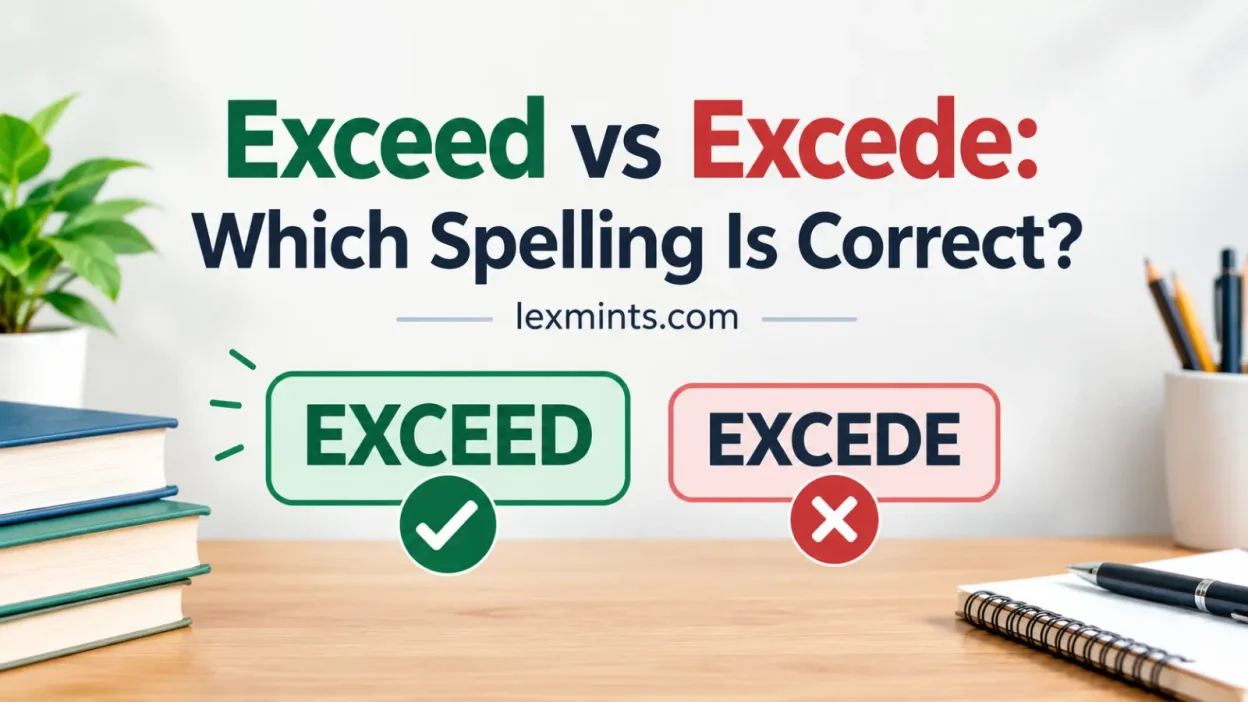
If you are unsure whether the correct spelling is exceed or excede, you are not alone. These two spellings look very similar, and the pronunciation can make the difference easy to overlook. However, only one of them is a standard English word.
The correct spelling is exceed.
Excede is a misspelling and should not be used in standard English writing. The word exceed is a verb that means to go beyond a particular limit, amount, standard, expectation, or level.
For example:
- The company’s sales exceed expectations.
- Do not exceed the recommended speed limit.
- Her performance exceeded everyone’s expectations.
- The cost may exceed $500.
In this guide, we will explain the difference between exceed vs excede, what exceed means, why excede is incorrect, how to use exceed in sentences, and how to remember the correct spelling.
Exceed vs Excede: The Quick Answer
The correct spelling is exceed with two e’s after the c:
Correct: exceed
Incorrect: excede
The word exceed is a standard English verb. It means to be greater than something, go beyond a limit, or surpass a particular level or expectation.
Excede is not the standard spelling of this English word. If you see “excede” in a sentence where the writer means “go beyond” or “surpass,” it is almost certainly a spelling error.
A simple example is:
The final bill may exceed the original estimate.
Not:
The final bill may excede the original estimate.
Remember that the correct spelling contains “ee” before the final d:
ex + ceed = exceed
What Does Exceed Mean?
Exceed is a verb meaning to go beyond something or to be greater than something.
It can refer to a numerical amount, a physical limit, a rule, a standard, an expectation, or a level of performance.
For example:
- The temperature exceeded 100 degrees.
- The project exceeded its original budget.
- His results exceeded the required standard.
- The athlete exceeded the previous record.
- The number of applicants exceeds the available positions.
The exact meaning depends on the context, but the central idea remains the same: something goes beyond a specified point or level.
Common meanings of exceed
The verb exceed can be used in several closely related ways.
1. To go beyond a limit
The driver exceeded the speed limit.
Here, the driver’s speed went beyond the legal limit.
2. To be greater than an amount
The expenses exceeded $2,000.
The expenses were greater than $2,000.
3. To surpass a standard
The product exceeded industry standards.
The product performed at a level higher than the required or expected standard.
4. To perform better than expected
The new employee exceeded expectations.
The employee performed better than people expected.
Why Is “Excede” Incorrect?
The spelling excede is incorrect because it does not follow the standard spelling of the English verb exceed.
One reason people make this mistake is that English contains many words with endings that can sound similar. When people hear exceed, they may think the word should be spelled with a single e before the final d.
However, the standard spelling is:
E-X-C-E-E-D
The two e’s in the middle are essential.
A useful way to divide the word is:
ex + ceed
This can make the correct spelling easier to remember.
Exceed has “ee”
Think:
exceed = ex + ceed
The spelling “ceed” appears in other English words as well, including:
- proceed
- succeed
- exceed
- recede
Although these words have different meanings, noticing familiar spelling patterns can help reinforce the spelling of exceed.
Exceed vs Excede: Spelling Comparison
| Word | Correct? | Meaning |
|---|---|---|
| exceed | Yes | To go beyond or surpass |
| excede | No | Common misspelling of “exceed” |
The difference is only one letter, but it matters in formal writing.
If you are writing an email, school assignment, report, article, business document, or professional communication, always use exceed.
Correct examples
- The expenses may exceed our budget.
- Her score exceeded the passing grade.
- The number of visitors exceeds last year’s total.
- The company hopes to exceed its sales target.
Incorrect examples
- The expenses may excede our budget.
- Her score exceded the passing grade.
- The number of visitors excedes last year’s total.
In each incorrect example, replace excede with the appropriate form of exceed.
How to Use Exceed in a Sentence
Exceed is normally followed by the thing, amount, limit, standard, or expectation that is being surpassed.
For example:
The restaurant’s capacity cannot exceed 100 people.
Here, exceed describes going beyond a maximum number.
Another example is:
The final cost exceeded our original estimate.
In this sentence, the final cost was greater than the estimated amount.
You can use exceed in everyday, academic, professional, technical, and formal writing.
Examples with different contexts
Business:
The company expects annual revenue to exceed its previous record.
Education:
Maya’s final score exceeded the class average.
Sports:
The runner’s time did not exceed the previous record.
Finance:
The expenses exceeded the department’s budget.
Rules and limits:
Visitors must not exceed the maximum occupancy.
Expectations:
The results exceeded our expectations.
Exceed vs Surpass
The words exceed and surpass are often similar in meaning.
Both can describe something that goes beyond another thing or performs better than it.
For example:
The team’s performance exceeded expectations.
and:
The team’s performance surpassed expectations.
Both sentences communicate a similar idea.
However, exceed is particularly common when talking about limits, numbers, quantities, standards, and expectations.
For example:
Do not exceed the weight limit.
You could use “surpass” in some contexts, but exceed is the natural choice when discussing a specified limit.
Exceed vs Excel
Another word that is sometimes confused with exceed is excel.
Although they are related in some contexts, they do not mean exactly the same thing.
Exceed means to go beyond or be greater than something.
The expenses exceeded the budget.
Excel means to perform exceptionally well.
She excels at mathematics.
You can remember the difference this way:
Exceed = go beyond
Excel = perform extremely well
For example:
The student excelled in mathematics and exceeded the required score.
Both words are correct, but they perform different jobs in the sentence.
Different Forms of Exceed
The verb exceed changes form depending on tense and grammatical context.
Here are the most common forms:
- Base form: exceed
- Third-person singular: exceeds
- Present participle: exceeding
- Past tense: exceeded
- Past participle: exceeded
Exceed
Use exceed with the base form of the verb.
We must not exceed the limit.
Exceeds
Use exceeds with a singular third-person subject.
The total exceeds the original estimate.
Exceeding
Use exceeding when the verb functions as a present participle or follows certain auxiliary verbs.
The company is exceeding its sales target.
Exceeded
Use exceeded for the simple past and past participle.
The project exceeded its budget.
The team has exceeded its original goal.
Common Phrases With Exceed
Learning common expressions can make it easier to remember how exceed is used naturally.
Exceed expectations
This is one of the most common expressions.
The new restaurant exceeded expectations.
It means the restaurant performed better than people expected.
Exceed the limit
This phrase is commonly used for rules, capacity, speed, weight, and other restrictions.
The vehicle exceeded the speed limit.
Exceed the budget
This means spending more money than originally planned.
The construction project exceeded the budget.
Exceed the maximum
This means going beyond the highest permitted amount.
Do not exceed the maximum recommended dosage.
Exceed the standard
This means performing at a level higher than a particular standard.
The equipment exceeds the required safety standard.
Exceed the target
This means achieving more than the planned goal.
The sales team exceeded its monthly target.
Common Mistakes With Exceed
Because exceed and excede look almost identical, spelling mistakes are common. Here are some mistakes to watch for.
Mistake 1: Writing “excede”
Incorrect:
The results excede our expectations.
Correct:
The results exceed our expectations.
The correct spelling contains ee.
Mistake 2: Writing “exceded”
Incorrect:
The project exceded its budget.
Correct:
The project exceeded its budget.
The past-tense form is exceeded, not exceded.
Mistake 3: Writing “excedes”
Incorrect:
The total excedes the legal limit.
Correct:
The total exceeds the legal limit.
The third-person singular form is exceeds.
Mistake 4: Confusing exceed with exceedance
In technical writing, you may sometimes encounter the noun exceedance, meaning an instance of going beyond a specified limit or standard.
For example:
The report identified several exceedances of the permitted limit.
This should not be confused with the misspelling excede.
How to Remember the Correct Spelling of Exceed
If you frequently confuse exceed vs excede, try using a simple memory trick.
Remember “EE” in exceed
The easiest method is to remember:
Exceed has double E.
Write it mentally as:
EX + CEED
The ending “ceed” is the key.
You can also connect it with other familiar words:
- proceed
- succeed
- exceed
Each contains ceed.
Another useful memory sentence is:
You need two E’s to exceed the limit.
This is not a grammar rule, but it is a useful spelling reminder.
Exceed in American English
Exceed is standard in American English and is widely used in everyday and professional communication.
There is no American English spelling variation in which excede becomes an accepted alternative spelling of exceed.
Therefore, if you are writing for a U.S. audience, use:
exceed
For example:
The cost should not exceed $1,000.
This is correct American English.
The same spelling is also standard in other major varieties of English.
20 Correct Examples of Exceed
Here are additional examples to help you understand the word in context:
- The final cost may exceed the original estimate.
- Please do not exceed the speed limit.
- Her performance exceeded expectations.
- The company’s profits exceeded last year’s results.
- The package must not exceed the weight limit.
- The temperature exceeded 100 degrees.
- The number of applicants exceeds the number of available positions.
- The project has exceeded its original budget.
- His score exceeded the required minimum.
- The demand may exceed the available supply.
- The new model exceeds the previous version in several areas.
- The building cannot exceed the permitted height.
- Sales are exceeding our expectations.
- The athlete exceeded the previous record.
- The total number of visitors exceeded 10,000.
- The repair costs could exceed the value of the vehicle.
- The company worked hard to exceed its annual target.
- The results exceeded what researchers had predicted.
- The shipment must not exceed the stated weight.
- The quality of the service exceeded our expectations.
Notice that exceed can work with numbers, limits, standards, expectations, goals, and performance.
FAQs
Is exceed or excede correct?
Exceed is correct. Excede is a misspelling and should not be used in standard English writing.
What does exceed mean?
Exceed means to go beyond something or to be greater than a particular amount, limit, standard, expectation, or level.
How do you spell exceed?
The correct spelling is E-X-C-E-E-D: exceed.
A useful way to remember it is ex + ceed.
Is excede a word?
No. Excede is not the standard English spelling of the verb meaning “to go beyond.” The correct word is exceed.
What is the past tense of exceed?
The past tense of exceed is exceeded.
Example:
The company’s sales exceeded expectations.
What is the difference between exceed and surpass?
Both words can mean to go beyond or perform better than something. Exceed is especially common when referring to limits, quantities, standards, targets, and expectations.
What is the easiest way to remember exceed?
Remember that exceed has two E’s before the final D:
exceed
Think of it as:
ex + ceed
This simple spelling pattern can help you avoid writing excede.
Conclusion
When deciding between exceed vs excede, the answer is straightforward:
Exceed is correct. Excede is incorrect.
Use exceed when you mean “to go beyond,” “to be greater than,” or “to surpass.”
For example:
The final expenses exceeded the original budget.
The word excede should be avoided because it is a misspelling in standard English.
The most important spelling detail to remember is the double E:
E-X-C-E-E-D
If you remember “ex + ceed,” you will be much less likely to write the incorrect form.


