
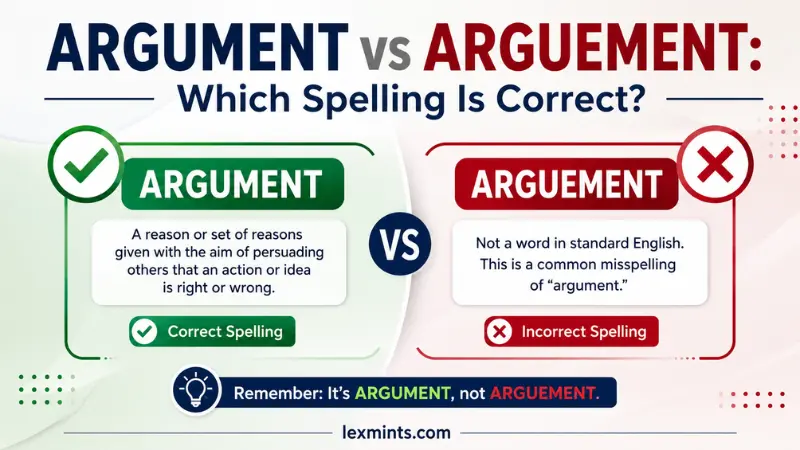
Argument and arguement look almost identical, which makes this an easy spelling mistake to make. The difference is just one extra e, but that extra letter makes the second form incorrect in standard modern English.
The correct spelling is argument.
Arguement is a misspelling of argument, not a separate standard spelling used in American English.
The confusion is understandable because argument is closely related to the verb argue. When writers see argue, they may expect the noun to keep the final e. However, the standard noun is spelled argument, without that extra letter.
So if you are writing an email, essay, report, text message, or professional document, remember:
argument ✓
arguement ✗
Quick Answer
Argument is correct. Arguement is incorrect.
Use argument whenever you need the standard noun.
For example:
She made a strong argument for changing the policy.
We had an argument about the travel plans.
His argument was supported by clear evidence.
Do not write:
She made a strong arguement for changing the policy.
The problem is simply the spelling. The standard word does not contain the extra e between the u and m.
There is also no normal American-versus-British distinction here. Argument is the standard spelling in both U.S. and UK English.
Why People Confuse Them
The main reason for the mistake is the word argue.
The verb is spelled:
argue
It is therefore easy to assume that adding -ment produces:
arguement
But that is not the standard spelling.
The noun is:
argument
The spelling connection between argue and argument can make the extra e feel natural, even though it is not part of the standard noun.
This kind of spelling mistake is especially common when someone knows the word mainly from speech. When you hear argument, you cannot see whether there is an extra e in the middle. You have to remember the written form.
A useful way to avoid the mistake is to memorize the noun separately:
argue → argument
not:
argue → arguement
Once you recognize argument as the correct written form, the difference becomes much easier to remember.
Key Differences At A Glance
There is no meaning difference between argument and arguement in standard contemporary English because arguement is not the accepted spelling of a separate word.
| Context | Best Choice | Why |
|---|---|---|
| U.S. English | argument | Standard spelling |
| UK English | argument | Standard spelling |
| Academic writing | argument | Correct formal spelling |
| Business writing | argument | Correct standard form |
| Legal writing | argument | Standard noun |
| Everyday conversation in writing | argument | Correct spelling |
| arguement | Avoid | Misspelling |
The simplest rule is:
If you mean the noun, spell it argument.
Are They the Same Word?
In modern everyday English, arguement is generally an incorrect spelling of argument, rather than a separate word with its own meaning.
Argument is a standard noun with several related meanings.
It can mean a disagreement between people:
The two coworkers had an argument about the schedule.
It can also mean a reason or set of reasons used to support a particular position:
The writer presented a convincing argument.
This distinction is important because argument does not always mean a fight. A person can make an argument without being angry or disagreeing personally with someone.
For example:
Her argument for expanding the program was based on strong evidence.
Here, argument means a reasoned case or position, not a quarrel.
The word is also used in specialized fields. Dictionaries recognize uses of argument in areas such as law, literature, mathematics, and grammar.
But none of these meanings requires the spelling arguement.
Pronunciation
In U.S. English, argument is commonly pronounced approximately:
AR-gyuh-mənt
The pronunciation does not provide a strong clue about the spelling, which is one reason learners may accidentally insert an extra e.
US vs UK Preference
Unlike some English spelling differences, argument does not have a standard U.S. spelling and a different standard UK spelling.
For example, English has genuine regional differences such as color/colour. But argument/arguement is not one of those pairs.
The standard form is:
- U.S. English: argument
- UK English: argument
So it would be incorrect to describe arguement as the British spelling.
If you are writing for an American audience, simply use argument.
If you are writing for a British audience, use argument as well.
This makes the choice particularly straightforward: there is no regional spelling decision to make.
Which Spelling Should You Use?
Use argument.
It is the correct choice in virtually every normal modern writing situation.
In academic writing
Use argument when discussing the main point or reasoning in an essay, article, research paper, or book.
The student’s argument was supported by several reliable sources.
The central argument of the essay is easy to identify.
In professional writing
Use argument in reports, emails, presentations, proposals, and workplace documents.
The manager made a convincing argument for changing the schedule.
In legal writing
Argument is also the standard form in legal contexts.
The attorney presented a detailed argument before the court.
In everyday writing
The same spelling applies to informal communication.
I don’t want to get into an argument about it.
We had a small argument yesterday.
Whether the writing is formal or casual, arguement should be corrected to argument.
When One Spelling Looks Wrong
At first glance, arguement may not look obviously wrong. It closely resembles argument, and the connection with argue makes the extra e seem reasonable.
However, once you know the standard spelling, arguement should stand out as a mistake.
Compare:
❌ arguement
✓ argument
The difference is only one letter, but the correct form is important in polished writing.
Consider these examples:
❌ The article presents a strong arguement.
✓ The article presents a strong argument.
❌ His arguement was based on outdated information.
✓ His argument was based on outdated information.
❌ They had an arguement over the contract.
✓ They had an argument over the contract.
The correction is always the same: remove the unnecessary e.
Common Mistakes (and Quick Fixes)
1. Writing “arguement” because of “argue”
This is the most obvious source of the mistake.
Wrong: argue → arguement
Correct: argue → argument
Remember that the noun does not retain the final e from argue.
2. Thinking “arguement” is British English
It is not the standard British spelling.
Correct: argument
The same spelling is used in standard U.S. and UK English.
3. Assuming both spellings are acceptable
They are not equally acceptable in contemporary standard writing.
Argument is the standard form.
Arguement should normally be treated as a spelling error.
4. Using the wrong spelling in the plural
The plural of argument is arguments.
Correct:
The students presented several arguments.
Incorrect:
The students presented several arguements.
5. Confusing “argument” with “argue”
These words are related but have different grammatical roles.
- argue = verb
- argument = noun
For example:
They argue about the issue.
Their argument lasted an hour.
Keeping these forms separate can help prevent the spelling mistake.
A Simple Memory Trick
Remember:
argument = argu + ment
There is no extra e before ment.
If you remember argument as a complete word rather than trying to build it from argue, the spelling becomes much easier.
Everyday Examples
Here are some natural examples of argument in modern U.S. English.
When it means a disagreement
I had an argument with my brother yesterday.
The argument started over something very small.
They tried to avoid another argument.
The couple had an argument about their vacation plans.
When it means a reason or position
She made a strong argument for investing in public transportation.
His argument was based on facts rather than assumptions.
The committee heard arguments from both sides.
The evidence supports her argument.
In school writing
The main argument of the essay is that students need more practical experience.
The student developed a clear argument and supported it with evidence.
In business writing
The report makes a convincing argument for updating the company’s software.
We need a stronger argument before presenting the proposal.
In legal contexts
The attorney presented a detailed argument to the court.
In ordinary conversation
That’s an interesting argument, but I’m not convinced.
Notice that argument can describe either a disagreement or a reasoned position. The surrounding sentence usually makes the intended meaning clear.
Dictionary-Style Word Details
Verb
Argument is not a verb.
The related verb is argue.
- argument: noun
- argue: verb
- arguement: misspelling, not the standard modern noun or verb
The verb argue can mean to give reasons for or against something or to disagree with someone.
Examples:
They argued about the decision.
She argued that the plan would cost too much.
The noun is:
Her argument was persuasive.
Noun
Argument is the standard noun.
It commonly refers to:
- a disagreement or quarrel
- a reason supporting or opposing an idea
- a connected set of reasons used to establish a position
It also has specialized meanings in fields such as law, literature, mathematics, and grammar.
Examples:
We had an argument about the decision.
He presented a strong argument for the proposal.
Arguement is not the standard spelling of this noun.
Synonyms
The best synonym for argument depends on which meaning is intended.
When it means a disagreement, closest plain alternatives include:
- disagreement
- dispute
- quarrel
- altercation
When it means a reasoned position, closest plain alternatives include:
- case
- reasoning
- position
- point
These words are not perfect substitutes in every sentence.
For example, dispute can replace argument in some contexts involving disagreement, while reasoning may work better when argument means a logical case.
Arguement has no separate synonym group because it is a misspelling of argument.
Example Sentences
Here are examples using the correct spelling:
She made a convincing argument for the new policy.
We had an argument about the best way to solve the problem.
His argument was supported by clear evidence.
The lawyer presented a detailed argument in court.
The essay has a strong central argument.
They decided to end the argument and discuss the issue calmly.
In each sentence, argument is the correct form.
If you see arguement in one of these sentences, replace it with argument.
Word History
Argument has a long history in English. Merriam-Webster traces the word through Middle English and Anglo-French to Latin argūmentum, related to arguere, meaning to show or demonstrate.
This history also helps explain why argument is connected to argue. However, the historical relationship does not mean that the modern noun should be spelled arguement.
For contemporary U.S. English, the spelling to remember is simply:
argument
Phrases Containing
Argument appears in many common English expressions.
Some examples include:
- make an argument
- strong argument
- convincing argument
- logical argument
- valid argument
- main argument
- central argument
- argument for
- argument against
- have an argument
- get into an argument
- settle an argument
- win an argument
- opening argument
- closing argument
Examples:
She made a strong argument for the proposal.
The article’s central argument is easy to understand.
The lawyers prepared their closing arguments.
They agreed to settle the argument peacefully.
These expressions all use argument, never the standard spelling arguement.
FAQs
1. Is it “argument” or “arguement”?
Argument is the correct spelling. Arguement is a common misspelling caused by confusion with the verb argue. In standard modern English, write argument without the extra e.
For example: “She made a strong argument for changing the policy.”
2. Why is “arguement” spelled incorrectly?
Arguement is usually spelled incorrectly because people connect the noun with argue and assume the final e should remain when the noun is formed. However, the standard noun is spelled argument.
A simple way to remember it is:
argue → argument
Not:
argue → arguement
3. Is “arguement” ever correct in English?
For normal modern English writing, arguement is not the spelling you should use. It is generally treated as a misspelling of argument. Whether you are writing an essay, email, report, or social media post, use argument.
4. Is “argument” the same spelling in American and British English?
Yes. Unlike some well-known U.S. and UK spelling differences, argument is the standard spelling in both American and British English. Arguement is not simply a British alternative to argument.
5. What is the easiest way to remember the spelling of “argument”?
Remember that argument does not have an extra e between the u and m:
argument ✓
arguement ✗
You can also connect the noun and verb this way: argue is the verb, while argument is the noun. Once you memorize the noun as argument, the spelling becomes much easier to recognize.
Conclusion
When choosing between argument and arguement, the answer is simple:
Argument is correct.
Arguement is a misspelling.
The extra e is probably tempting because of the related verb argue, but the standard noun is spelled argument. There is also no normal U.S.-versus-UK spelling difference here; argument is the standard form in both varieties of English.
Use argument in essays, emails, reports, legal writing, professional documents, and everyday messages.
A quick way to remember it is:
argue → argument
not:
argue → arguement
Whenever you are unsure, choose argument.