
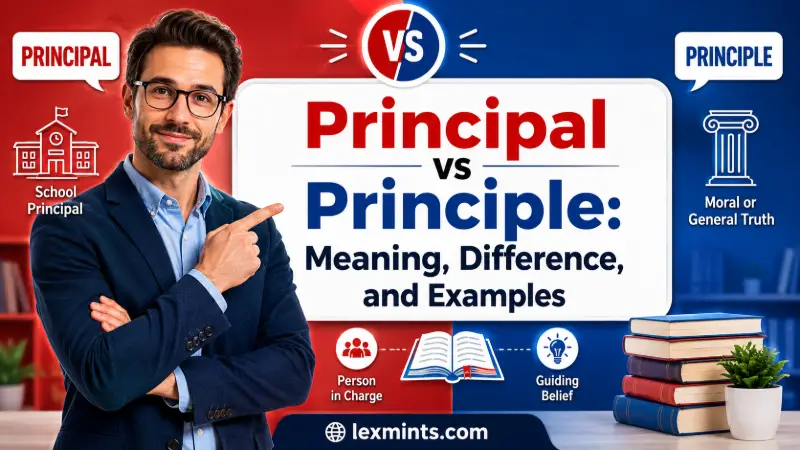
Principal vs principle is confusing because the words look almost alike and sound the same. Their meanings and grammar, however, are different.
Use principal for a person in charge, the main or most important thing, or a sum of money in finance. Use principle for a rule, belief, standard, law, or basic truth.
Once you connect each spelling to its job in a sentence, the choice becomes much easier.
Quick Answer
Choose principal when you mean main, most important, a person in charge, or the financial amount on which interest is based.
Choose principle when you mean a rule, belief, standard, law, or fundamental idea.
A simple test is:
- main / leader / money → principal
- rule / belief / basic truth → principle
Why People Confuse Them
The biggest reason is pronunciation. In standard US English, principal and principle are homophones: both are pronounced roughly PRIN-suh-pul. You cannot hear the spelling difference in normal speech.
Their spellings also differ only at the end. That makes errors especially easy when someone knows the word by sound but has not connected the spelling with the meaning.
The familiar memory trick “the principal is your pal” helps with the school meaning, but it does not cover every use of principal, especially finance and the adjective meaning “main.”
Key Differences At A Glance
- Principal can be a noun or adjective.
- Principle is a noun in standard modern US English.
- As a noun, principal can mean a person in charge or a financial sum.
- As an adjective, principal means main, chief, or most important.
- Principle means a rule, standard, belief, law, or basic truth.
- The words sound the same, but they are not interchangeable.
Meaning and Usage Difference
Principal has several common uses. As a noun, it can identify the head of a school: “The principal spoke with the parents.” In finance, it can mean the amount borrowed or invested apart from interest: “The payment reduced the principal.”
As an adjective, principal means “main” or “most important.” You might write “the principal reason,” “the principal concern,” or “the principal investigator.”
Principle works differently. It names an idea that guides behavior or explains how something works. Honesty can be a principle. A scientific rule can be a principle. A company can operate according to certain principles.
The grammar gives you a useful clue: if the word directly means “main” before another noun, principal is usually the correct choice.
Tone, Context, and Formality
Both words are standard in American English and can appear in casual, academic, professional, financial, and educational writing.
As an adjective, principal can sound slightly more formal than main in expressions such as “principal concern” or “principal objective.” It is also standard in fixed professional terms such as “principal investigator.”
Principle is common when discussing ethics, policy, science, law, beliefs, or general rules. Phrases such as on principle and in principle are also standard.
The choice is mainly about meaning and grammar, not politeness or formality.
Which One Should You Use?
Use the sentence context to identify what the word represents.
| Context | Best Choice | Why |
|---|---|---|
| Head of a school | principal | It names a person in charge. |
| Main reason | principal | It works as an adjective meaning “most important.” |
| Loan amount before interest | principal | It names the financial sum. |
| Moral belief | principle | It names a guiding standard. |
| Scientific rule | principle | It names a fundamental law or idea. |
| Agreement in theory | principle | The standard phrase is “in principle.” |
| Lead researcher | principal | “Principal investigator” uses the adjective meaning “main” or “leading.” |
When in doubt, replace the word mentally. If main, leader, or financial sum fits, choose principal. If rule, belief, or basic truth fits, choose principle.
When One Choice Sounds Wrong
Some errors happen because the wrong word is asked to do a grammatical job it does not normally perform.
“Principle reason” is wrong when you mean “main reason” because principle is not an adjective. Write principal reason.
“School principle” is wrong when you mean the person who runs the school. Write school principal.
“Principle balance” is wrong for the amount still owed on a loan. Write principal balance.
Likewise, the standard expression is in principle, not in principal, when you mean “in theory” or “as a general idea.”
Common Mistakes (and Quick Fixes)
A good correction method is to identify the meaning before checking the spelling.
Mistake: The principle concern is safety.
Fix: The principal concern is safety.
Why: “Principal” means main.
Mistake: I spoke with the school principle.
Fix: I spoke with the school principal.
Why: The word names a person in charge.
Mistake: She would not compromise her principals.
Fix: She would not compromise her principles.
Why: The word refers to guiding beliefs.
Mistake: We agreed in principal.
Fix: We agreed in principle.
Why: “In principle” is the standard expression.
Everyday Examples
Here are natural examples across common US contexts:
- The principal emailed families about the new attendance policy.
- Cost was the principal reason we changed vendors.
- My extra mortgage payment went toward the principal.
- Fairness is an important principle in our household.
- The design follows a simple principle of balance.
- She refused the offer on principle.
- The principal investigator presented the study results.
- We support the proposal in principle, but the final details still need work.
Dictionary-Style Word Details
Verb
Principal: Not commonly used as a verb in standard modern US English.
Principle: Not commonly used as a verb in standard modern US English.
Noun
Principal: A person in a leading or controlling position, especially the head of a school; also a capital sum in finance, such as the amount borrowed or invested apart from interest.
Principle: A fundamental rule, truth, law, standard, or belief that guides conduct or explains how something works.
Synonyms
Principal: As an adjective, close alternatives include main, chief, primary, and leading. As a noun for a person, head or leader may fit in some contexts. In finance, capital can be a close alternative in certain uses. A clear adjective antonym is secondary.
Principle: Depending on the meaning, close alternatives include rule, standard, tenet, doctrine, and guideline. No single antonym works across all meanings of principle.
Example Sentences
Principal: Our principal concern is keeping the project within budget. The borrower paid an additional $200 toward the principal.
Principle: The policy reflects the principle of equal treatment. He declined the shortcut because it violated his principles.
Word History
Principal and principle are historically related. Principal came through French from Latin wording connected with being first or chief. Principle came through French from Latin principium, associated with a beginning, foundation, or source.
That shared history helps explain their similar forms, but modern English assigns them different grammatical roles and meanings.
Phrases Containing
Principal: school principal, principal amount, principal balance, principal concern, principal reason, principal investigator.
Principle: in principle, on principle, matter of principle, guiding principle, basic principle, first principle.
FAQs
Is a school leader a principal or principle?
A school leader is a principal. In US English, principal can be a noun for the person who heads a school. Principle cannot name that person because it refers to a rule, belief, law, or basic truth.
Is it principal amount or principle amount?
The standard phrase is principal amount. In finance, principal refers to the original or outstanding sum of money that is borrowed, invested, or owed, separate from interest. Principle amount is incorrect when you mean the financial sum.
Is it principal reason or principle reason?
Use principal reason when you mean the main or most important reason. Here, principal works as an adjective modifying reason. Principle reason does not work in standard usage because principle is a noun, not an adjective.
Is the correct phrase in principle or in principal?
The correct expression is in principle. It means that something is accepted or true at the level of a general idea, even if details remain unsettled. In principal does not carry this standard idiomatic meaning.
Can principle ever be used as an adjective?
In standard modern US English, principle functions as a noun, not an adjective. That is why phrases such as principle concern are incorrect when you mean “main concern.” For that meaning, use principal concern instead.
What is the easiest way to remember principal vs principle?
A useful memory trick is that principal ends in pal, which can remind you of a school principal as a person. For broader cases, use a meaning test: main, leader, or money points to principal; rule or belief points to principle.
Conclusion
The choice between principal and principle depends on meaning and grammar.
Use principal for a leader, the main or most important thing, or a financial sum. Use principle for a rule, belief, standard, law, or basic truth.
If you remember main / leader / money = principal and rule / belief = principle, you can handle the most common cases with confidence.