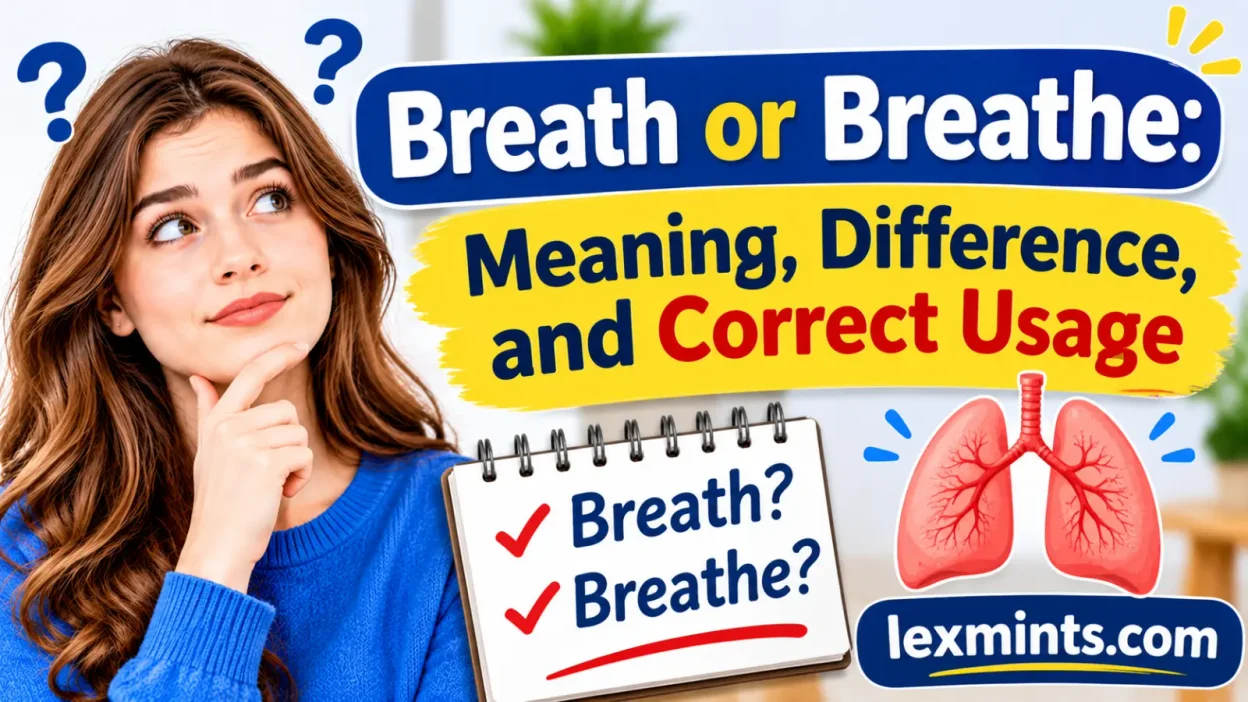
Breath or breathe is a common English usage question because these two words look almost identical. They share the same letters, have related meanings, and appear in similar situations. However, using the wrong word can change the grammar of your sentence.
You might write about taking a deep breath before a presentation. You might also tell someone to breathe slowly when they feel nervous. Both sentences are correct, but each word has a different job.
Understanding this distinction can improve your everyday writing, school assignments, emails, and professional communication. It also helps you avoid common spelling mistakes.
In this guide, you will learn what each word means, how to pronounce it, and when to use it. You will also discover practical examples, common expressions, and simple memory tricks.
Quick Answer: Breath or Breathe?
Both breath and breathe are correct English words, but they have different grammatical functions.
- Breath is a noun. It means the air you take into or release from your lungs.
- Breathe is a verb. It means to move air into and out of your lungs.
For example:
- Take a deep breath before speaking.
- Remember to breathe slowly during the exercise.
A simple way to remember the difference is this: You take a breath, but you breathe.
What Does Breath Mean?
Breath is a noun that refers to the air moving into and out of your lungs. It can describe the air itself or one complete act of inhaling and exhaling.
People commonly use this word when discussing relaxation, exercise, health, speaking, and physical activity.
For example:
- She took a deep breath before answering the question.
- I could see my breath in the freezing morning air.
- He was out of breath after running up the stairs.
- Please hold your breath while I count to five.
In each sentence, breath names something. It does not describe an action performed by the subject.
Different Meanings of Breath
The noun breath has several related meanings.
Air entering or leaving the lungs
This is its most familiar meaning.
Example: His breath smelled like peppermint after brushing his teeth.
One complete breathing action
It can describe one inhalation or exhalation.
Example: Take one slow breath and relax your shoulders.
The ability to breathe
It can also refer to someone’s ability to move air through their lungs.
Example: The swimmer struggled to catch his breath after reaching the shore.
A small amount of air
Sometimes, breath describes a gentle movement or flow of air.
Example: A breath of wind moved the curtains beside the window.
Breath as a Noun in Everyday English
You will find breath in many everyday expressions.
- Take a breath: Pause and inhale.
- Catch your breath: Recover normal breathing.
- Hold your breath: Stop breathing temporarily.
- Out of breath: Breathing heavily after physical activity.
- Short of breath: Having difficulty getting enough air.
- Under your breath: Speaking quietly.
- A breath of fresh air: Something refreshing or pleasantly different.
These expressions are common in American conversations, books, and everyday writing.
What Does Breathe Mean?
Breathe is a verb that means to take air into your lungs and release it. It describes the physical action of inhaling and exhaling.
Unlike breath, breathe tells readers what someone or something does.
For example:
- Try to breathe slowly when you feel nervous.
- Most people breathe automatically without thinking.
- The children went outside to breathe fresh air.
- It was difficult to breathe inside the crowded room.
In these examples, breathe describes an action.
Different Meanings of Breathe
Although its main meaning relates to respiration, breathe also has figurative and extended uses.
To inhale and exhale air
This is the primary meaning.
Example: Remember to breathe normally while exercising.
To allow air to pass through
Something that breathes allows air to circulate.
Example: These lightweight shoes help your feet breathe.
To expose something to air
The word can describe allowing something to come into contact with air.
Example: Let the wine breathe before serving it.
To give something new energy
In figurative language, breathe can mean to bring life, energy, or freshness to something.
Example: The new manager breathed life into the struggling business.
To feel relieved
The expression breathe easily means to feel less worried or anxious.
Example: After receiving the good news, the family could finally breathe easily.
These extended meanings make breathe useful in both literal and figurative writing.
Breath vs. Breathe: Main Differences
The biggest difference involves their parts of speech. Breath is a noun, while breathe is a verb.
| Feature | Breath | Breathe |
|---|---|---|
| Part of speech | Noun | Verb |
| Main meaning | Air taken in or released | Action of moving air |
| Pronunciation | BRETH | BREETH |
| Example | Take a breath. | Breathe slowly. |
| Common phrase | Hold your breath | Breathe deeply |
Remember that the final letter e in breathe is important. It changes the pronunciation and helps identify the verb.
You can also check the word’s position in a sentence. Articles and possessive words often appear before nouns, while verbs describe actions.
Examples:
- She took a breath.
- She began to breathe.
- He held his breath.
- He could barely breathe.
How to Pronounce Breath and Breathe
Pronunciation is another useful way to understand these words.
Although their spelling is similar, their vowel and final consonant sounds are different.
Breath: Pronounced BRETH, with a short e sound. The final th is unvoiced, as in the word think.
Breathe: Pronounced BREETH, with a long ee sound. The final th is voiced, as in the word this.
The pronunciation difference is easy to hear when you say both words aloud.
Try these examples:
- One breath.
- Breathe deeply.
- Take a breath.
- Learn to breathe.
Practicing these phrases can help you recognize the correct word when speaking and writing.
When to Use Breath
Use breath when you need a noun to identify air, a breathing action, or the ability to breathe.
It commonly appears after words such as a, the, my, your, his, and her.
Examples of Breath in Sentences
- I took a deep breath before entering the interview room.
- Her breath became faster after the workout.
- The cold weather made his breath visible.
- He tried to catch his breath after climbing the hill.
- She whispered something under her breath.
- The singer held her breath before the final note.
- My dog smelled my breath when I came home.
- Take a breath and think about your answer.
- The runner was completely out of breath.
- The beautiful view took my breath away.
Common Expressions with Breath
Some expressions use breath in ways that go beyond its literal meaning.
Don’t hold your breath
This expression means you should not expect something to happen soon.
Example: Don’t hold your breath waiting for the company to announce its decision.
A breath of fresh air
This phrase describes someone or something refreshing, new, or different.
Example: The new teacher was a breath of fresh air for the students.
Take someone’s breath away
This means to surprise, impress, or amaze someone.
Example: The beautiful sunset took our breath away.
Save your breath
This means not to waste time speaking when your words are unlikely to change someone’s mind.
Example: Save your breath; he has already made his decision.
When to Use Breathe
Use breathe when describing the action of taking air into and releasing it from your lungs.
It can also describe air circulation, relief, and renewal.
Examples of Breathe in Sentences
- Try to breathe slowly during the yoga session.
- Babies breathe faster than adults.
- I could not breathe properly in the smoky room.
- The doctor asked the patient to breathe deeply.
- Remember to breathe through your nose.
- The athlete stopped running to breathe normally.
- We went outside to breathe fresh air.
- Open the windows and let the room breathe.
- The new design breathed life into the old building.
- After the examination results arrived, I could breathe easily.
Common Expressions with Breathe
Breathe easy
This means to relax because a problem or worry has ended.
Example: We can breathe easy now that the missing documents have been found.
Breathe down someone’s neck
This expression means to watch someone too closely or put pressure on them.
Example: My supervisor was breathing down my neck throughout the project.
Breathe new life into something
This means to make something feel fresh, active, or interesting again.
Example: The renovation breathed new life into the old neighborhood.
Live and breathe something
This means to be extremely interested or involved in an activity.
Example: My brother lives and breathes basketball.
Common Mistakes When Using Breath and Breathe
Many writers confuse these words because they differ by only one letter. However, the correct choice becomes easier when you understand their grammatical roles.
Here are common mistakes and their corrections.
Mistake: I need to take a deep breathe.
Correct: I need to take a deep breath.
Explanation: Deep describes a noun here. Therefore, breath is correct.
Mistake: Please breath slowly.
Correct: Please breathe slowly.
Explanation: Slowly describes an action. The sentence needs the verb breathe.
Mistake: She couldn’t catch her breathe.
Correct: She couldn’t catch her breath.
Explanation: The expression catch your breath always uses the noun breath.
Mistake: Remember to breath before swimming.
Correct: Remember to breathe before swimming.
Explanation: The word to is followed by the base form of a verb.
Mistake: He took one last breathe.
Correct: He took one last breath.
Explanation: The word one identifies a single thing or action, so the noun is needed.
Mistake: I can hardly breath after running.
Correct: I can hardly breathe after running.
Explanation: The modal verb can requires the base form of the verb breathe.
A helpful editing habit is to identify the sentence’s action before choosing the spelling.
Easy Tricks to Remember the Difference
You do not need to memorize complicated grammar rules to use these words correctly. A few simple tricks can help you remember their meanings.
Remember: Breath Is a Thing
Breath is a noun. It names the air or a single breathing action.
Think about these phrases:
- A deep breath.
- My last breath.
- Your breath.
- Hold your breath.
If you can place a, my, your, or one before the word, breath may be the correct choice.
Remember: Breathe Is an Action
Breathe is a verb. It describes what someone does.
Think about these phrases:
- Breathe slowly.
- Breathe deeply.
- Breathe fresh air.
- Learn to breathe.
If the sentence describes an action, breathe is usually the correct choice.
Use the Extra E Trick
Notice that breathe has an additional e at the end.
You can connect this extra letter with the action of breathing. When someone tells you to breathe, they are giving you an instruction to perform an action.
This memory trick is simple and useful for students and English learners.
Try Replacing the Word
Another helpful method is to replace the word with a related expression.
If you can replace it with air or a single inhalation, use breath.
If you can replace it with inhale or exhale, use breathe.
For example:
- Take a deep breath = Take a deep inhalation.
- Breathe slowly = Inhale and exhale slowly.
This quick test often reveals the correct choice.
Related Words and Similar Spelling Patterns
Breath and breathe belong to a group of related English words with different grammatical functions.
Understanding these patterns can help you recognize similar spelling changes.
| Noun | Verb | Example |
|---|---|---|
| Bath | Bathe | I bathe every morning. |
| Cloth | Clothe | They clothe the children. |
| Teeth | Teethe | Babies begin to teethe. |
| Breath | Breathe | We breathe fresh air. |
These pairs show how adding an e can create a related verb.
However, do not assume every English noun becomes a verb by adding e. English spelling patterns have exceptions, so always consider the meaning and grammar.
Breath or Breathe in Different Contexts
The correct word sometimes depends on the structure of the sentence. Looking at common situations can make the distinction easier.
| Context | Best Choice | Why |
|---|---|---|
| Taking air into the lungs | Breathe | Describes an action |
| Taking one deep inhalation | Breath | Names one action |
| Holding air temporarily | Breath | Refers to the air or breathing |
| Giving breathing instructions | Breathe | Expresses a command |
| Describing someone’s exhaled air | Breath | Refers to the air |
| Describing air circulation | Breathe | Describes what something allows |
| Referring to relief | Breathe | Used in the expression breathe easy |
Consider the following examples:
- Correct: Take a breath before you speak.
- Correct: Breathe before you start speaking.
- Correct: I could see her breath in the cold air.
- Correct: These fabrics allow your skin to breathe.
The words may appear in similar situations, but their grammatical roles remain different.
FAQs
Is breath or breathe correct?
Both words are correct, but they have different meanings and grammatical roles. Breath is a noun referring to air or one breathing action. Breathe is a verb describing the action of inhaling and exhaling.
What is the difference between breath and breathe?
Breath names the air you take into or release from your lungs. Breathe describes the action of moving that air. For example, you take a breath and then breathe normally.
Is breathe a noun or a verb?
Breathe is a verb. It describes the action of inhaling and exhaling air. It can also have figurative meanings, such as giving new energy to something.
Is breath a noun or a verb?
Breath is a noun. It refers to the air entering or leaving your lungs, or one act of breathing. You can use it in expressions such as take a breath and hold your breath.
How do you remember breath vs. breathe?
Remember that breath is a thing, while breathe is an action. You take a breath, but you breathe air. The extra e at the end of breathe can help you remember its spelling.
How do you spell breathing?
The correct spelling is breathing. It comes from the verb breathe, but the final e is dropped before adding -ing.
Example: She was breathing slowly after the workout.
Is it take a breath or take a breathe?
The correct expression is take a breath. Breath is a noun in this phrase because it names one act of inhaling or exhaling.
Mini Quiz: Test Your Knowledge
Choose the correct word to complete each sentence.
Question 1: Take a deep ______ before answering the question.
- A. Breath
- B. Breathe
Question 2: You should ______ slowly when you feel nervous.
- A. Breath
- B. Breathe
Question 3: The runner was out of ______ after the race.
- A. Breath
- B. Breathe
Question 4: Remember to ______ normally during the exercise.
- A. Breath
- B. Breathe
Question 5: I could see my ______ in the cold morning air.
- A. Breath
- B. Breathe
Answer Key
- A. Breath — It is a noun describing one breathing action.
- B. Breathe — It is a verb describing an action.
- A. Breath — The expression out of breath requires a noun.
- B. Breathe — Remember to is followed by a verb.
- A. Breath — It refers to the air released from the lungs.
Conclusion
Understanding breath or breathe becomes simple when you remember their grammatical roles. Breath is a noun, while breathe is a verb.
Use breath when referring to air or one breathing action. Use breathe when describing the act of inhaling and exhaling.
Practice these examples in your everyday writing to avoid confusion. Remember: Take a breath, then breathe!