
Have you ever wondered whether to write minuscule or miniscule? These two spellings look almost identical, and both appear in everyday English writing. However, choosing the right form can be confusing, especially when dictionaries treat the alternative spelling differently.
The word describes something extremely small, tiny, or insignificant. You might use it when discussing a small amount of money, a tiny detail, a limited chance, or a very small object.
The confusion usually comes from the word’s appearance. Many English words use the prefix “mini” to describe something small. Examples include miniature, minivan, and miniseries. Because of this pattern, people often write “miniscule.”
However, the traditional and preferred spelling is minuscule. Understanding its meaning, spelling, pronunciation, and everyday usage can help you avoid mistakes. This guide explains both forms, provides practical examples, and shows you how to use the word confidently.
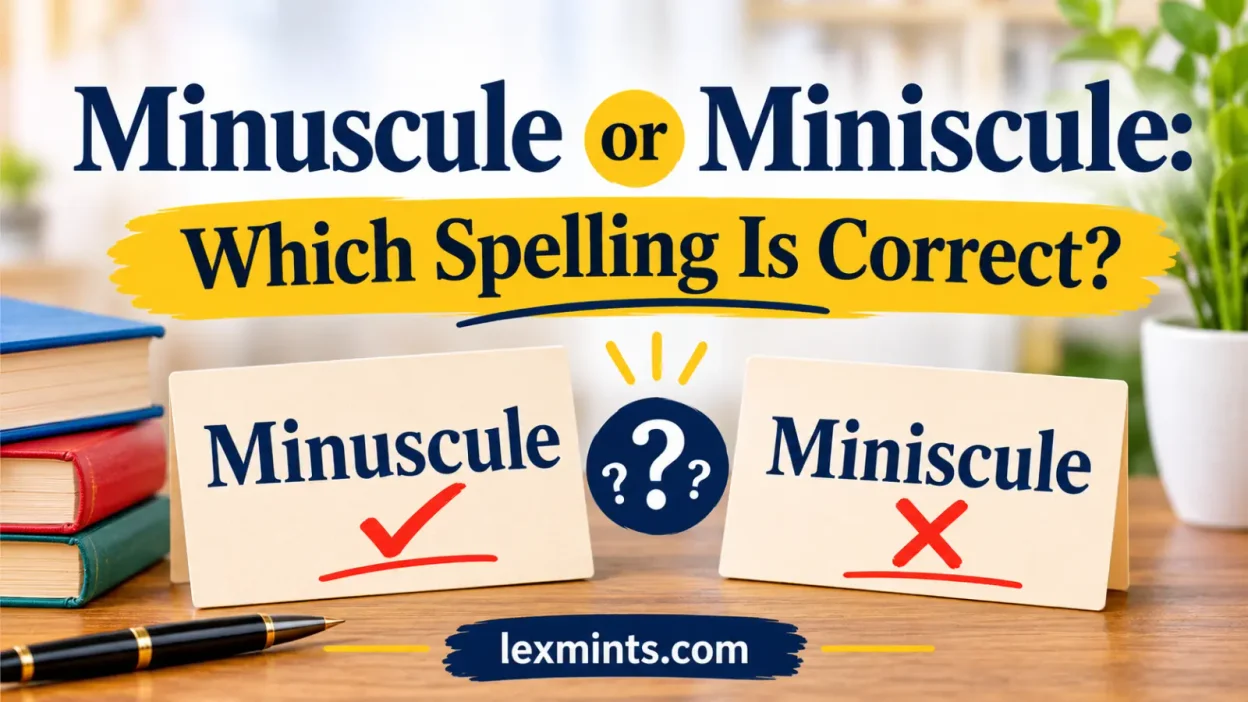
Minuscule or Miniscule: Which Spelling Is Correct?
The preferred spelling in standard American English is minuscule. It means extremely small or very little. The spelling “miniscule” is also found in modern writing, but many editors and traditional usage guides discourage it.
Here is the basic distinction:
- Minuscule: The established and preferred spelling.
- Miniscule: A widely used alternative spelling that some dictionaries recognize as a variant.
For formal writing, school assignments, business communication, and professional documents, choose “minuscule.”
For example:
- Correct: The difference between the two measurements was minuscule.
- Less preferred: The difference between the two measurements was miniscule.
Although readers will usually understand both forms, using the established spelling makes your writing more consistent.
What Does Minuscule Mean?
Minuscule means extremely small in size, amount, degree, or importance. It describes something that is much smaller than expected or compared with something else.
In simple English, it means tiny, very little, or almost insignificant.
For example, imagine receiving a very small discount on an expensive purchase. You could describe that discount as minuscule.
Similarly, a tiny amount of water inside a large container could be called minuscule.
Consider these examples:
- The company made a minuscule profit last year.
- There was only a minuscule amount of sugar left.
- The insect left a minuscule mark on the window.
- Her chances of winning seemed minuscule.
- The difference between the two prices was minuscule.
In each sentence, the word emphasizes how small something is.
It can describe physical size, numbers, amounts, chances, and even importance.
Minuscule Meaning in Plain English
The easiest way to understand minuscule is to think of something extremely tiny.
It describes something so small that it may be difficult to notice or measure.
For instance, a grain of sand is tiny compared with a large building. A small scratch on a phone screen might also be described as minuscule.
The word can also describe things that are not physical.
Imagine a business earning millions of dollars but receiving only a few dollars from one small transaction. That transaction might represent a minuscule part of its total income.
Here are some simple explanations:
- Minuscule amount: An extremely small quantity.
- Minuscule difference: A very slight difference.
- Minuscule chance: A very low possibility.
- Minuscule detail: A tiny or insignificant detail.
- Minuscule portion: A very small part of something.
The word is useful because it communicates more than ordinary smallness. It emphasizes that something is remarkably small.
Is Minuscule a Noun or an Adjective?
Minuscule can function as both an adjective and a noun. However, its adjective form is much more common in everyday English.
Understanding these two roles helps you use the word correctly.
Minuscule as an Adjective
As an adjective, minuscule describes a person, object, amount, or situation that is extremely small.
It usually appears before a noun or after a linking verb.
Examples:
- The apartment has a minuscule kitchen.
- We received a minuscule amount of financial support.
- Her handwriting was minuscule.
- The possibility of failure seemed minuscule.
- Only a minuscule portion of the food remained.
In these examples, minuscule describes the size or degree of something.
You can also use it after verbs such as “seem,” “look,” and “appear.”
Example:
The difference between the two products appears minuscule.
Minuscule as a Noun
Minuscule can also be a noun, especially in discussions about handwriting, typography, and historical manuscripts.
As a noun, it refers to a lowercase letter or a style of small-letter writing.
Examples:
- The manuscript contains several beautiful minuscules.
- Medieval scribes used minuscule lettering.
- The student learned to recognize different minuscule scripts.
This meaning is more specialized than the everyday adjective meaning.
When discussing ordinary objects, amounts, or differences, you will usually encounter minuscule as an adjective.
Why Do People Spell Minuscule as Miniscule?
The spelling confusion comes mainly from the influence of the word “mini.
Many English words use “mini” to communicate small size. Some familiar examples include:
- Miniature
- Minivan
- Miniskirt
- Miniseries
- Minicomputer
Because these words begin with “mini,” people naturally assume that the word describing something extremely small should also contain “mini.”
That assumption leads to the spelling “miniscule.”
However, minuscule has a different historical background. It comes from French and ultimately from the Latin word “minusculus,” meaning rather small or somewhat smaller.
The Latin element is connected to “minus,” meaning less.
This explains why the traditional spelling contains “u” rather than “i” after the initial letters.
The spelling miniscule developed through association with familiar words beginning with “mini.” Its appearance is understandable, but the traditional form remains the preferred choice in careful writing.
What Is the Difference Between Minuscule and Miniscule?
Both spellings are associated with the meaning “extremely small.” However, they do not have exactly the same status in standard written English.
Minuscule is the established spelling. Miniscule is a common alternative that some dictionaries recognize, while other references identify it as a misspelling.
The difference is mainly about spelling preference and editorial standards, not meaning.
| Feature | Minuscule | Miniscule |
|---|---|---|
| Meaning | Extremely small | Extremely small |
| Standard preference | Preferred | Less preferred |
| Formal writing | Recommended | Usually avoided |
| Dictionary treatment | Standard spelling | Recognized variant in some dictionaries |
| Common usage | Established form | Common alternative |
For American English, minuscule is the safest choice.
You should use it consistently in academic writing, professional documents, reports, and published articles.
How to Use Minuscule in a Sentence
Minuscule is easy to use once you understand what it describes.
You can place it before a noun to explain that something is extremely small. You can also place it after a linking verb.
The following examples show how it works in everyday situations.
Examples About Size
Use minuscule when describing something physically tiny.
- The puppy had a minuscule spot on its nose.
- A minuscule insect landed on the kitchen table.
- She noticed a minuscule crack in the glass.
- The necklace contained a minuscule diamond.
- The artist painted minuscule details on the model.
Examples About Money and Numbers
The word can describe small amounts of money, percentages, or financial changes.
- The bank charged a minuscule service fee.
- Our monthly savings increased by a minuscule amount.
- The business reported a minuscule profit.
- The price difference was minuscule.
- Only a minuscule percentage of customers complained.
Examples About Chances and Possibilities
Minuscule can also describe something that has a very low possibility of happening.
- There is a minuscule chance of rain tomorrow.
- His chances of winning the competition were minuscule.
- The possibility of finding the missing document seemed minuscule.
- We had a minuscule chance of catching the last train.
Examples About Importance
Sometimes the word describes something that has very little importance compared with a larger situation.
- The mistake was minuscule compared with the overall problem.
- Her contribution represented a minuscule part of the project.
- The delay was minuscule and did not affect the schedule.
- The disagreement became minuscule after they resolved the main issue.
These examples demonstrate that minuscule works in many different situations.
When Should You Use Minuscule?
Use minuscule when you want to emphasize that something is extremely small.
It is suitable for formal, academic, professional, and everyday communication.
Here are some common situations where the word fits naturally.
Academic writing: Use it to describe small measurements, limited quantities, or slight differences.
Example: The experiment produced a minuscule change in temperature.
Business communication: Use it when discussing small profits, expenses, percentages, or financial differences.
Example: The company experienced a minuscule increase in operating costs.
Everyday conversation: Use it when describing tiny objects or small amounts.
Example: There was a minuscule piece of paper under the desk.
Scientific descriptions: Use it when describing extremely small measurements or quantities, provided the context supports that description.
Example: Researchers detected a minuscule change in the sample.
Creative writing: Use it to add emphasis when describing tiny details or subtle changes.
Example: A minuscule light appeared in the distance.
The word works best when ordinary words such as “small” or “little” do not express the intended degree of smallness strongly enough.
When Should You Avoid Minuscule?
Although minuscule is a useful word, it does not fit every situation.
Avoid using it when you simply mean something is moderately small. The word communicates an unusually small size or amount.
For example:
Less natural: I bought a minuscule television for my bedroom.
More natural: I bought a small television for my bedroom.
The first sentence suggests that the television is extremely tiny.
You should also avoid using minuscule when describing something large or substantial.
Incorrect: The company experienced a minuscule increase of 500 percent.
Better: The company experienced a substantial increase of 500 percent.
Another mistake is using minuscule when you mean something is unimportant without considering the context.
For example, a small financial difference may still be important to someone with a limited budget.
Choose words carefully so that the description matches the actual situation.
Minuscule Pronunciation
Minuscule is generally pronounced:
MIN-uh-skyool
A common pronunciation guide is /ˈmɪn.ə.skjuːl/.
In American English, you may also hear a pronunciation closer to “muh-NUS-kyool.”
The spelling and pronunciation can seem unusual because the word does not follow the familiar “mini” pattern.
The alternative spelling miniscule may encourage some readers to pronounce the beginning like “mini.”
However, both spellings are commonly understood in speech.
Remember that the traditional spelling is minuscule, regardless of which familiar pronunciation you use.
What Is the Origin of Minuscule?
The history of minuscule explains why its spelling contains the letter “u.”
The word entered English through French and ultimately comes from the Latin term “minusculus.”
This Latin word means rather small or somewhat smaller. It is related to “minus,” which means less.
Historically, minuscule also developed a specialized meaning in writing and typography.
It referred to small letters, especially lowercase letters used in handwritten manuscripts.
In historical handwriting, minuscule writing became an important style. It was used in medieval manuscripts and helped shape the development of written lettering.
Today, the word has a much broader everyday meaning.
People commonly use it to describe anything extremely small, including physical objects, amounts, measurements, and possibilities.
The spelling miniscule developed later through its association with the familiar “mini” pattern.
This connection explains why the alternative spelling looks reasonable to many English speakers.
Synonyms of Minuscule
Synonyms are words with similar meanings.
Several English words can replace minuscule, depending on the sentence and intended meaning.
Tiny: Describes something very small.
Example: A tiny insect was sitting on the leaf.
Minute: Describes something extremely small or difficult to notice.
Example: The machine detected a minute difference in pressure.
Little: Describes something small in size or amount.
Example: We had very little time to finish.
Small: A general word for something that is not large.
Example: She lives in a small apartment.
Microscopic: Describes something so small that it may require a microscope to see.
Example: The scientist examined microscopic organisms.
Insignificant: Describes something that has very little importance or influence.
Example: The error was insignificant compared with the overall result.
These words are related, but they are not always interchangeable.
For example, microscopic usually suggests an extremely small physical size. Insignificant focuses more on importance than physical dimensions.
Choose the synonym that best communicates your intended meaning.
Antonyms of Minuscule
An antonym is a word with an opposite or contrasting meaning.
Several words can express the opposite of minuscule.
Huge: Extremely large.
Example: They purchased a huge house near the lake.
Enormous: Very large in size or amount.
Example: The company made an enormous investment.
Massive: Very large, heavy, or substantial.
Example: A massive tree stood outside the building.
Substantial: Considerable in size, amount, or importance.
Example: The project required a substantial financial investment.
Gigantic: Extremely large.
Example: A gigantic building dominated the city skyline.
These words are useful when comparing something extremely small with something very large.
However, the best opposite depends on the sentence.
For example, “huge” works well for physical size, while “substantial” may be more appropriate for financial amounts.
Common Mistakes When Using Minuscule
Writers sometimes make mistakes because the spelling and meaning are unfamiliar.
Understanding these errors can improve your everyday writing.
Using miniscule in formal documents
The alternative spelling appears in published material, but minuscule remains the safer editorial choice.
Correction: Write “minuscule” in professional and academic documents.
Confusing minuscule with miniature
Both words describe small things, but they are not always interchangeable.
Minuscule emphasizes extremely small size. Miniature often describes a smaller version or model of something.
Example:
- The miniature house was displayed on the table.
- The difference between the measurements was minuscule.
Using it for ordinary smallness
Minuscule is stronger than the general word “small.”
Example:
Less accurate: I have a minuscule bedroom with enough space for a bed and desk.
Better: I have a small bedroom with enough space for a bed and desk.
Assuming it is related directly to mini
The familiar prefix “mini” influences the alternative spelling. However, the traditional word comes from Latin minusculus.
Remembering this connection can help you choose the established spelling.
Using it as an adverb
Minuscule is an adjective and can also function as a noun. It is not normally used as an adverb.
Incorrect: The company earned minuscule profits.
Correct: The company earned extremely small profits.
You can also write: The company earned a minuscule profit.
Quick Tips to Remember the Correct Spelling
Remembering minuscule becomes easier with a few simple techniques.
- Remember that the word comes from the Latin minusculus.
- Associate its spelling with minus, not mini.
- Use minuscule in professional and academic writing.
- Remember that miniscule is a common alternative spelling.
- Check your dictionary when following a particular publication’s style.
A useful memory trick is to connect minuscule with minus.
Both contain the letters “minus,” which can remind you of the traditional spelling.
When you are unsure, choose minuscule.
Minuscule or Miniscule: Quick Comparison Examples
The following sentences show how the preferred spelling works in different contexts.
| Sentence | Recommended spelling |
|---|---|
| The difference was extremely tiny. | Minuscule |
| We received a very small amount of money. | Minuscule |
| She noticed a tiny crack in the wall. | Minuscule |
| The chance of success was extremely low. | Minuscule |
| The company reported a very small profit. | Minuscule |
In each example, minuscule communicates that something is extremely small.
Although miniscule appears in some dictionaries and published writing, minuscule is the more dependable choice for careful writing.
FAQs
Is minuscule or miniscule correct?
Minuscule is the traditional and preferred spelling in standard American English. Miniscule is a common alternative that some dictionaries recognize as a variant. For formal writing, use minuscule.
What does minuscule mean in simple English?
Minuscule means extremely small or tiny. It can describe physical objects, amounts, differences, and possibilities. For example, a minuscule amount of money is an extremely small amount.
Is miniscule ever accepted?
Yes. Some dictionaries recognize miniscule as a variant spelling of minuscule. However, other references identify it as a misspelling. Writers who want to follow traditional American usage should choose minuscule.
Why is minuscule spelled with a U?
The word comes from the Latin minusculus, meaning rather small. It is related to the Latin word minus, meaning less. Its traditional spelling therefore uses “u” rather than the “i” found in mini.
Is minuscule an adjective or a noun?
Minuscule can function as both an adjective and a noun. As an adjective, it describes something extremely small. As a noun, it can refer to a lowercase letter or a historical style of small-letter writing.
What are some synonyms for minuscule?
Common synonyms include tiny, minute, little, small, and microscopic. Insignificant can also work when describing something with very little importance. The best synonym depends on the context.
How do you pronounce minuscule?
Minuscule is commonly pronounced “MIN-uh-skyool” in American English. Another pronunciation sounds like “muh-NUS-kyool.” Both are recognized pronunciations.
Mini Quiz: Test Your Understanding
Check your understanding of minuscule with these short questions.
Question 1: Which spelling is preferred in standard American English?
A. Miniscule
B. Minuscule
C. Miniscul
Question 2: What does minuscule mean?
A. Extremely large
B. Extremely small
C. Moderately expensive
Question 3: Which sentence uses minuscule correctly?
A. The difference between the prices was minuscule.
B. The difference between the prices was minusculely.
C. The difference between the prices was minuscule size.
Question 4: What is the Latin word associated with the origin of minuscule?
A. Miniature
B. Minusculus
C. Maximum
Answer Key:
- B — Minuscule.
- B — Extremely small.
- A — The difference between the prices was minuscule.
- B — Minusculus.
If you answered all four correctly, you understand the spelling, meaning, and basic usage of minuscule.
Conclusion
When choosing between minuscule or miniscule, minuscule is the preferred spelling in standard American English. It means extremely small and can describe objects, amounts, differences, and possibilities.
Although miniscule is a recognized alternative in some dictionaries, minuscule remains the safest choice for professional and academic writing.
Remember the connection with the Latin word minusculus, and you will find the traditional spelling easier to remember. Use minuscule in your next sentence whenever you want to describe something remarkably small.