
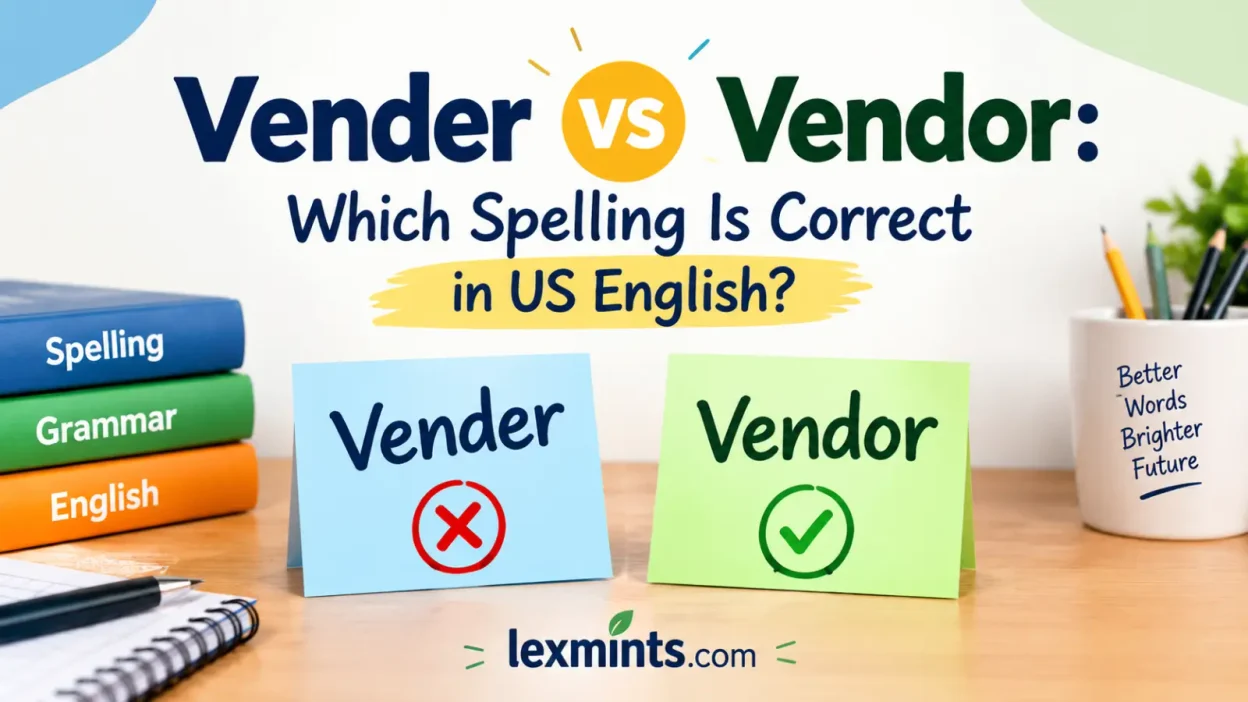
The correct word in most everyday situations is vendor, which means a person or business that sells goods or services. Vender is also a real English word, but it is a less common spelling of the same noun in some dictionaries and usage contexts.
For a US English article, business document, school assignment, or website, vendor is the safer and more widely recognized choice. It is the standard spelling used when discussing suppliers, sellers, market stalls, software providers, and business services.
The key is understanding the context. If you are writing about a company that supplies office equipment, a person selling food at a street market, or a business providing software, use vendor. The word vender may appear in older texts or alternative spelling references, but it is uncommon in modern American writing.
Vender vs. Vendor: Meaning, Usage, and Examples
Meta title: Vender vs Vendor: 7 Clear Rules for Correct Usage
Meta description: Vender vs. vendor explained with clear definitions, real examples, spelling tips, and simple rules to help you choose the correct word in US English.
Feature image prompt: Create an educational grammar illustration showing a street seller at a market stall beside a business supplier delivering boxes, with the headline “Vender vs. Vendor: Which Spelling Is Correct?” and the website name “lexmints.com.” Use a clean, modern layout with readable typography and a 16:9 aspect ratio.
Alt text: Vender vs. vendor spelling guide showing a market seller and business supplier.
Quick Answer: Vender or Vendor?
Vendor is the preferred spelling in modern American English. It refers to a person or business that sells goods or services.
Vender is also recognized as a variant spelling, particularly in American dictionary references. However, it is much less common, so vendor is the better choice for most writing. Cambridge Dictionary identifies vendor as the main form and lists vender as an alternative in US business usage. definition in the Cambridge English Dictionary+1
Examples:
- Correct and preferred: The company hired a new vendor to supply office furniture.
- Recognized but uncommon: The company hired a new vender to supply office furniture.
For business emails, reports, contracts, school assignments, and website content, choose vendor unless you must preserve a particular source’s spelling.
What Does Vendor Mean?
A vendor is a person, company, or organization that sells products or services. The word can describe someone selling items directly to customers or a business supplying another company.
Vendors operate in many industries. They may sell food, clothing, electronics, software, office supplies, or professional services.
Consider these examples:
- A hot dog vendor sells food from a cart.
- A clothing vendor sells shirts, dresses, and other apparel.
- A software vendor provides applications or computer programs.
- An office supply vendor sells paper, printers, and other workplace products.
- A wedding vendor provides services such as photography, flowers, or catering.
In each example, vendor identifies the person or business offering something for sale.
The term is also common in legal and property settings. A person selling a house or parcel of land may be called the vendor, while the person buying it is the purchaser. English meaning – Cambridge Dictionary+1
Vendor in a sentence
“Our company is comparing three vendors before renewing its software contract.”
Here, vendors refers to businesses offering software products or services.
Another example is, “The street vendor sold fresh lemonade outside the park.” In this sentence, the word refers to a person selling a product directly to customers.
What Does Vender Mean?
Vender is a recognized spelling variant of vendor. It carries the same basic meaning: a person or business that sells something.
Although dictionaries recognize the form, it is uncommon in everyday American writing. Readers may understand it, but many will expect to see vendor instead.
For example:
- “The vender sold fresh fruit at the market.”
- “We contacted the vender about our delayed order.”
Both sentences use vender with the intended meaning of a seller. However, replacing it with vendor makes the spelling more familiar to most readers.
The spelling vender may appear in older books, historical documents, and some modern publications. Its presence in a published source does not automatically make it the preferred spelling for general use. definition in the Cambridge English Dictionary+1
The practical lesson is simple: recognize vender when you encounter it, but use vendor when writing for a general American audience.
Vender vs. Vendor: Key Differences
The main distinction is not meaning. It is conventional spelling and modern usage.
| Feature | Vendor | Vender |
|---|---|---|
| Meaning | A person or business that sells | A person or business that sells |
| Dictionary status | Standard, established spelling | Recognized variant |
| Modern US usage | Preferred and widely familiar | Less common |
| Business documents | Recommended | Usually avoid |
| Everyday writing | Natural and expected | May look unusual |
| Plural | Vendors | Venders |
The two spellings can communicate the same idea, but they are not equally suitable for every situation.
When you write a business proposal, invoice, purchase agreement, or professional email, vendor is the clearer choice. It matches the spelling readers commonly encounter in business communication.
For example:
Preferred: “Please send the vendor a copy of the purchase order.”
Less common: “Please send the vender a copy of the purchase order.”
The second sentence remains understandable, but the first follows standard modern usage.
Why Do People Confuse Vender and Vendor?
The confusion comes from the fact that both spellings exist in English and have the same basic meaning. The endings -er and -or can both appear in words that describe people who perform an action.
For example:
- Teacher: a person who teaches.
- Writer: a person who writes.
- Actor: a person who performs in plays or films.
- Editor: a person who edits written material.
- Vendor: a person or business that sells something.
English spelling does not follow one simple rule for choosing between -er and -or. As a result, someone might assume that vender is just as common as vendor.
However, the established spelling is vendor. Learning the conventional form is more useful than trying to create a general spelling rule that does not always work.
A simple way to remember the spelling
Think of the phrase vendor business. Both words contain the letter o, which can help you remember the preferred spelling.
You can also memorize a few familiar combinations:
- Food vendor
- Street vendor
- Software vendor
- Retail vendor
- Third-party vendor
Repeated exposure to these expressions makes the correct spelling easier to recall.
How to Use Vendor Correctly
The word vendor is a noun. It names a person, company, or organization that sells something.
You can use it in casual conversations, professional communication, academic writing, and technical documents. Its meaning depends on the situation, but the central idea remains the same: someone is supplying goods or services.
Use vendor for people who sell goods
A vendor may sell products directly to customers at a market, event, store, or roadside stand.
Examples:
- The food vendor prepared fresh tacos for the festival.
- We bought handmade jewelry from a local vendor.
- A street vendor was selling umbrellas outside the train station.
- The market has several vendors selling fresh vegetables.
These sentences show how the word applies to sellers in everyday settings.
Use vendor for businesses that supply products
Companies often buy products from other businesses. In this context, a vendor provides the goods needed for daily operations.
Examples:
- The restaurant found a new vendor for fresh produce.
- Our office vendor delivered the printer paper this morning.
- The retailer works with several clothing vendors.
- We need a reliable vendor for packaging materials.
In these examples, vendor refers to a business relationship rather than only a person selling items directly.
Use vendor for service providers
The word can also describe a company that provides a service. This usage is common in business and technology.
Examples:
- The company selected a new software vendor.
- We contacted the internet service vendor about the outage.
- The wedding planner coordinated with every event vendor.
- Our payment vendor will update its system next week.
A vendor does not always sell a physical object. Depending on the context, it may provide software, payment processing, catering, or another service.
Vendor in Business and Technology
In professional settings, vendor often has a more specific meaning than simply “seller.” It can refer to an outside company that supplies products, services, or systems to another organization.
What is a vendor in business?
A business vendor supplies goods or services under an agreed arrangement. A company may work with several vendors to obtain materials, maintain equipment, or complete projects.
For example, a small business might use one vendor for office supplies, another for internet access, and another for accounting software.
A vendor relationship may involve prices, delivery schedules, payment terms, service agreements, and customer support. The exact responsibilities depend on the agreement between the parties.
Example: “Our purchasing department reviews each vendor before approving a new contract.”
Here, the word refers to a supplier being considered for a business relationship.
What is a software vendor?
A software vendor is a person or company that sells, licenses, or provides software. The software may be designed for individuals, businesses, schools, or government organizations.
Examples include companies offering accounting applications, security programs, project management platforms, and customer service systems.
Example: “The company changed its software vendor to improve customer support.”
The term does not necessarily mean that the software is purchased outright. Some vendors provide subscriptions or other licensing arrangements.
What is a third-party vendor?
A third-party vendor is an outside provider that supplies products or services to a person or organization. The term helps distinguish an external provider from the organization itself.
For instance, a retailer may use a third-party vendor to process online payments. A school may hire an outside vendor to manage cafeteria services.
Example: “The hospital checks its third-party vendors before sharing business information.”
This usage is especially common in procurement, information technology, and business administration.
Vendor vs. Seller, Supplier, and Provider
Several English words are related to vendor, but they do not always mean exactly the same thing. Choosing the best word depends on what the person or company does.
| Word | Meaning | Example |
|---|---|---|
| Vendor | A person or business selling goods or services | The vendor delivered our supplies. |
| Seller | A person or business selling something | The seller accepted our offer. |
| Supplier | A person or business providing goods or materials | The supplier sent the raw materials. |
| Provider | A person or organization delivering a service | The provider maintains our website. |
| Retailer | A business selling products to consumers | The retailer opened a new store. |
Vendor is a broad term that works in many commercial settings. Seller is a straightforward alternative when the act of selling is the main point.
Supplier often emphasizes the provision of goods or materials. Provider is especially useful when discussing services, although its meaning is broader than commerce.
These words overlap, but they are not always interchangeable. A company may be a service provider without selling physical products, while a retailer specifically sells goods to customers.
Is Vender Ever Correct?
Yes. Vender is a recognized spelling variant, rather than a completely invented word. Some dictionaries list it as an alternative spelling of vendor. Collins English Dictionary+1
However, dictionary recognition and everyday preference are different things. A word can be valid while remaining unusual in most modern writing.
You might encounter vender in an older text, a quotation, or a publication that follows a particular editorial preference. In those situations, the spelling may be intentional.
For example, if you are transcribing an old document, you may need to preserve the original spelling. If you are discussing a historical advertisement, changing every occurrence could make your transcription less faithful to the source.
In ordinary writing, though, there is little reason to choose vender over vendor.
Use vendor in your own sentences unless you have a specific reason to retain the alternative spelling.
Common Mistakes When Using Vender and Vendor
Knowing the preferred spelling helps, but writers can also make mistakes with meaning, number, and context.
Mistake: Assuming both spellings are equally common
Incorrect assumption: “Vendor and vender are equally preferred in American English.”
Correction: Vendor is the standard, familiar choice for general writing. Vender is a recognized but much less common variant.
Mistake: Using vender in a professional report
Less suitable: “We reviewed each vender before signing the agreement.”
Better: “We reviewed each vendor before signing the agreement.”
The revised sentence uses the spelling most readers expect in business communication.
Mistake: Confusing a vendor with a customer
A vendor sells or supplies goods or services. A customer buys them.
Incorrect: “The vendor purchased our products for personal use,” if you mean the person who bought the products from your business.
Better: “The customer purchased our products for personal use.”
The word vendor describes the selling role, not the buying role.
Mistake: Using the wrong plural form
The standard plural of vendor is vendors.
Examples:
- One vendor supplied the equipment.
- Three vendors submitted proposals.
- We contacted the vendors about delivery.
If you are using the less common variant vender, its plural is venders. Nevertheless, vendors is the preferred form in ordinary modern writing.
Mistake: Thinking vendor only means a street seller
A vendor can sell products at a street market, but the word also applies to companies supplying software, equipment, materials, and services.
For example, “The hospital selected a new medical equipment vendor” uses the word correctly in a professional setting.
Seven Practical Rules for Choosing the Correct Spelling
These simple rules can help you make the right choice without overthinking the word.
Rule 1: Choose vendor for everyday writing.
Use it when discussing people or businesses that sell goods or services.
Rule 2: Use vendor in business documents.
Purchase orders, invoices, contracts, reports, and professional emails generally call for the familiar spelling.
Rule 3: Use vendor for technology companies.
Expressions such as software vendor and technology vendor are common in professional English.
Rule 4: Use vendor for street sellers.
A person selling food, flowers, or handmade products at a market can be called a vendor.
Rule 5: Recognize vender without automatically treating it as a typo.
The spelling is documented, even though it is not the usual choice for modern American writing.
Rule 6: Preserve vender when an exact quotation requires it.
Do not silently alter the spelling of a source when accuracy requires you to reproduce its original wording.
Rule 7: Stay consistent throughout your document.
If you are writing about suppliers, use vendor consistently unless a quotation or source requires another form.
Following these rules will help make your writing clearer and more natural.
FAQs
Is vender or vendor correct in American English?
Vendor is the preferred spelling in modern American English. Vender is also recognized as a variant, but it is less common. Use vendor for most everyday and professional writing.
Does vender mean the same thing as vendor?
Yes. When used as a noun meaning a seller, vender has essentially the same meaning as vendor. The difference is that vendor is the conventional spelling most readers expect.
Is vender a misspelling?
Not necessarily. Dictionaries recognize vender as an alternative spelling. However, because vendor is much more familiar, using vender in ordinary writing may look like a spelling mistake to some readers.
What is the plural of vendor?
The plural is vendors. For example, “Several vendors attended the trade show.” The less common variant vender can also form the plural venders.
What is the difference between a vendor and a supplier?
A vendor is a person or business that sells goods or services. A supplier typically emphasizes providing goods, materials, or resources. The terms can overlap, depending on the business relationship.
Is a vendor a person or a company?
It can be either. A vendor may be an individual selling food at a market or a company providing software to a large organization.
How do you pronounce vendor?
In American English, vendor is commonly pronounced VEN-der, with the stress on the first syllable. The word vender is generally pronounced the same way, so pronunciation does not help distinguish the spellings.
Mini Quiz: Test Your Understanding
Choose the best answer for each question.
Question 1: Which spelling is preferred in a business email?
A. Vender
B. Vendor
Question 2: What does a vendor do?
A. Buys goods or services
B. Sells goods or services
Question 3: Which sentence uses the preferred spelling?
A. The software vendor updated its application.
B. The software vender updated its application.
Question 4: Is vender a recognized English spelling?
A. Yes
B. No
Question 5: What is the plural of vendor?
A. Vendors
B. Vendor’s
Answer Key
- Question 1: B — Vendor.
- Question 2: B — Sells goods or services.
- Question 3: A — The software vendor updated its application.
- Question 4: A — Yes, it is a recognized variant.
- Question 5: A — Vendors.
Conclusion
When deciding between vender and vendor, choose vendor for clear, natural, and professional American English. It is the established spelling for a person or business that sells goods or services.
Although vender exists as a variant, it is rarely the better choice in everyday writing. Use vendor in your next report, email, or article, and you can write with greater confidence.