
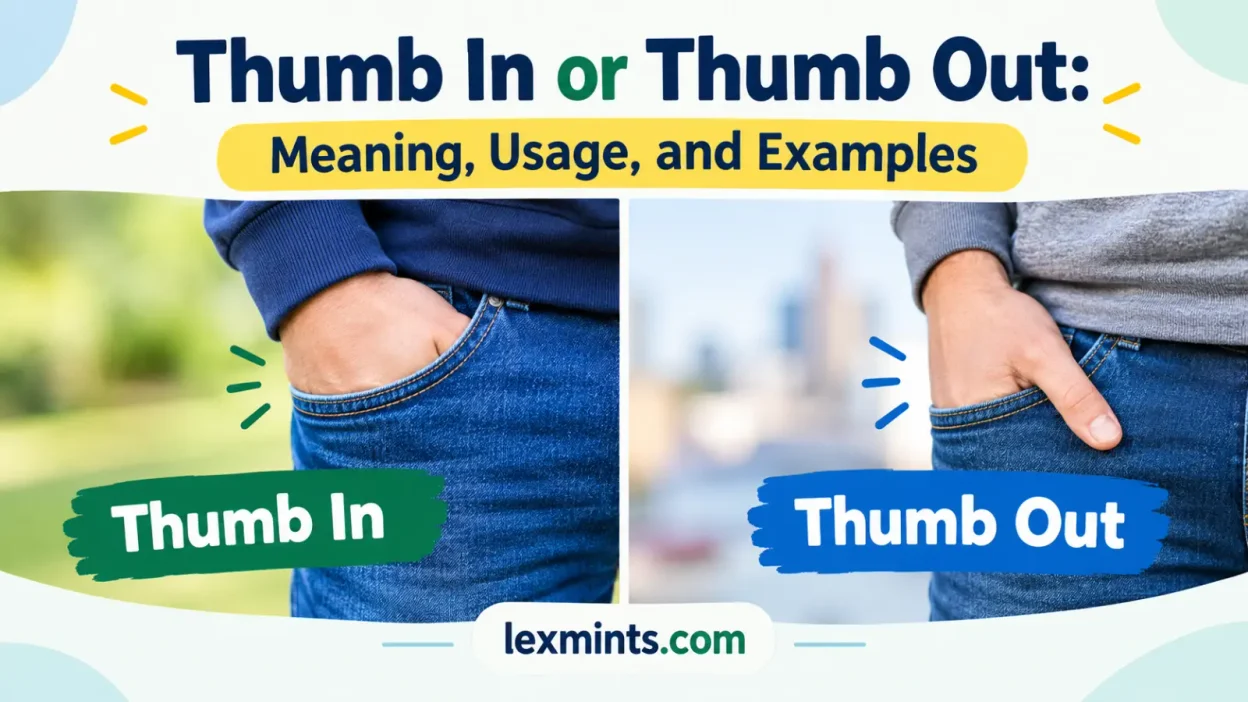
The phrase “thumb in or thumb out” can describe different hand positions, gestures, or actions depending on the situation. A thumb may be tucked into a fist, placed inside a pocket, held outside a hand, or extended to communicate a message. Understanding the context helps you determine what someone means when they use these expressions.
In everyday American English, people often describe hand positions using simple phrases such as “thumbs up,” “thumbs down,” “thumb in your pocket,” or “thumb out.” However, “thumb in” and “thumb out” do not have one universal meaning in every situation. Their meanings depend on what the speaker is describing.
This guide explains the possible meanings of “thumb in” and “thumb out,” how these expressions work in sentences, and where you might encounter them. You will also learn the difference between literal hand positions and symbolic gestures, along with practical examples that make the expressions easier to understand.
Quick Answer
“Thumb in” means keeping your thumb tucked inward or placing it inside something, while “thumb out” means extending your thumb outward or keeping it outside something. The exact meaning depends on the context. For example, “thumb out” can describe the gesture used when hitchhiking to ask for a ride.
What Does “Thumb In or Thumb Out” Mean?
“Thumb in or thumb out” generally refers to whether a person’s thumb is positioned inward or outward in relation to the hand, a pocket, or another object. The exact meaning depends on the physical action being discussed.
Thumb in usually describes a thumb tucked inside something or positioned toward the palm. For example, someone might put their thumb inside a closed fist or tuck it into a pocket.
Thumb out generally describes a thumb positioned outside something, extended away from the palm, or visible beyond the edge of an object. For example, a person might keep their thumb outside a pocket or extend it while making a gesture.
These descriptions are not fixed idioms with one meaning. They are ordinary combinations of words whose meanings change with context.
Consider these examples:
- “Keep your thumb in your pocket.” This describes placing the thumb inside the pocket.
- “Keep your thumb out of your fist.” This describes keeping the thumb outside the closed hand.
- “He stuck his thumb out to hitchhike.” This describes extending the thumb to signal passing drivers.
- “She tucked her thumb in while making a fist.” This describes a particular hand position.
The surrounding sentence tells readers which meaning applies.
What Does “Thumb In” Mean?
“Thumb in” can describe placing the thumb inside an object, tucking it toward the palm, or keeping it within a particular position. It is usually a literal description rather than a special expression.
The phrase becomes clearer when the speaker identifies where the thumb should go. Without that information, readers may need additional context to understand the intended action.
Thumb Tucked Inside the Hand
When making a fist, a person may position the thumb against the fingers or across the outside of them. In other situations, someone may tuck the thumb into the palm.
For example:
- “Keep your thumb in when you close your hand.”
- “He curled his fingers around the ball and tucked his thumb in.”
- “The instructor showed us how to position our thumbs before gripping the handle.”
These sentences describe hand positioning. They do not automatically communicate approval, disapproval, or another symbolic message.
The exact position can matter during sports, exercise, crafts, and other activities. If a particular technique requires a specific thumb position, follow the instructions for that activity rather than assuming every use of “thumb in” means the same thing.
Thumb Inside a Pocket
People sometimes use “thumb in” to describe a thumb placed inside a pocket.
For example:
- “He stood with his thumb in his jacket pocket.”
- “Keep your thumb in your pocket while you wait.”
- “She walked with both hands in her coat pockets.”
The first two sentences specifically mention the thumb. The third describes the hands more generally.
This usage is straightforward and depends on the physical location of the thumb. It does not have a standard hidden meaning in ordinary conversation.
Thumb Positioned Toward the Palm
In some contexts, “thumb in” means moving the thumb inward toward the palm or the other fingers.
For example:
- “Bring your thumb in toward your palm.”
- “Move your thumb in slightly to complete the hand position.”
- “The coach asked the player to bring the thumb in before gripping the equipment.”
Here, “in” describes direction. It does not necessarily mean that the thumb enters a pocket, fist, or other object.
This distinction is useful when following instructions. The word “in” may refer to a location, a direction, or a position within a larger movement.
What Does “Thumb Out” Mean?
“Thumb out” generally describes a thumb that extends outward, remains outside an object, or is positioned away from the palm. Like “thumb in,” it is not a single fixed expression with one universal interpretation.
The phrase often appears in instructions, descriptions of gestures, and everyday conversations about hand positions.
Thumb Extended Away From the Hand
A person may extend their thumb outward while keeping the other fingers curled. This position can be used for a gesture, a demonstration, or a physical movement.
Examples include:
- “Hold your hand steady with your thumb out.”
- “He extended his thumb out from his closed fist.”
- “The demonstration showed the thumb out to the side.”
These sentences explain a visible hand position. The meaning comes from the action being described rather than from a special idiom.
Thumb Outside a Pocket or Object
“Thumb out” can also mean keeping the thumb outside something.
For example:
- “Keep your thumb out of the pocket opening.”
- “She rested her hand on the table with her thumb out.”
- “He held the object with his thumb outside the opening.”
In these examples, “out” identifies the thumb’s position relative to a pocket, hand, or object.
The phrase does not necessarily mean that the thumb points upward. It may simply describe a thumb that remains outside a particular space.
Thumb Out as a Hitchhiking Gesture
One familiar use of an extended thumb occurs during hitchhiking. A person may stand beside a road and extend a thumb toward approaching traffic to signal that they want a ride.
For example:
- “The traveler stood beside the highway with his thumb out.”
- “She put her backpack down and stuck her thumb out.”
- “The man held his thumb out while waiting for a passing car.”
In this context, “thumb out” describes a recognizable gesture associated with requesting a ride.
However, the phrase does not always refer to hitchhiking. A sentence about exercise, hand positioning, or an object may use the same words in a completely different way.
Thumb In vs. Thumb Out: Key Differences
The main difference is the position described by the words “in” and “out.” Neither expression has one meaning that applies to every situation.
| Expression | General meaning | Example |
|---|---|---|
| Thumb in | The thumb is tucked inward or placed inside something | “Keep your thumb in your pocket.” |
| Thumb out | The thumb is extended or positioned outside something | “He stood with his thumb out.” |
| Thumb pointing up | The thumb points upward, often as a gesture | “She gave a thumbs-up.” |
| Thumb pointing down | The thumb points downward, sometimes signaling disapproval | “The audience gave a thumbs-down.” |
Notice that “thumb out” and “thumbs up” are not interchangeable. A thumb can point outward without pointing upward.
Similarly, “thumb in” does not automatically mean disapproval. The meaning depends on the action and the surrounding words.
Is “Thumb In or Thumb Out” an Idiom?
An idiom is a phrase whose overall meaning cannot always be understood from the meanings of its individual words. For example, “break the ice” usually means helping people feel comfortable in a social situation.
“Thumb in” and “thumb out” are generally literal descriptions rather than established idioms. They usually refer to the physical position or movement of a thumb.
The phrase “thumb out” can have a familiar contextual meaning when someone is hitchhiking. Even then, its meaning comes from a recognizable gesture rather than from an unrelated figurative definition.
Consider the following examples:
- “Put your thumb in your pocket.” This is a literal instruction.
- “Keep your thumb out of the opening.” This is a literal instruction.
- “He had his thumb out beside the highway.” This likely describes hitchhiking when the surrounding context supports that interpretation.
It is best not to assign a symbolic meaning to either expression without evidence from the situation.
How to Use “Thumb In” and “Thumb Out” in Sentences
Both expressions can be used in ordinary descriptions and instructions. The clearest sentences explain what the thumb is doing or where it is positioned.
Use “Thumb In” for an Inward Position
Choose “thumb in” when the thumb is being moved inward or placed inside a specified area.
Examples:
- “Move your thumb in toward the center of your palm.”
- “He kept his thumb in his jacket pocket.”
- “The instructor asked her to tuck her thumb in.”
- “Keep your thumb in the marked area.”
These examples describe different actions, but each provides enough context to make the intended position understandable.
Use “Thumb Out” for an Outward Position
Choose “thumb out” when the thumb is extended or kept outside a specified area.
Examples:
- “Move your thumb out slightly.”
- “Keep your thumb out of the opening.”
- “The traveler stood with his thumb out.”
- “She held the object with her thumb out to the side.”
The phrase becomes more precise when you add a location or direction. For example, “thumb out to the side” gives a clearer picture than “thumb out” alone.
Use Complete Instructions When Precision Matters
Short phrases can be useful during casual conversation. However, complete instructions are often better when the exact hand position matters.
Instead of saying, “Thumb in,” you could say, “Tuck your thumb toward your palm.”
Instead of saying, “Thumb out,” you could say, “Extend your thumb away from your palm.”
These longer instructions reduce confusion because they explain both the movement and the intended position.
Common Mistakes With “Thumb In” and “Thumb Out”
Although these expressions look simple, their meanings can be misunderstood when the context is missing.
Assuming “Thumb Out” Always Means Hitchhiking
The phrase can describe hitchhiking, but it can also refer to an ordinary hand position.
Incorrect assumption: “Thumb out always means asking for a ride.”
Better explanation: “Thumb out” can describe an extended thumb. In a roadside context, it may indicate hitchhiking.
Confusing “Thumb Out” With “Thumbs Up”
A thumbs-up gesture usually involves raising the thumb to communicate approval, agreement, or encouragement.
A thumb-out position only tells the reader that the thumb extends outward or remains outside something. It does not automatically express approval.
For example, “He held his thumb out to the side” describes a position. “He gave me a thumbs-up” describes a recognizable gesture.
Treating “Thumb In” as a Sign of Disapproval
There is no universal rule that “thumb in” means disagreement or rejection.
The phrase generally describes a physical position. If a person uses a particular gesture to communicate a message, the surrounding situation determines its likely meaning.
Leaving Out Necessary Context
A sentence such as “Put your thumb in” may be unclear if the listener does not know where the thumb should go.
A clearer instruction is “Put your thumb inside the pocket” or “Move your thumb toward your palm.”
Likewise, “Keep your thumb out” becomes clearer as “Keep your thumb outside the opening.”
Ignoring the Difference Between Singular and Plural
“Thumb” refers to one thumb. “Thumbs” refers to both thumbs or to thumbs generally.
For example:
- “Keep your thumb out of the opening.”
- “Keep your thumbs outside the openings.”
- “He raised his thumb.”
- “She gave two thumbs-up gestures.”
Choose the singular or plural form according to the number of thumbs being described.
Common Contexts Where These Expressions Appear
The meaning of “thumb in” or “thumb out” becomes easier to understand when you identify the setting.
Everyday Conversation
People may describe how someone holds their hand, carries an object, or places a thumb inside a pocket.
For example, “He stood with his thumb in his pocket” gives a simple description of posture.
Sports and Physical Activities
An instructor may describe a thumb position while demonstrating a grip or movement. In these situations, the phrase should be interpreted according to the specific activity.
If the instruction concerns safety or technique, ask for clarification when the position is unclear.
Hitchhiking and Roadside Situations
“Thumb out” is commonly associated with the gesture used to request a ride from passing motorists.
For example, “They walked along the road with their thumbs out” may describe people seeking a ride.
The location and surrounding action help establish this meaning.
Photography and Visual Descriptions
A writer might use either expression to describe a person’s hand in a photograph.
For example, “Her thumb was tucked in” or “His thumb extended out from the fist” helps readers picture the hand position.
In visual descriptions, specific details are usually more helpful than vague instructions.
Does “Thumb In” or “Thumb Out” Have a Hidden Meaning?
Neither phrase has one widely applicable hidden meaning in standard American English. Their meanings can change with the context, the speaker’s intention, and the activity being discussed.
A particular group may use a hand gesture as a signal. A sports instructor may use the same words to describe a technique. A traveler may use “thumb out” to describe hitchhiking.
These uses should not be treated as identical.
If you encounter either expression in a text message, online discussion, video, or conversation, consider the surrounding words first. Look for clues about whether the speaker is discussing a literal hand position, a recognizable gesture, or a specialized activity.
If the context remains unclear, asking what the speaker means is more reliable than guessing at a hidden definition.
Related Expressions and Their Meanings
Several familiar English expressions also use the word “thumb.” Understanding them can prevent confusion.
Thumbs up: A gesture commonly used to express approval, agreement, or encouragement.
Example: “The manager gave the proposal a thumbs-up.”
Thumbs down: A gesture commonly associated with disapproval or rejection.
Example: “The audience gave the performance a thumbs-down.”
Thumb your nose: A gesture that can express mockery or disrespect.
Example: “The child thumbed his nose at the rules.”
Stick your thumb out: To extend the thumb outward. In a roadside setting, it can describe the hitchhiking gesture.
Example: “He stuck his thumb out and waited for a ride.”
Keep your thumb on something: To maintain contact or pressure with the thumb.
Example: “Keep your thumb on the button until the light turns green.”
These expressions have different meanings. A thumb’s physical position alone does not determine the message conveyed by every gesture.
FAQs
What does “thumb in” mean?
“Thumb in” generally describes a thumb tucked inward, placed inside something, or moved toward the palm. The exact meaning depends on the sentence and situation.
What does “thumb out” mean?
“Thumb out” usually describes a thumb extended outward or positioned outside something. In a roadside context, it may refer to the gesture used for hitchhiking.
Is “thumb in or thumb out” a common idiom?
It is not generally treated as a fixed idiom in standard American English. It is usually a literal description of hand position, although context can give the expression a familiar meaning.
Does “thumb out” mean thumbs-up?
No. A thumb-out position does not necessarily point upward or express approval. “Thumbs-up” is a separate expression commonly associated with approval or encouragement.
Does “thumb in” mean disapproval?
Not by itself. “Thumb in” generally describes a physical position rather than a standard signal of disagreement or rejection.
How can I tell which meaning is intended?
Look at the words around the phrase and identify the situation. References to pockets, hand movements, sports, or roadside travel can help clarify the intended meaning.
Mini Quiz
Test your understanding of these expressions.
Question 1: What does “thumb out” most likely mean in the sentence “He stood beside the road with his thumb out”?
A. He was pointing at the ground.
B. He was likely signaling for a ride.
C. He was hiding his hand.
Question 2: Which sentence clearly describes an inward thumb position?
A. “Move your thumb toward your palm.”
B. “Raise your thumb above your head.”
C. “Wave your whole hand.”
Question 3: Does “thumb out” always mean approval?
A. Yes.
B. No.
Question 4: Which expression commonly communicates approval?
A. Thumb in.
B. Thumbs-up.
C. Thumb outside the pocket.
Answer Key: 1—B; 2—A; 3—B; 4—B.
Conclusion
“Thumb in” and “thumb out” generally describe different thumb positions, but their exact meanings depend on context. Neither expression automatically communicates approval or disapproval.
Use clear descriptions when explaining a hand position, and consider the surrounding situation when interpreting a gesture. If you encounter these phrases in a specific sentence, examine that context to determine their intended meaning.