
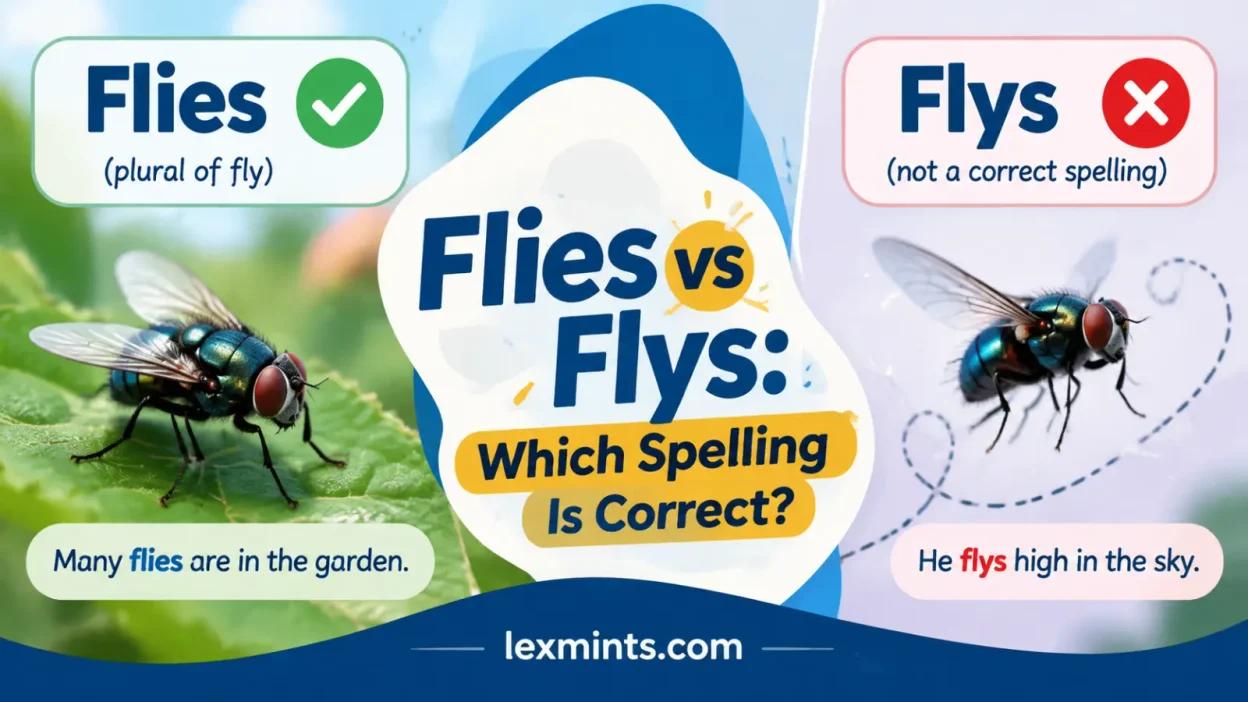
If you are wondering whether the correct spelling is “flies” or “flys,” the correct form is flies. The spelling flys is generally incorrect in standard English.
However, flies can have more than one meaning. It can be the plural of fly, referring to insects, or the third-person singular form of the verb fly. Understanding these different uses can make it much easier to know when to use flies in a sentence.
In this guide, we will explain the difference between flies vs flys, show you the correct spelling, explain the grammar rule behind it, and provide plenty of examples.
Flies vs Flys: Quick Answer
Flies is the correct spelling in standard English.
Flys is not normally considered a correct standard-English spelling.
The word flies can be used in several ways:
- Flies can mean more than one insect called a fly.
- Flies can mean that a person, bird, or aircraft travels through the air.
- Flies can describe something moving quickly through the air.
- Flies can be a noun meaning the ropes or equipment used to move scenery in a theater.
For example:
- There are several flies around the food.
- The bird flies over the trees.
- The airplane flies across the country.
- Time flies when you are having fun.
The spelling flys should generally be avoided in standard English writing.
What Does “Flies” Mean?
Flies is a correctly spelled English word with several grammatical uses.
Most commonly, it is either a plural noun or a third-person singular verb.
Flies as a Plural Noun
When flies is used as a noun, it is the plural form of fly, the name of an insect.
For example:
- One fly is sitting on the window.
- Two flies are sitting on the window.
The singular noun is fly, while the plural noun is flies.
More examples include:
- The kitchen has several flies.
- We noticed flies near the trash can.
- The horse was bothered by flies.
- The screen keeps the flies outside.
- Several flies landed on the table.
Flies as a Verb
Flies is also the third-person singular present-tense form of the verb fly.
For example:
- The bird flies south in the winter.
- She flies to Chicago every month.
- The plane flies over the mountains.
- The eagle flies high above the valley.
Here, flies does not refer to insects. Instead, it describes the action of traveling through the air.
What Does “Flys” Mean?
In standard modern English, flys is generally considered an incorrect spelling when you mean the plural of fly or the verb form flies.
For example, this sentence is incorrect:
The bird flys over the house.
The correct sentence is:
The bird flies over the house.
Likewise, this sentence is incorrect:
There are many flys in the kitchen.
The correct version is:
There are many flies in the kitchen.
The reason is that English has a spelling rule for many nouns and verbs ending in -y.
Why Is “Flies” Correct Instead of “Flys”?
The answer comes from a common English spelling rule.
When a word ends in a consonant + y, the y often changes to i before certain endings are added.
For example:
- fly → flies
- baby → babies
- city → cities
- story → stories
- party → parties
- family → families
The word fly ends in a consonant followed by y:
fl + y
When forming the plural noun, the y changes to i, and -es is added:
fly → flies
The same spelling pattern occurs when fly becomes the third-person singular verb:
fly → flies
This is why flys is not the standard spelling.
The Spelling Rule for Words Ending in “Y”
A useful rule is to look at the letter immediately before the final y.
When a word ends in a consonant + y, the y usually changes to i before adding -es or -ed, depending on the grammatical form.
For plurals:
- baby → babies
- city → cities
- country → countries
- family → families
- fly → flies
This pattern helps explain why we write flies, not flys.
However, when a word ends in a vowel + y, the y usually stays unchanged.
For example:
- boy → boys
- toy → toys
- day → days
- key → keys
- journey → journeys
Compare:
fly → flies
but:
toy → toys
The difference is the letter before the y.
In fly, the letter before y is l, a consonant.
In toy, the letter before y is o, a vowel.
Flies as the Plural of “Fly”
One of the most common uses of flies is as the plural of fly.
A fly is a small flying insect. More than one is called flies.
Examples:
- There is a fly in the room.
- There are several flies in the room.
- I saw one fly near the window.
- I saw five flies near the window.
- The fly landed on the food.
- The flies landed on the food.
Notice how the spelling changes from fly to flies.
Flies as a Verb
The word flies can also be a verb.
The base form is fly.
With the pronouns I, you, we, and they, we use fly:
- I fly to New York tomorrow.
- You fly very often.
- We fly to Florida every winter.
- They fly across the country.
But with he, she, or it, the verb becomes flies:
- He flies to New York tomorrow.
- She flies every week.
- The bird flies over the lake.
- The plane flies at night.
This is another reason why flies is a standard English word.
Flies vs Flys in Everyday Sentences
Here are some examples that make the difference clear.
Correct
The bird flies over the house.
Incorrect
The bird flys over the house.
Correct
There are many flies near the garbage.
Incorrect
There are many flys near the garbage.
Correct
She flies to California every summer.
Incorrect
She flys to California every summer.
Correct
The screen keeps flies out of the kitchen.
Incorrect
The screen keeps flys out of the kitchen.
In each case, flies is the correct spelling.
Flies in Different Contexts
The word flies can appear in several different contexts.
1. Insects
This is probably the most familiar meaning.
Examples:
- The flies are bothering us.
- I closed the window because of the flies.
- The garbage attracted many flies.
2. Air Travel
Flies can describe someone traveling by airplane.
For example:
- Maria flies to Boston every month.
- My brother flies home on Friday.
- She flies from Los Angeles to Denver.
3. Birds and Animals
The word can describe an animal moving through the air.
Examples:
- The eagle flies above the mountains.
- A hummingbird flies from flower to flower.
- The hawk flies across the field.
4. Figurative Expressions
Flies can also appear in expressions that describe the passing of time.
A common example is:
Time flies.
This means that time seems to pass very quickly.
For example:
Time flies when you are having fun.
Here, flies is a verb, not a noun referring to insects.
“Time Flies” vs “Time Flys”
The expression “time flies” is correct.
The expression “time flys” is incorrect in standard English.
Why?
Because time is a singular subject, so the verb fly changes to flies in the present tense.
Correct:
Time flies.
Incorrect:
Time flys.
You may also see:
Time flies when you’re having fun.
This is a very common English expression.
“Fly” vs “Flies”
It is also important to understand the difference between fly and flies.
Fly
Fly can be a singular noun or the base form of the verb.
Examples:
- I saw a fly.
- Birds fly south.
- We fly home tomorrow.
Flies
Flies can be a plural noun or a third-person singular verb.
Examples:
- I saw several flies.
- The bird flies south.
- She flies home tomorrow.
The correct form depends on the sentence.
Common Mistakes With “Flies”
Many writers accidentally use flys because they assume that adding -s to fly is enough to create the plural or verb form.
That pattern works with many English words, but not with nouns and verbs like fly.
For example:
- cat → cats
- book → books
- car → cars
But:
- fly → flies
- baby → babies
- city → cities
- story → stories
The spelling change is important.
How to Remember “Flies”
A simple way to remember the correct spelling is:
Fly + es = flies
Think of the word as changing from y to i:
fly → flies
You can also remember other words that follow the same pattern:
- baby → babies
- lady → ladies
- city → cities
- party → parties
- country → countries
- fly → flies
Once you recognize this pattern, flies becomes much easier to spell correctly.
Is “Flys” Ever Correct?
For normal standard-English writing, flys should not be used as the plural of fly or as the third-person singular form of the verb fly.
There may be unusual contexts where a nonstandard spelling, proper name, brand name, username, or specialized name uses Flys, but those are exceptions rather than standard English grammar.
If you are writing an essay, article, email, school assignment, business document, or website content, use flies when you mean the standard English word.
Flies vs Flys: Grammar Comparison
| Word | Correct? | Common Use |
|---|---|---|
| flies | Yes | Plural of fly; third-person singular verb |
| flys | No | Generally incorrect in standard English |
Examples:
| Incorrect | Correct |
|---|---|
| The bird flys away. | The bird flies away. |
| There are three flys here. | There are three flies here. |
| Time flys quickly. | Time flies quickly. |
| She flys to Texas. | She flies to Texas. |
| I saw several flys. | I saw several flies. |
Examples of “Flies” as a Noun
Here are more examples where flies is a plural noun:
- The flies gathered around the trash.
- We need to keep the flies out of the house.
- Several flies landed on the fruit.
- The farmer used a screen to keep flies away.
- I noticed a few flies near the window.
- The warm weather brought out more flies.
- The restaurant works hard to prevent flies from entering.
- The horse was surrounded by flies.
- The children tried to chase the flies away.
- The open door allowed several flies inside.
In all these sentences, flies means more than one fly.
Examples of “Flies” as a Verb
Now look at flies as a verb:
- The eagle flies over the mountains.
- She flies to Seattle tomorrow.
- The airplane flies at night.
- The bird flies across the lake.
- He flies home every weekend.
- The butterfly flies from one flower to another.
- The pilot flies the plane carefully.
- The kite flies high in the wind.
- The helicopter flies over the city.
- Time flies when we are together.
In these examples, flies describes an action.
How “Flies” Changes With the Subject
Understanding subject-verb agreement can help you use flies correctly.
With I, you, we, and they, use fly:
- I fly tomorrow.
- You fly often.
- We fly together.
- They fly every month.
With he, she, and it, use flies:
- He flies tomorrow.
- She flies often.
- It flies very high.
This is a basic third-person singular verb rule in English.
Flies in Formal and Informal Writing
The spelling flies is appropriate in both formal and informal English.
You can use it in:
- Academic writing
- Business writing
- Emails
- School assignments
- News articles
- Blog posts
- Social media posts
- Everyday conversations
For example:
The airplane flies approximately 500 miles before landing.
This is perfectly acceptable in formal writing.
Likewise:
Wow, time flies!
is natural in casual conversation.
The spelling does not change based on formality.
Why “Flys” Looks Correct to Some Writers
The mistake happens because many English plurals are formed simply by adding -s.
For example:
- dog → dogs
- car → cars
- book → books
- tree → trees
Writers may therefore assume:
fly + s = flys
But English spelling has several special patterns. Words ending in a consonant followed by y commonly change y to i before -es.
So:
fly → flies
not:
fly → flys
This is a spelling rule rather than an optional style preference.
Quick Memory Trick
Remember this simple sentence:
A fly becomes flies when there is more than one.
Then remember the verb:
He flies, she flies, it flies.
These two patterns cover most situations in which people confuse flies and flys.
FAQs
Is “flys” a correct word?
Flys is generally not correct in standard English when you mean the plural of fly or the third-person singular form of the verb fly. The correct spelling is flies.
Is it “flies” or “flys”?
The correct spelling is flies. For example, “There are several flies in the room” and “The bird flies over the house.”
Why does fly become flies?
Because fly ends in a consonant followed by y. When forming the plural or the third-person singular present-tense verb, the y changes to i and -es is added: fly → flies.
Is “time flys” correct?
No. The correct expression is “time flies.” For example: “Time flies when you’re having fun.”
Is “flies” singular or plural?
It can be either, depending on how it is used. As a noun, flies is the plural of fly. As a verb, flies is the third-person singular form of fly.
What is the plural of “fly”?
The plural of fly is flies.
Is “She flys” correct?
No. The correct form is “She flies.” The verb changes from fly to flies with a third-person singular subject such as she.
What is the difference between fly and flies?
Fly can be a singular noun or the base form of a verb. Flies can be the plural noun or the third-person singular form of the verb. For example, “I saw a fly,” “I saw two flies,” and “The bird flies.”
Conclusion
When choosing between flies vs flys, use flies.
Flies is the standard and correct spelling. It can be:
- The plural of fly: “There are many flies.”
- The third-person singular form of fly: “The bird flies.”
- Part of common expressions: “Time flies.”
Flys is generally an incorrect spelling in standard English.
The easiest rule to remember is:
fly → flies
not:
fly → flys
So, if you are writing for a school assignment, professional document, website, email, or any other standard-English context, choose flies.


