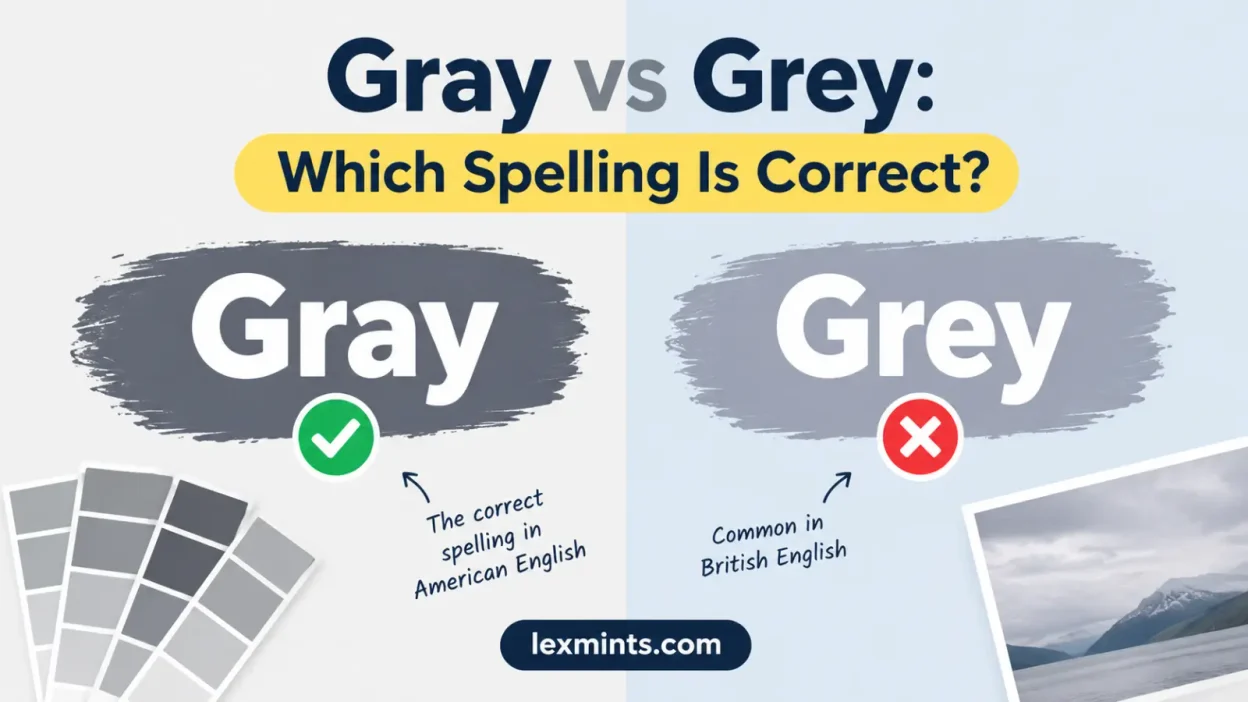
Gray vs grey is a common spelling question in English. Both gray and grey are correct spellings of the same word. The main difference is regional usage: gray is the standard spelling preferred in American English, while grey is more common in British English and several other varieties of English.
For readers in the United States, gray is generally the better choice. For British audiences, grey is usually preferred.
Both spellings refer to the color between black and white, and both can also be used in expressions such as “gray area” or “grey area.” The meaning does not change simply because the spelling changes.
Gray vs Grey: Quick Answer
Gray is the preferred spelling in American English.
Grey is the preferred spelling in British English.
Here is the simple comparison:
| Spelling | Main Usage | Example |
|---|---|---|
| Gray | American English | The sky looked gray before the storm. |
| Grey | British English | The sky looked grey before the storm. |
If you are writing for a U.S. audience, use gray consistently. If your audience follows British English conventions, grey is usually the natural choice.
What Does Gray Mean?
Gray is an adjective and noun that describes a color between black and white.
As an adjective, it describes something that has a gray color.
For example:
- She wore a gray sweater.
- The building has a gray exterior.
- Dark gray clouds covered the sky.
- He bought a gray jacket for winter.
As a noun, gray refers to the color itself.
For example:
- Gray is a neutral color.
- The room contains several shades of gray.
- I prefer gray over bright colors.
The word can also be used figuratively. A gray area is a situation where the rules, answer, or distinction is unclear.
For example:
- The law leaves a gray area regarding the issue.
- There is a gray area between the two categories.
In American English, gray is the standard spelling in these uses.
What Does Grey Mean?
Grey has the same meaning as gray. It refers to the same color and can be used in the same grammatical situations.
For example:
- She wore a grey sweater.
- The walls were painted grey.
- The sky turned grey in the afternoon.
- He has grey hair.
The spelling grey is especially common in British English.
So, if you see “grey” in a British book, article, website, or publication, it is not a spelling error. It is simply the spelling preferred in that variety of English.
Likewise, an American writer using gray is following standard American English spelling.
Gray vs Grey: American and British English
The biggest difference between gray and grey is regional spelling preference.
American English generally uses gray.
British English generally uses grey.
This is similar to other spelling differences between American and British English. For example, American English commonly uses color, while British English commonly uses colour.
The same general pattern applies here:
- American English: gray
- British English: grey
If you are writing an article for an American website, school assignment, business audience, or U.S. publication, gray is usually the safest choice.
If you are writing specifically for a British audience, grey is usually more appropriate.
Is Gray or Grey Correct?
Both gray and grey are correct.
There is no universal rule that makes one spelling correct and the other incorrect. The preferred form depends primarily on the variety of English being used.
For American English:
Gray is correct and preferred.
For British English:
Grey is correct and preferred.
Therefore, it would be incorrect to tell every English speaker that “grey” is wrong or that “gray” is wrong. Both forms are established English spellings.
The important thing is to choose the spelling appropriate for your audience and remain consistent.
Gray vs Grey in American English
If your goal is to follow standard American English, choose gray.
Examples include:
- gray hair
- gray shirt
- gray eyes
- gray clouds
- gray paint
- gray matter
- gray area
- gray wolf
For example:
The old house had a gray roof.
Another example:
The manager said the situation was a gray area.
In a U.S.-focused article, repeatedly using grey may make the writing appear more British, even though the spelling is still understandable and recognized.
For an American audience, consistency with gray is generally the better editorial choice.
Gray vs Grey in British English
British English generally favors grey.
Examples include:
- grey hair
- grey coat
- grey sky
- grey clouds
- grey paint
- grey area
- grey matter
For example:
The grey sky made the afternoon feel gloomy.
A British publication may therefore use grey throughout its content.
This does not mean British English considers gray completely meaningless or impossible. Rather, grey is the more familiar conventional spelling in British usage.
Why Are There Two Spellings?
The existence of gray and grey reflects the development and regional variation of English spelling.
English has absorbed vocabulary and spelling conventions from several linguistic traditions over time. Different regions eventually developed their own preferred spelling practices.
Today, gray is strongly associated with American English, while grey is strongly associated with British English.
The distinction is now well established in modern written English.
You do not need to think of the two forms as two different words. They are alternative spellings of the same word.
Does Gray Mean Something Different From Grey?
No.
In ordinary English, gray and grey have the same meaning.
Both describe the color between black and white.
For example:
- The car is gray.
- The car is grey.
The meaning of these sentences is the same. The difference is spelling preference rather than meaning.
Likewise:
- gray area
- grey area
Both expressions describe an unclear or uncertain situation.
The choice between them usually depends on the variety of English being used.
Gray vs Grey as an Adjective
Both words can function as adjectives.
An adjective describes a noun, so gray or grey can tell us the color or appearance of something.
Examples with gray:
- a gray shirt
- a gray building
- a gray cat
- a gray sky
- a gray road
Examples with grey:
- a grey shirt
- a grey building
- a grey cat
- a grey sky
- a grey road
The grammatical function is identical.
The only difference is the spelling convention.
Gray vs Grey as a Noun
Both spellings can also function as nouns when referring to the color.
Examples:
- Gray is a versatile color.
- She chose gray for the walls.
- Grey is often associated with cloudy weather.
- He prefers grey to bright colors.
Again, the grammatical role and meaning remain the same.
Gray vs Grey in “Gray Area” and “Grey Area”
One of the most common expressions involving this word is gray area.
In American English, gray area is the preferred form.
It describes something that is not clearly defined, classified, allowed, or prohibited.
Example:
The situation falls into a gray area of the policy.
British English commonly uses grey area instead.
Example:
The situation falls into a grey area of the policy.
Both expressions have the same figurative meaning.
If your article is written for Americans, use gray area. If it is written for a British audience, grey area is generally the better choice.
Gray vs Grey for Hair
Both spellings can describe hair that has lost much of its original pigmentation and appears gray or grey.
American English typically uses:
- gray hair
- gray-haired
British English commonly uses:
- grey hair
- grey-haired
Examples:
My grandfather has gray hair.
My grandfather has grey hair.
Both sentences are grammatically correct. The regional spelling preference determines which form sounds more natural in a particular variety of English.
Gray vs Grey for Animals
The color word also appears in the names or descriptions of many animals.
American English generally prefers gray in descriptive phrases.
Examples include:
- gray wolf
- gray squirrel
- gray fox
- gray whale
British English may use grey in corresponding expressions.
However, proper names and officially established species names can have their own conventions. When writing scientific or technical material, it is best to follow the terminology used by the relevant authority or publication rather than changing a name simply to match a general spelling preference.
Gray vs Grey in Names and Titles
Sometimes Gray or Grey appears as part of a proper name, title, brand, organization, publication, or other fixed expression.
In these situations, do not automatically change the spelling.
For example, if a person’s surname is Gray, changing it to Grey would create a different name. Likewise, if an official title uses Grey, it should normally remain Grey.
Proper names should be preserved exactly as officially written.
This is an important distinction between ordinary vocabulary and names.
Gray vs Grey: Which One Should You Use?
The best choice depends on your audience.
Use “gray” when:
- You are writing for a U.S. audience.
- You are following American English.
- Your website targets readers in the United States.
- Your publication uses American spelling.
- Your style guide specifies American English.
Examples:
The walls are gray.
He bought a gray suit.
The issue is a gray area.
Use “grey” when:
- You are writing for a British audience.
- You are following British English.
- Your publication uses British spelling.
- Your style guide specifies British conventions.
Examples:
The walls are grey.
He bought a grey suit.
The issue is a grey area.
Common Mistakes With Gray vs Grey
The most common mistake is assuming that one spelling is always correct and the other is always wrong.
That is not the case.
Mistake 1: Saying “Grey” Is Incorrect
This is incorrect because grey is a standard spelling, especially in British English.
Mistake 2: Saying “Gray” Is Incorrect
This is also incorrect. Gray is the standard American English spelling.
Mistake 3: Switching Between Them Randomly
Although both spellings are correct, switching between gray and grey without a reason can make writing look inconsistent.
For example:
The gray sky covered the grey mountains.
There may be situations where such a mixture is intentional, but in ordinary writing, consistency is usually better.
Mistake 4: Changing Proper Names
If a person’s surname or an official name is Gray, do not change it to Grey merely because you are using British English.
Proper names follow their established spelling.
Gray vs Grey Example Sentences
Here are examples using the American spelling gray:
- The gray clouds moved across the sky.
- She bought a gray winter coat.
- His gray hair made him look distinguished.
- The room has gray walls.
- The cat has soft gray fur.
- The road disappeared into the gray fog.
- We chose a light gray color for the bedroom.
- The rules leave some room for a gray area.
- He wore a gray suit to the meeting.
- The painting contains several shades of gray.
The same sentences can use grey when following British spelling conventions.
For example:
The grey clouds moved across the sky.
She bought a grey winter coat.
His grey hair made him look distinguished.
The meaning remains unchanged.
Gray vs Grey in Formal Writing
Both spellings can be used in formal writing. The key is to follow the spelling convention appropriate to your audience.
For American formal writing, gray is generally the preferred choice.
For British formal writing, grey is generally preferred.
The choice does not make writing more or less formal by itself.
For example:
The report identifies a gray area in the current policy.
This is perfectly suitable for American professional writing.
A British publication might write:
The report identifies a grey area in the current policy.
Both are formal and grammatically correct.
Gray vs Grey in Academic Writing
Academic writers should follow the style guide required by their institution, journal, publisher, or instructor.
If the work follows American English conventions, gray is generally appropriate.
If it follows British English conventions, grey may be preferred.
Consistency is especially important in academic writing. Once you establish a spelling convention, use it consistently throughout the paper unless a proper name or quoted material requires another form.
For example, an American-English research paper should normally use gray consistently rather than alternating between gray and grey.
Gray vs Grey in SEO Content
For SEO content, the best spelling depends on the intended search audience.
If you are targeting readers in the United States, gray is usually the strongest primary spelling because it matches standard American usage.
If you are targeting readers in the United Kingdom, grey may be more appropriate.
However, both spellings can be relevant because people may search for either form.
A well-written article can naturally mention both:
Gray and grey are two accepted spellings of the same color. Gray is preferred in American English, while grey is more common in British English.
This immediately answers the user’s question while also covering the spelling variation.
The key is not to force the alternative spelling unnaturally into every sentence. Write naturally and prioritize the spelling that matches the target audience.
Memory Trick for Gray vs Grey
A simple way to remember the American spelling is:
GrAy = American English
Think of the A in gray as standing for American.
For British English, remember:
GrEy = British English
This is only a memory trick, but it can help you remember which spelling is generally preferred in each variety.
Gray vs Grey: Easy Comparison
Here is the difference in one glance:
Gray
- Standard American English spelling
- Common in the United States
- Refers to the same color as “grey”
- Used in expressions such as “gray area”
Grey
- Standard British English spelling
- Common in the United Kingdom and other varieties influenced by British English
- Refers to the same color as “gray”
- Used in expressions such as “grey area”
Neither spelling is universally wrong.
FAQs
Is gray or grey correct?
Both gray and grey are correct spellings. Gray is preferred in American English, while grey is more common in British English.
Is gray American or British?
Gray is the standard spelling in American English. British English generally prefers grey.
Is grey wrong in American English?
No. Grey is recognized and understood in American English, but gray is the usual American spelling.
Is gray wrong in British English?
No. Gray is understandable and used in some contexts, but grey is generally the more conventional British spelling.
Do gray and grey mean the same thing?
Yes. They have the same meaning and refer to the same color. The primary difference is regional spelling preference.
Which spelling should I use in the United States?
Use gray if you are following standard American English.
Which spelling should I use in the UK?
Use grey if you are following standard British English.
Why are gray and grey spelled differently?
They are regional spelling variants that developed within English. Modern usage generally associates gray with American English and grey with British English.
Is “gray area” or “grey area” correct?
Both are correct. Gray area is preferred in American English, while grey area is more common in British English.
Should I use gray or grey consistently?
Yes. In most writing, consistency is best. Choose the spelling that matches your target variety of English and use it throughout your content.
Conclusion
So, gray vs grey—which spelling is correct?
Both are correct.
If you are writing in American English, choose gray.
If you are writing in British English, choose grey.
The two spellings have the same meaning and pronunciation in ordinary usage. The main difference is regional spelling preference, not definition or grammar.
For a U.S.-focused website or article, gray is the recommended spelling. For a British-focused publication, grey is generally the better choice.
The easiest rule to remember is:
American English → gray
British English → grey
Once you know your target audience, choosing the correct form becomes simple. The most important thing is to use the appropriate regional spelling consistently throughout your writing.