
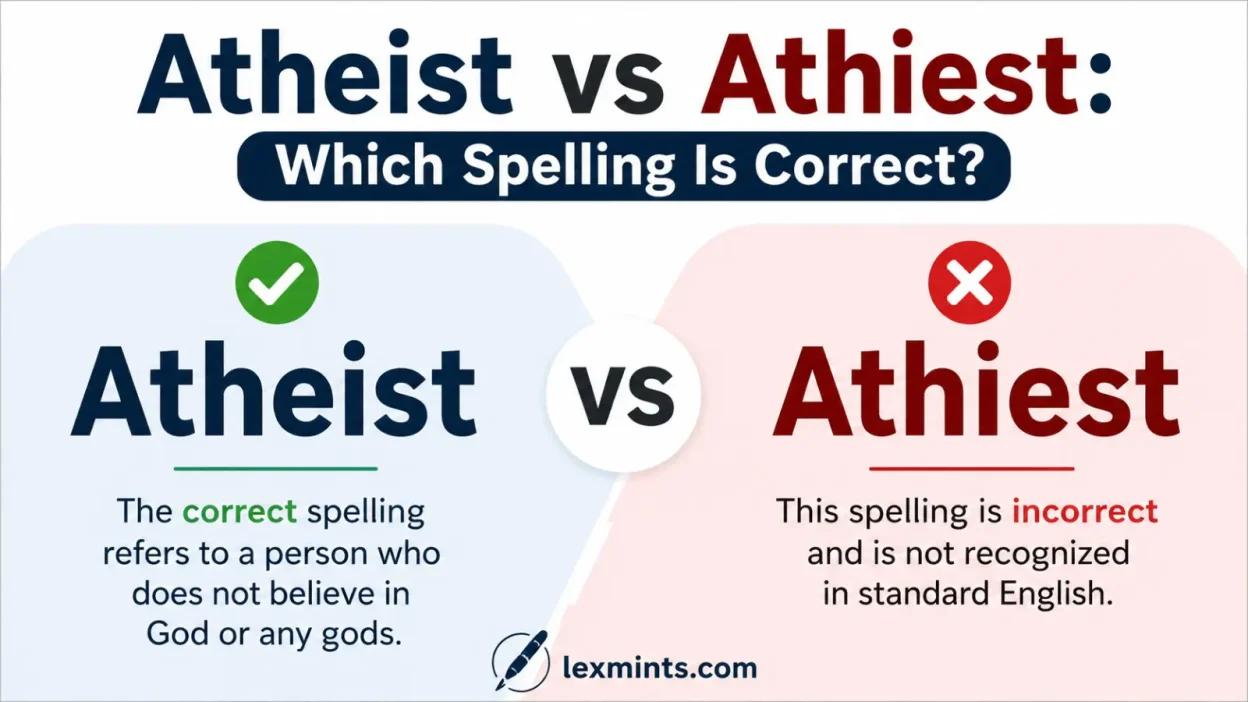
Atheist vs athiest is a simple spelling question with a clear answer: atheist is the correct spelling, while athiest is a common misspelling.
If you are writing in standard American English, use atheist. The spelling athiest is not an accepted US or UK spelling variant. The mistake usually happens when the e and i are placed in the wrong order.
The correct spelling is:
A-T-H-E-I-S-T
The incorrect form is:
A-T-H-I-E-S-T
So, when choosing between atheist vs athiest, always choose atheist.
Quick Answer
Atheist is the correct spelling.
Athiest is a misspelling and should not be used in standard American English.
The correct word is spelled:
A-T-H-E-I-S-T
The most common mistake is reversing the e and i, producing:
A-T-H-I-E-S-T
That incorrect letter order is what creates athiest.
For example:
She describes herself as an atheist.
Not:
She describes herself as an athiest.
The word atheist is a noun referring to a person who does not believe in the existence of a god or gods. The adjective form is atheistic, as in “atheistic philosophy.”
If you only need the answer for a spelling check, remember this:
Atheist is correct. Athiest is misspelled.
There is no standard US-versus-UK spelling distinction here that makes athiest acceptable in one variety of English. The issue is not regional preference. It is simply correct spelling versus a common spelling error.
Atheist vs athiest is a simple spelling question with a clear answer: atheist is the correct spelling, while athiest is a common misspelling.
Why People Confuse Them
The mistake athiest is understandable because atheist does not always look the way people expect it to sound.
When people learn a word primarily through speech, they may try to reconstruct the spelling from its pronunciation. This can lead to the letters i and e being placed in the wrong order.
The correct spelling contains:
atheist → ei
The common misspelling contains:
athiest → ie
That small difference is enough to make the spelling incorrect.
Another reason for the confusion is that English contains many words in which ie and ei appear in different patterns. Writers may remember a general spelling pattern and apply it incorrectly to atheist.
The word can also be harder to spell because it begins with athe-, which some readers may not immediately recognize as a familiar word pattern.
The safest approach is not to rely entirely on pronunciation. Instead, remember the visual structure of the correct spelling:
atheist
You can mentally divide it into:
athe + ist
That makes the sequence easier to recognize.
It is also useful to notice that atheist is related to atheism.
Compare:
- atheist
- atheism
- atheistic
Seeing these words together can make the spelling easier to remember.
The important point is that athiest is not a second accepted spelling. It is simply a frequent mistake.
Key Differences At A Glance
The difference between the two forms is straightforward.
| Context | Best Choice | Why |
|---|---|---|
| Standard American English | atheist | This is the correct standard spelling. |
| School or college writing | atheist | Use the established spelling. |
| Professional writing | atheist | The misspelling should be avoided. |
| Informal messages | atheist | Informal writing does not make “athiest” correct. |
| Dictionary-style writing | atheist | This is the standard lexical form. |
| “Athiest” | Avoid | It is a misspelling of “atheist.” |
Here is the difference in one compact comparison:
| Feature | atheist | athiest |
|---|---|---|
| Standard spelling | Yes | No |
| Standard US English | Yes | No |
| Standard UK English | Yes | No |
| Same intended word | — | Usually intended to mean “atheist” |
| Recommended in formal writing | Yes | No |
| Common spelling mistake | No | Yes |
There is no meaningful difference in pronunciation that makes the two spellings separate words. In most cases, someone who writes athiest is trying to write atheist.
Are They the Same Word?
They are not two standard spellings of the same word.
Instead, atheist is the correct word, while athiest is an incorrect spelling of that word.
When someone writes athiest, readers can usually understand what they intended. However, understanding the intended word does not make the spelling acceptable in careful writing.
The standard word atheist is a noun.
It refers to a person who does not believe in the existence of a god or gods.
For example:
Mark identifies as an atheist.
Here, atheist is the noun describing Mark.
The word can appear in many ordinary contexts, including discussions of religion, philosophy, culture, history, education, and personal belief.
For example:
The author was an atheist who wrote extensively about philosophy.
Or:
Her friend is an atheist, while her parents are religious.
The misspelling athiest does not create a different meaning.
If you see athiest in a text, it is normally safe to understand it as an attempt to spell atheist.
However, when you are writing the word yourself, choose atheist.
Pronunciation
Pronunciation can help explain why this word is sometimes misspelled.
Atheist is commonly pronounced approximately like:
AY-thee-ist
The middle sounds can make the spelling feel less obvious, especially for someone who has heard the word more often than they have seen it written.
A useful strategy is to connect the pronunciation with the written form:
atheist → AY-thee-ist
Do not use the pronunciation as a reason to spell the word athiest. The correct written form remains atheist.
US vs UK Preference
There is no important US-versus-UK spelling difference between atheist and athiest.
American English uses:
atheist
British English also uses:
atheist
The spelling athiest is not a standard alternative reserved for British English.
This distinction matters because English does have many genuine regional spelling differences. For example, some words have established American and British variants. But atheist vs athiest is not one of those cases.
You should therefore avoid thinking of the two forms as American and British versions.
The correct spelling is atheist in both varieties.
For US readers, the rule is especially simple:
Use atheist.
If you are writing for an American audience, there is no need to change the spelling based on region, publication style, or ordinary usage.
Why “Athiest” Can Look Familiar
A misspelling can become familiar simply because many people make the same error.
That does not turn it into a standard spelling.
Words with frequent spelling mistakes can appear repeatedly in informal writing, online posts, messages, comments, and drafts. As a result, an incorrect form may begin to look visually familiar.
That is likely part of why athiest can seem plausible at first glance.
Still, familiarity is not the same as correctness.
When you need the standard form, use:
atheist
Which Spelling Should You Use?
Use atheist.
There is no situation in standard American English where you should intentionally choose athiest as an alternative spelling.
If you are proofreading a sentence and find athiest, replace it with atheist.
For example:
Incorrect:
He considers himself an athiest.
Correct:
He considers himself an atheist.
Incorrect:
The book examines the experiences of athiests in modern society.
Correct:
The book examines the experiences of atheists in modern society.
Notice that the plural form also keeps the correct spelling pattern:
atheist → atheists
The incorrect form athiest should not be treated as a stylistic choice.
This is different from genuine spelling variants, where two forms may both be acceptable depending on region or editorial convention. Here, there is no comparable standard variation.
A Simple Memory Trick
One useful way to remember the spelling is to focus on the sequence:
atheist = athe + ist
Think of the word as beginning with athe-, followed by -ist.
You can also connect it with:
atheism → atheist
Both words begin with:
athe-
That makes the correct spelling easier to recall.
If you are unsure while writing, stop and check the middle letters.
Correct:
a-t-h-e-i-s-t
Incorrect:
a-t-h-i-e-s-t
The key is:
EI, not IE.
When One Spelling Looks Wrong
The word athiest may look almost correct because it contains all the same letters as atheist.
The problem is their order.
Correct:
atheist
Misspelled:
athiest
The two forms contain the same letters, but e and i have switched positions.
This is a classic spelling error: the writer knows which word they want but places two letters in the wrong order.
The mistake becomes particularly noticeable in formal writing.
For example, consider a college paper:
The author was an athiest who rejected organized religion.
The reader will probably understand the intended meaning, but the spelling error is still distracting.
The corrected version is:
The author was an atheist who rejected organized religion.
The same applies to professional communication:
Our discussion included atheist and religious perspectives.
Using the correct spelling makes the writing look polished and dependable.
Is “Athiest” Ever Correct?
No. Athiest is not the standard spelling of the word.
It should not be used as a US spelling, a UK spelling, or a special formal variant.
If your intended word is the noun describing someone who does not believe in the existence of a god or gods, write:
atheist
If you encounter athiest, treat it as a spelling mistake.
Common Mistakes (and Quick Fixes)
The biggest mistake is simply reversing the e and i.
Mistake 1: Writing “athiest”
Incorrect:
He is an athiest.
Correct:
He is an atheist.
Remember EI in atheist.
Mistake 2: Writing “athiest” in the plural
Incorrect:
Several athiests attended the discussion.
Correct:
Several atheists attended the discussion.
The correct base spelling remains atheist, so the plural is atheists.
Mistake 3: Assuming it is a regional spelling
Incorrect idea:
“Athiest” must be the British spelling.
Correct idea:
“Atheist” is the standard spelling in both American and British English.
Do not use athiest because you think it belongs to another variety of English.
Mistake 4: Changing the spelling because of pronunciation
Some writers spell the word according to how they hear it.
That can produce:
athiest
Instead, remember the established spelling:
atheist
Pronunciation can help you recognize the word, but the spelling needs to be memorized accurately.
Mistake 5: Treating the misspelling as a separate word
There is no standard meaning distinction between atheist and athiest.
If someone writes athiest, they normally mean atheist.
Do not create a meaning difference where none exists.
Quick Fix
Whenever you see athiest, ask:
Did I put the E before the I?
If not, correct it to:
atheist
That single check can prevent the most common spelling error.
Everyday Examples
The correct spelling atheist works naturally in many types of American English writing.
Everyday Conversation
My friend is an atheist, but we have always respected each other’s beliefs.
She told me that she is an atheist.
He became an atheist as an adult.
School and College Writing
The essay examines how atheists are represented in modern literature.
The professor discussed different philosophical arguments involving atheism and belief.
The student interviewed an atheist for the class project.
Workplace and Professional Writing
The report considers how people with different religious and nonreligious views may approach the issue.
The organization serves religious and nonreligious communities, including atheists.
News and General Writing
The article included perspectives from Christians, Muslims, atheists, and people with other beliefs.
The survey asked participants whether they identified as religious, nonreligious, or atheist.
Historical or Philosophical Writing
The philosopher’s work has often been discussed in relation to atheism.
The book examines the arguments of several atheist thinkers.
Examples Showing the Spelling Error
These sentences contain the common mistake:
He describes himself as an athiest.
She interviewed an athiest for her paper.
The article discussed athiests and religious communities.
Correct them to:
He describes himself as an atheist.
She interviewed an atheist for her paper.
The article discussed atheists and religious communities.
The important lesson is consistent in every context: atheist is the correct spelling.
Dictionary-Style Word Details
Verb
atheist: Not normally used as a verb. It is primarily a noun.
athiest: Not a standard verb. It is a misspelling of atheist.
Neither spelling should be treated as a standard English verb.
For example, it would be incorrect to invent a verb such as “to atheist” simply because atheist is a noun. If you need to describe someone’s belief or position, use appropriate wording such as “is an atheist” or “identifies as an atheist.”
Noun
atheist: A noun referring to a person who does not believe in the existence of a god or gods.
Example:
Daniel is an atheist.
The word can be singular or plural:
- singular: atheist
- plural: atheists
athiest: Not a standard noun spelling. It is a misspelling of atheist.
If you see athiest in a sentence, the intended noun is almost certainly atheist.
Synonyms
Because atheist describes a particular position concerning belief in gods, exact synonyms depend on context.
Possible closest plain alternatives include expressions such as:
- nonbeliever
- person who does not believe in God or gods
- person who does not believe in the existence of a god or gods
These alternatives are not always exact substitutes. “Nonbeliever,” for example, can be broader than atheist because it may refer to someone who does not believe in a particular claim without necessarily describing their overall position about gods.
Atheist remains the most direct word when that specific meaning is intended.
Athiest has no separate synonyms because it is not a separate standard word. It is simply an incorrect spelling of atheist.
There is also no need to create a separate synonym list for the misspelled form.
Example Sentences
Atheist:
She is an atheist who enjoys studying comparative religion.
My class included students with religious and nonreligious backgrounds, including one atheist student.
The author identified as an atheist.
He said that becoming an atheist changed how he approached philosophical questions.
The documentary includes interviews with atheists and religious believers.
Athiest:
“Athiest” is not the standard spelling.
When the intended word is atheist, rewrite the sentence using the correct spelling.
Incorrect:
She is an athiest.
Correct:
She is an atheist.
Incorrect:
The writer interviewed three athiests.
Correct:
The writer interviewed three atheists.
Word History
The spelling atheist is connected to the broader word family built around atheism and the idea of lacking belief in a god or gods.
The English word ultimately comes through older forms associated with Greek atheos, meaning “without a god” or “godless.” The prefix a- carries a sense of absence or lack, while theos relates to a god.
The related English forms include:
- atheist
- atheism
- atheistic
This word history helps explain why atheist has the spelling it does.
Importantly, none of this supports athiest as a historical or regional spelling variant. The modern standard form remains atheist.
There is therefore no historical reason to use athiest in contemporary English.
Phrases Containing
Atheist appears naturally in phrases and combinations such as:
- atheist writer
- atheist author
- atheist philosopher
- atheist perspective
- atheist community
- atheist organization
- atheist student
- atheist speaker
- atheist worldview
- identify as an atheist
- describe someone as an atheist
Examples:
The atheist author wrote about philosophy and religion.
She identifies as an atheist.
The discussion included an atheist perspective.
The professor invited an atheist philosopher to speak to the class.
The misspelled form athiest should not be used in these phrases.
For example:
Incorrect:
atheist writer → correct
athiest writer → incorrect
The spelling stays atheist regardless of the phrase.
FAQs
Is “atheist” or “athiest” correct?
Atheist is the correct spelling. Athiest is a common misspelling caused by reversing the e and i. If you are writing in standard American English, always use atheist.
Why do people spell atheist as “athiest”?
People often write athiest because the pronunciation of atheist can make the letter order difficult to remember. The two forms look very similar, and reversing e and i creates the common spelling mistake. The correct spelling is atheist, with ei in the middle.
Is “athiest” an accepted spelling in British English?
No. Athiest is not a standard British spelling. The correct spelling is atheist in both American and British English. This is not a US-versus-UK spelling difference; athiest is simply a misspelling.
What is the plural of “atheist”?
The plural of atheist is atheists. For example: “The discussion included several atheists.” Do not write athiests, because that form carries the same spelling error as athiest.
How can I remember the correct spelling of atheist?
A simple way to remember it is to focus on the middle letters: atheist contains ei, not ie. You can also connect it with the related word atheism, which begins with the same athe- spelling. When in doubt, remember: atheist = correct; athiest = misspelled.
Conclusion
The answer to “atheist vs athiest” is clear:
Atheist is correct. Athiest is incorrect.
The two forms are not competing US and UK spellings. Athiest is simply a common misspelling created by putting i before e instead of using the correct ei sequence.
When you mean a person who does not believe in the existence of a god or gods, write:
atheist
When you need the plural, write:
atheists
A simple way to remember the spelling is to focus on the middle:
atheist = EI
not:
athiest = IE
The correct spelling works in everyday conversation, school writing, professional documents, journalism, and formal prose. There is no need to change it based on American or British spelling preferences.
So if you are choosing between the two forms, choose atheist every time.


