
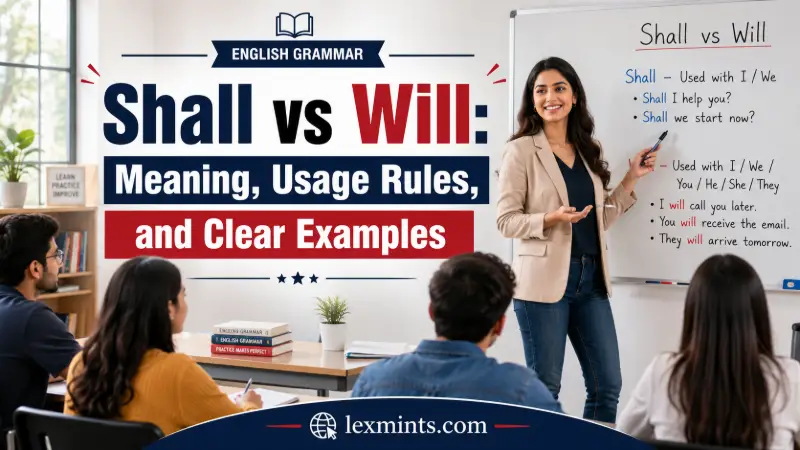
Shall vs will can be confusing because both words can refer to future actions. Older grammar lessons also taught a strict rule that used shall with I and we and will with other subjects.
That rule does not describe normal American English very well today.
For most everyday future statements, Americans use will with any subject: I will call, we will leave, she will arrive, and they will decide.
Shall has a narrower role. It still appears in questions such as Shall I help? and Shall we begin? It can also create a formal, traditional, forceful, or legal tone.
The right choice therefore depends more on meaning and context than on memorizing the old first-person rule.
Quick Answer
Use will for most ordinary future statements, predictions, promises, decisions, and requests in modern American English. Use shall mainly with I or we when making an offer or suggestion, as in Shall I help? or Shall we leave? Shall also appears in formal and legal-style writing.
Why People Confuse Them
The confusion has two main causes.
First, both words are modal auxiliary verbs and can refer to future events:
- We will return tomorrow.
- We shall return tomorrow.
Both sentences are grammatical, but the second sounds much more formal to many American readers.
Second, older grammar instruction created a memorable rule: use shall with I and we for simple future meaning and will with other subjects. Modern American usage generally does not follow that pattern.
Contractions hide the distinction even further. Both I shall and I will can become I’ll, while we shall and we will can both become we’ll.
Key Differences At A Glance
- Ordinary future: will is the normal American choice.
- Offer with I: Shall I…? can politely offer to do something.
- Suggestion with we: Shall we…? asks whether the speaker and listener should do something together.
- Future question: Will we…? asks what is expected to happen rather than proposing an action.
- Tone: shall often sounds more formal, traditional, ceremonial, or forceful in statements.
- Legal-style use: shall may state an obligation, while will generally describes future action.
- Subject range: will works naturally with all persons. Everyday shall is most recognizable with I and we, though formal directives can use it with other subjects.
Meaning and Usage Difference
Both shall and will function as modal auxiliary verbs in this comparison. They normally come before the base form of another verb:
We will leave.
Shall we leave?
For ordinary future meaning, will is the broad, unmarked choice in American English.
Use it for predictions:
The delivery will arrive Friday.
Use it for decisions:
I’ll answer the email after lunch.
It also works naturally for promises and willingness:
I will help you finish the project.
Shall has more specialized uses.
With I, it can make an offer:
Shall I carry that box?
With we, it can make a suggestion or seek agreement:
Shall we meet at noon?
In formal statements, shall may also express future intention or determination:
We shall continue.
That construction is grammatical, but it carries a stronger stylistic effect than an ordinary American sentence with will.
Tone, Context, and Formality
For an American audience, will usually sounds neutral and natural.
I will send the file this afternoon.
Shall can make the same basic future idea sound noticeably more formal:
I shall send the file this afternoon.
The second sentence is not incorrect. It simply creates a different register.
Questions are different. Shall we start? does not necessarily sound excessively formal because this structure has a specific function: it invites agreement or proposes an action.
Legal and regulatory language creates another distinction. Shall has traditionally been used to state requirements. However, its meaning can become unclear because the same word can also express future action. Modern US plain-language drafting often favors more explicit wording for duties rather than relying on shall alone.
Which One Should You Use?
For modern American English, choose according to what the sentence is doing.
| Context | Best Choice | Why |
|---|---|---|
| Ordinary future statement | will | Natural default in American English |
| Future prediction | will | States what is expected to happen |
| Immediate decision | will | Natural for a decision made now |
| Promise or willingness | will | Clearly expresses intention or willingness |
| Request to another person | will | Natural in questions such as “Will you help?” |
| Offer made by the speaker | shall | “Shall I…?” offers to take an action |
| Suggestion involving speaker and listener | shall | “Shall we…?” proposes a shared action |
| Deliberately formal future statement | shall | Creates a formal or traditional tone |
A useful American-English default is simple: use will unless you have a clear reason to choose shall.
When One Choice Sounds Wrong
Sometimes both forms are grammatical, but one does not express the intended meaning naturally.
Consider:
Shall you send me the report?
That sounds unusual if you simply want to make a request. Will you send me the report? is the natural choice.
Now compare:
Will we leave now?
This normally asks whether leaving now is expected to happen.
Shall we leave now?
This proposes leaving and asks the other person to agree.
An everyday statement can also become unintentionally grand with shall:
I shall pick up some milk after work.
It is grammatical, but I will pick up some milk after work sounds much more natural in ordinary American conversation.
Common Mistakes (and Quick Fixes)
A common mistake is treating the traditional first-person rule as mandatory.
Awkward rule-following: We shall get pizza tonight.
Natural everyday choice: We will get pizza tonight.
Another mistake is assuming shall and will always mean exactly the same thing.
Shall I open the window? is an offer.
Will I open the window? asks about what the speaker expects to happen.
Writers also sometimes assume that legal shall always has one perfectly clear meaning. It often signals an obligation, but modern drafting practice recognizes that it can be ambiguous.
Finally, avoid forcing shan’t into normal American conversation. It is the contraction of shall not, but American speakers generally use other constructions more often.
Everyday Examples
Here are natural examples showing how the choice changes with context:
Future event:
The store will open at 10 tomorrow.
Prediction:
I think traffic will be heavy tonight.
Promise:
I will call you when I get home.
Request:
Will you check the address for me?
Offer:
Shall I save you a seat?
Suggestion:
Shall we grab lunch before the meeting?
Formal statement:
We shall continue despite the delay.
Different meanings:
Shall we take the train? asks for agreement.
Will we take the train? asks whether taking the train is expected.
Dictionary-Style Word Details
Verb
shall: A modal auxiliary verb used for future reference, determination, commands, formal requirements, and especially offers or suggestions in questions with I and we. It takes the base form of the following verb.
will: A modal auxiliary verb used for future reference, willingness, decisions, requests, predictions, commands, and several other modal meanings. Will also has separate lexical-verb senses, but those are not part of the shall vs will choice discussed here.
Noun
shall: Not commonly used as a noun in standard modern American English.
will: Will can be a noun meaning determination, desire, or a legal document concerning a person’s estate. Those noun meanings are separate from the modal auxiliary will being compared with shall.
Synonyms
Neither word has one exact substitute that works in every context.
shall: Closest plain alternatives depend on meaning. For future meaning, will often works. For a binding requirement, wording that directly expresses necessity may be clearer.
will: For some future statements, be going to is a close alternative, though the two constructions do not match in every situation. For willingness or intention, the closest alternative depends on the sentence.
There is no single useful antonym for either modal across all of their meanings.
Example Sentences
shall:
- Shall I close the door?
- Shall we meet outside the theater?
- We shall remember this day.
will:
- I will text you after class.
- The game will begin at 7.
- Will you join us for dinner?
Word History
Shall developed from Old English forms associated with ideas such as owing or being obliged.
Will developed from Old English forms associated with wishing, wanting, and intending.
Over time, both became important ways of expressing future meaning. Grammarians later promoted a detailed distinction between them, including the famous rule that paired shall with first-person subjects for simple futurity.
That prescribed distinction dates back centuries, but actual English usage has never followed it consistently. Modern American usage has moved strongly toward will as the ordinary future form.
Phrases Containing
shall:
- Shall I…?
- Shall we…?
- We shall see.
- shall not
will:
- will be
- will do
- Will you…?
- will not
The first two shall patterns remain especially useful because they perform a job that an ordinary future question with will does not always perform.
FAQs
Is “shall” or “will” more correct in American English?
For ordinary future statements, will is usually the natural choice in American English. Shall is still correct, but it often sounds formal or traditional. In “Shall we leave?”, however, shall expresses a suggestion rather than a simple future prediction.
Should I say “I shall” or “I will”?
In modern American English, I will is normally the better everyday choice. I shall is grammatical, but it can sound formal in a simple future statement. Use it when that tone is intentional, not because first-person sentences require it.
What is the difference between “Shall we?” and “Will we?”
Shall we? commonly asks for agreement or makes a suggestion, while Will we? usually asks what is expected to happen. “Shall we order now?” invites a decision. “Will we order before the show?” asks about a future event.
Can “shall” and “will” be used interchangeably?
Sometimes, but not in every context. Both can refer to the future, especially in formal first-person statements. Still, replacing shall with will in a suggestion can change the meaning. “Shall I call?” offers action; “Will I call?” asks about the future.
Is “shall” too formal for everyday conversation?
Often, yes, especially in American statements such as “I shall return tomorrow.” That sentence is correct but noticeably formal. In contrast, “Shall we start?” can sound natural because it works as a polite suggestion rather than simply marking future time.
Does “shall” mean the same thing as “will” in legal writing?
Not always. In legal or regulatory wording, shall may signal a required action, while will usually points to future action. Because shall can be interpreted in different ways, many modern US drafting guidelines favor clearer wording for binding duties.
Conclusion
For shall vs will, modern American usage makes will the safest and most natural choice for ordinary future statements, predictions, promises, decisions, and requests.
Shall still has a useful place. Choose it mainly for offers such as Shall I help?, suggestions such as Shall we begin?, or when you deliberately want a formal or traditional tone.
The old I/we shall rule is useful historical background, but you do not need to follow it to write natural American English today.



[…] Especially clear in careful US usage […]