
You probably see internet slang every day. It appears in text messages, TikTok comments, gaming chats, memes, and social media posts. Words like “LOL,” “BRB,” and “AFK” are now common in online conversations.
Internet slang helps people communicate faster and sound more casual online. Some terms are funny, while others show emotions, reactions, or group identity. New slang words also appear often, especially on social media.
This guide explains the internet slang meaning in simple English. You will learn what it is, where people use it, how to understand it, and when you should avoid using it.
Quick Answer
Internet slang meaning refers to informal words, abbreviations, and expressions people use online. It is common in texting, gaming, social media, and chat apps.
Most internet slang is casual and should not be used in formal writing.
TL;DR
• Internet slang is informal online language.
• It often uses abbreviations and shortcuts.
• Common examples include LOL, BRB, and AFK.
• It appears in texts, memes, and social media.
• Most internet slang is not formal English.
• Context matters when using slang online.
What Does Internet Slang Mean?
Internet slang is a type of informal language used online. People use it in chats, comments, messages, and social media posts.
Many slang terms are shortened forms of longer phrases. Others come from memes, gaming culture, or online communities.
For example:
• LOL = laughing out loud
• BRB = be right back
• IMO = in my opinion
• AFK = away from keyboard
Internet slang changes quickly. Some words stay popular for years, while others disappear fast.
Internet Slang Definition in Plain English
In plain English, internet slang means casual online language people use to communicate quickly and naturally.
It often includes:
• Acronyms
• Shortened words
• Emojis
• Memes
• Funny expressions
For example, someone might text:
“OMG that video was hilarious lol”
This sentence uses multiple slang forms together.
Internet slang is usually easier to understand when you know the online context.
Is Internet Slang Formal or Informal?
Internet slang is mainly informal. People use it with friends, online communities, and casual groups.
It is usually not appropriate for:
• School essays
• job applications
• business emails
• formal reports
For example:
Incorrect in a work email:
“BRB, gonna fix it lol”
Better:
“I will return shortly and resolve the issue.”
Some slang words are harmless in casual workplaces. Still, formal communication should stay clear and professional.
Common Types of Internet Slang
Internet slang appears in several forms.
Acronyms
These use the first letters of words.
Examples:
• LOL = laughing out loud
• BTW = by the way
• IDK = I don’t know
Abbreviations
These shorten regular words.
Examples:
• pic = picture
• tho = though
• msg = message
Emoji-Based Slang
Some emojis now carry special meanings online.
Example:
• 💀 often means “that was extremely funny”
• 🔥 can mean “excellent” or “cool”
Meme Expressions
These come from internet culture and trends.
Examples:
• no cap
• main character energy
• it’s giving
Popular Internet Slang Examples
Here are some common internet slang terms used in the USA.
| Slang | Meaning | Example |
| LOL | Laughing out loud | “LOL that joke was funny.” |
| BRB | Be right back | “BRB, dinner is ready.” |
| AFK | Away from keyboard | “I’ll be AFK for ten minutes.” |
| IMO | In my opinion | “IMO that movie was great.” |
| TBH | To be honest | “TBH I forgot the meeting.” |
| SMH | Shaking my head | “SMH, that was careless.” |
Some terms become outdated over time. Others become part of everyday speech.
Where People Commonly Use Internet Slang
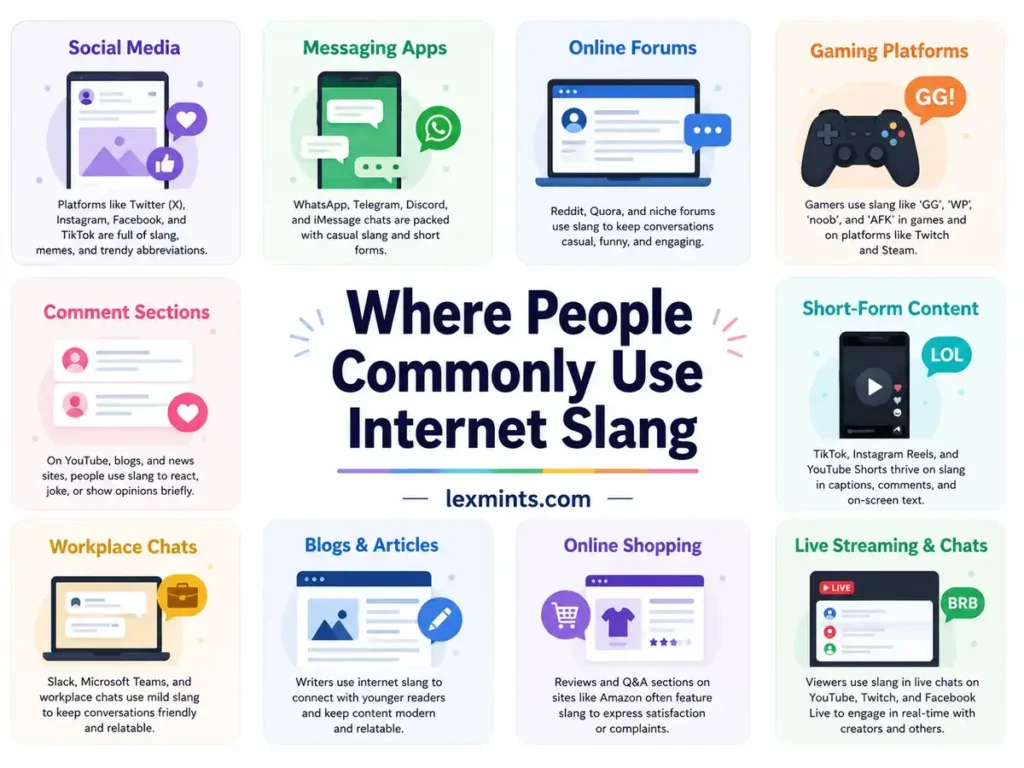
Internet slang appears in many online spaces.
Common places include:
• Text messages
• TikTok comments
• Instagram captions
• Gaming chats
• Reddit discussions
• Discord servers
• YouTube comments
You may also hear some internet slang in real-life conversations, especially among younger speakers.
How to Use Internet Slang Correctly
Use internet slang carefully. Context matters a lot.
Here are some simple tips:
• Use it with people who understand it
• Keep it casual
• Avoid overusing slang
• Learn the tone before copying terms
For example, “LOL” is usually friendly and light. However, some slang can sound rude or sarcastic.
A common mistake is using trendy slang without understanding the meaning.
Incorrect:
“That homework is bussin.”
Better:
“That pizza is bussin.”
When Not to Use Internet Slang
Avoid internet slang in serious or formal situations.
Examples include:
• Work presentations
• College applications
• Professional emails
• Legal documents
• Academic writing
Some slang also becomes outdated quickly. Using old slang can sound awkward or forced.
If you are unsure, use standard English instead.
Pronunciation and Part of Speech
“Internet slang” is a noun phrase.
Simple pronunciation:
in-ter-net slang
Many slang abbreviations are spoken differently.
Examples:
• LOL may sound like “lawl” or be read letter by letter
• AFK is usually spoken as individual letters
• BRB is often typed more than spoken
Pronunciation depends on the community and context.
Synonyms, Related Terms, and Common Confusions
Related terms include:
• online slang
• texting slang
• chat slang
• netspeak
• cyber slang
These terms are similar but not always identical.
For example, “texting slang” mainly refers to mobile messages. “Internet slang” is broader and includes social media and gaming language.
There is no perfect opposite of internet slang. However, “formal language” is often the closest contrast.
Common Mistakes With Internet Slang
Many learners make similar mistakes.
Using Slang in Formal Writing
This is the most common problem.
Incorrect:
“Thx for the opportunity lol.”
Better:
“Thank you for the opportunity.”
Misunderstanding Tone
Some slang sounds playful. Other slang sounds insulting.
Always check the meaning before using new terms.
Overusing Slang
Too much slang can confuse readers.
Natural online writing usually mixes standard English with a few slang terms.
Internet Slang Comparison Table
| Context | Best Choice | Why |
| Texting friends | Internet slang | Sounds casual and natural |
| Work email | Standard English | More professional |
| Gaming chat | Internet slang | Faster communication |
| School essay | Formal English | Clear and appropriate |
Mini Quiz
1. What does LOL mean?
Answer: Laughing out loud.
2. Is internet slang usually formal?
Answer: No, it is informal.
3. Where is internet slang commonly used?
Answer: Social media, texting, and online chats.
4. What does AFK mean?
Answer: Away from keyboard.
FAQ
What is internet slang?
Internet slang is informal language used online. It includes abbreviations, acronyms, memes, and casual expressions.
Is internet slang real English?
Yes. Many people use it in everyday communication. However, it is usually informal English.
Why do people use internet slang?
People use it to communicate quickly and casually. It can also create a sense of community online.
Is internet slang used in real life?
Yes. Some internet slang appears in spoken conversations, especially among younger people.
What are common internet slang words?
Common examples include LOL, BRB, IMO, AFK, TBH, and SMH.
Can internet slang be rude?
Sometimes. Certain slang terms may sound insulting or inappropriate depending on the situation.
Should students use internet slang in school writing?
Usually no. Formal assignments should use clear standard English.
Conclusion
Understanding internet slang meaning can help you follow modern online conversations more easily. It also helps you avoid confusion in texts, memes, and social media.
Learn the meaning first, then pay attention to tone and context. That makes internet slang easier and safer to use naturally.

[…] where people use it, and how these expressions work in real conversations. You will also learn common examples, pronunciation tips, and mistakes to […]
[…] Business is a noun with several common meanings: […]
[…] common meaning is to admit that something is true, especially after initially disagreeing with […]