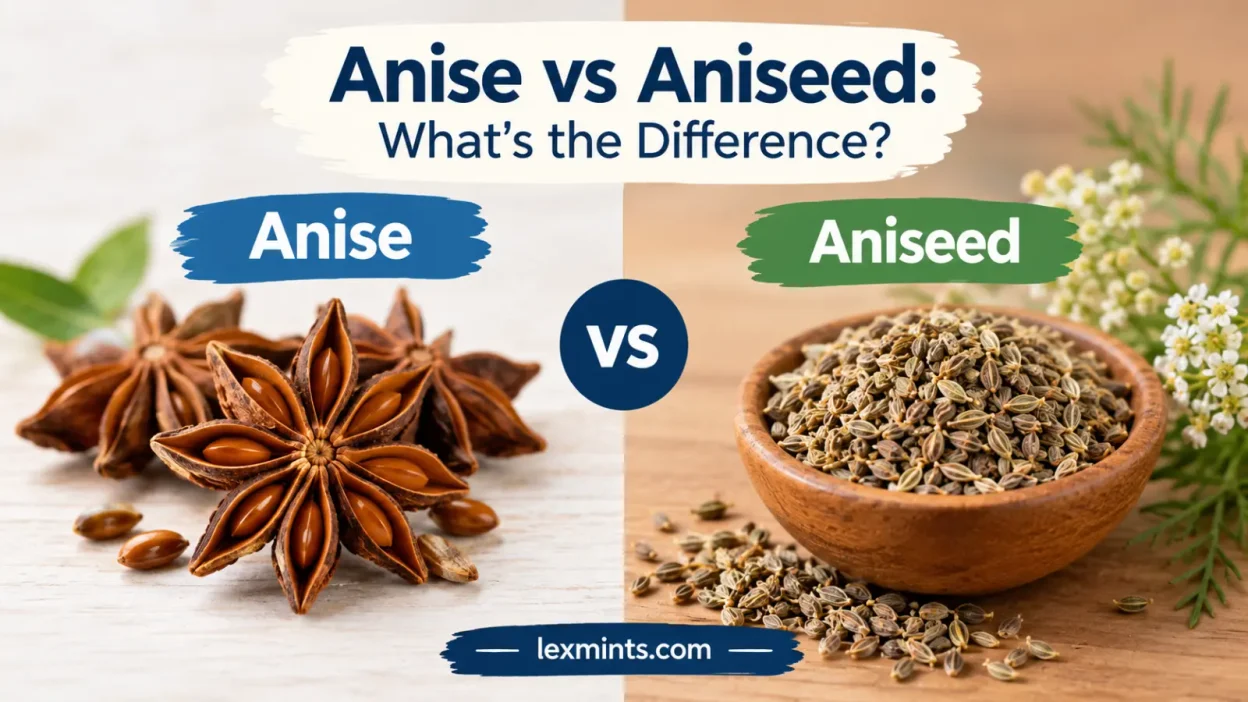
Anise vs aniseed can be confusing because both terms are associated with the same aromatic spice and have a strong licorice-like flavor. In many contexts, people use them interchangeably, but there is a useful distinction between the two words.
Anise is the name of the plant and its aromatic fruit, which is commonly used as a spice. Aniseed usually refers specifically to the seeds or dried fruits of the anise plant. In everyday English, however, especially when discussing cooking, recipes, and spices, the two terms may refer to essentially the same ingredient.
If you are wondering whether anise or aniseed is correct, the answer depends on what you are describing. In American English, anise is the more common term for the spice itself, while aniseed is more specific when referring to the seeds.
Anise vs Aniseed: Quick Answer
The main difference between anise and aniseed is their usage.
- Anise is the common name for the plant and its aromatic fruit used as a spice.
- Aniseed specifically emphasizes the seed-like dried fruit of the anise plant.
- Anise is more common in American English.
- Aniseed is also correct and is particularly common in British English and some international contexts.
- Both have a sweet, aromatic flavor similar to licorice.
- Both terms can refer to the spice used in cooking and baking.
- Anise can also describe the plant itself.
- Aniseed generally refers to the spice rather than the whole plant.
For most US readers, anise is the natural choice when talking about the spice.
What Does Anise Mean?
Anise is a noun used for a flowering plant and for the aromatic spice obtained from it. The plant is scientifically known as Pimpinella anisum and belongs to the parsley family.
Anise has a distinctive sweet and slightly spicy flavor that is often compared with licorice. Its aromatic fruit is commonly dried and used as a culinary spice. Anise is also used to flavor beverages, baked goods, candies, and other foods.
The word anise can therefore have more than one closely related meaning. It may refer to the plant, its fruit used as a spice, or the characteristic flavor associated with the spice.
Examples of “Anise”
- I added a little anise to the cookie dough.
- The recipe calls for ground anise.
- The bakery sells bread flavored with anise.
- Anise has a distinctive licorice-like flavor.
- The tea contains anise and other aromatic spices.
In American English, anise is generally the more familiar term when discussing the spice.
What Does Aniseed Mean?
Aniseed is a noun that refers specifically to the small dried fruits of the anise plant, which are commonly treated as seeds and used as a spice.
The word is formed from anise + seed, making its meaning relatively straightforward. When someone says “aniseed,” they are generally focusing on the seed-like spice rather than the entire plant.
For example:
- The recipe uses whole aniseed.
- Add one teaspoon of aniseed to the mixture.
- The bread is flavored with aniseed.
- Ground aniseed can be used in baking.
Although botanically the structures called anise seeds are actually dried fruits, aniseed is an established everyday English term.
Is Anise or Aniseed Correct?
Both anise and aniseed are correct English words.
The important difference is mainly one of specificity and regional usage.
If you are referring to the plant or the spice generally, anise is usually the better choice. If you specifically want to emphasize the seed-like spice, aniseed is appropriate.
For example:
The recipe calls for anise.
This is a natural sentence in American English.
You could also write:
The recipe calls for aniseed.
That sentence is also correct, particularly in varieties of English where “aniseed” is commonly used.
The two words can overlap significantly in culinary contexts.
Anise vs Aniseed in American English
For a US audience, anise is generally the more familiar and natural term.
American recipes, food labels, product descriptions, and general discussions often use “anise” when referring to the spice.
For example:
- anise flavor
- anise extract
- anise cookies
- anise seeds
- anise tea
- anise spice
The compound aniseed is still understandable and correct, but it may sound less familiar to some American readers.
If your goal is to write naturally for a US audience, anise is usually the safest general term.
Anise vs Aniseed in British English
Aniseed is especially familiar in British English and other varieties of English influenced by British usage.
British speakers and writers may use “aniseed” when referring to the dried spice. You may also encounter anise in British English, particularly in names, product descriptions, and references to the plant or flavor.
This means that neither word should automatically be labeled “wrong” based only on regional preference.
A useful way to remember the difference is:
American English: “anise” is often the preferred general term.
British and international usage: “aniseed” may be more common when referring specifically to the spice.
Are Anise and Aniseed the Same Thing?
In many everyday situations, anise and aniseed refer to the same culinary ingredient.
The distinction is that anise has a broader meaning, while aniseed is more specifically associated with the seed-like dried fruit.
Think of the relationship this way:
Anise → plant and spice name
Aniseed → the seed-like spice from the anise plant
This distinction becomes particularly useful when discussing the plant itself.
For example:
Anise is an annual herb.
Here, “aniseed” would not normally be used because the sentence is talking about the plant.
But:
The recipe contains aniseed.
Here, “aniseed” works naturally because the sentence is specifically discussing the spice.
Anise vs Aniseed Flavor
Both anise and aniseed are associated with a strong, sweet, aromatic flavor.
The flavor is commonly described as licorice-like, although anise and licorice are not the same plant.
Anise has a distinctive aroma that can be noticeable even in relatively small quantities. It is used in a variety of foods and beverages, particularly in recipes that benefit from a warm, sweet, aromatic note.
You may see the flavor described as:
- sweet
- aromatic
- licorice-like
- slightly spicy
- herbal
- warm
- fragrant
Because the flavor is so distinctive, anise is easy to recognize in many traditional recipes.
Anise vs Star Anise
One common source of confusion is star anise.
Anise and star anise are not the same plant.
Anise comes from Pimpinella anisum, while star anise comes from Illicium verum. They belong to different plant families.
However, they share a similar flavor profile because they contain anethole, an aromatic compound responsible for much of the characteristic licorice-like taste.
Despite their similar names and flavors, anise and star anise are different spices.
This distinction matters when following a recipe. Whole star anise is a star-shaped spice, whereas anise seeds are small, elongated, and seed-like.
So:
Anise ≠ Star anise
Aniseed ≠ Star anise
They can sometimes provide a similar flavor, but they are botanically different ingredients.
How Is Anise Used?
Anise is widely used as a flavoring ingredient.
It can be used whole, ground, or processed into extracts and flavorings.
Common uses include:
Baking
Anise is used in cookies, cakes, breads, pastries, and other baked goods.
It can provide a distinctive sweet and aromatic flavor that works especially well with sugar, citrus, nuts, and other spices.
Candy
Anise flavor is used in various candies and sweets. Its strong flavor makes it particularly suitable for products where a noticeable herbal or licorice-like taste is desired.
Beverages
Anise is also used to flavor certain teas and alcoholic beverages. The spice’s aromatic character can give drinks a distinctive flavor.
Savory Cooking
Although anise is strongly associated with sweets, it can also be used in savory recipes. Small amounts can complement meat, vegetables, sauces, and spice blends.
How Is Aniseed Used?
Aniseed is commonly used in much the same way as anise.
It may be used whole or ground, depending on the recipe.
For example, whole aniseed can be incorporated into bread dough, while ground aniseed may be mixed into cookie or cake batter.
Some common uses include:
- bread
- cookies
- cakes
- pastries
- spice mixtures
- teas
- sauces
- candies
- flavored beverages
The choice between whole and ground aniseed depends on the desired texture and intensity of flavor.
Anise vs Aniseed: Grammar and Word Usage
From a grammar perspective, anise and aniseed are both nouns.
You can use them as subjects, objects, or modifiers in appropriate noun phrases.
Anise as a Noun
- Anise has a strong aroma.
- I bought some anise.
- The recipe contains anise.
Aniseed as a Noun
- Aniseed has a distinctive flavor.
- I bought some aniseed.
- The recipe contains aniseed.
Both words can be grammatically correct in similar culinary sentences.
The main difference is not grammar. It is meaning, specificity, and regional preference.
Common Confusion: Anise, Aniseed, and Anise Seeds
You may encounter three expressions:
- Anise
- Aniseed
- Anise seeds
These expressions can overlap in everyday usage.
“Anise” is the broadest and most common term in many American contexts.
“Aniseed” specifically identifies the seed-like spice.
“Anise seeds” is an especially clear phrase when you want to tell readers exactly what part of the plant you mean.
For example:
Add one teaspoon of anise seeds.
This is immediately clear to most readers.
Similarly:
Add one teaspoon of aniseed.
This is concise and natural in contexts where the term is familiar.
Anise vs Aniseed: Which One Should You Use?
Use anise when:
- You are writing for a US audience.
- You are referring to the spice generally.
- You are referring to the plant.
- You are describing the flavor.
- You are discussing anise extract or anise flavoring.
- You want the more familiar American-English term.
Use aniseed when:
- You specifically mean the seed-like spice.
- You are writing in a variety of English where “aniseed” is common.
- The context calls for a more specific reference to the spice.
- You are discussing whole or ground aniseed.
For most general American-English writing, anise is the preferred choice.
Examples of Anise and Aniseed in Sentences
Here are examples that show how the two words work in context:
Examples with Anise
- The recipe calls for ground anise.
- She added a small amount of anise to the cookies.
- Anise gives the bread a distinctive flavor.
- The tea has a subtle anise aroma.
- The candy has a strong anise flavor.
- Anise extract is commonly used in baking.
- The chef used anise to add an aromatic note to the dish.
- The plant produces small fruits commonly used as a spice.
Examples with Aniseed
- Add a teaspoon of aniseed to the bread mixture.
- The recipe uses whole aniseed.
- Ground aniseed works well in cookies.
- The dish has a noticeable aniseed aroma.
- She sprinkled aniseed over the dough.
- The spice mixture contains aniseed.
- The baker used aniseed to flavor the loaf.
- Store the dried aniseed in an airtight container.
These examples show that both terms can work naturally when the context is clear.
Common Mistakes With Anise and Aniseed
One common mistake is assuming that one word is always correct and the other is always incorrect.
That is not the case.
Mistake 1: Calling “Aniseed” Wrong
Incorrect assumption: Aniseed is a misspelling of anise.
Reality: Aniseed is a legitimate English word.
Mistake 2: Treating Anise and Star Anise as Identical
Although their flavors are similar, anise and star anise come from different plants.
Mistake 3: Using Aniseed for the Whole Plant
“Aniseed” normally refers to the seed-like spice rather than the entire anise plant.
Mistake 4: Assuming Regional Differences Mean One Word Is Incorrect
English vocabulary can vary by region. A word may be common in British English but less common in American English without being incorrect.
Anise vs Aniseed: Comparison Table
| Feature | Anise | Aniseed |
|---|---|---|
| Part of speech | Noun | Noun |
| Refers to plant | Yes | Generally no |
| Refers to spice | Yes | Yes |
| Refers specifically to seed-like fruit | Sometimes | Yes |
| Common in US English | Yes | Less common |
| Common in British/international usage | Yes | Often common |
| Licorice-like flavor | Yes | Yes |
| Correct English word | Yes | Yes |
Which Is Better for SEO and Content Writing?
If you are writing an article for a US audience, anise is generally the stronger primary term because it is familiar and broadly understood.
However, aniseed is valuable as a related keyword and should not be treated as an error.
A natural article can use both terms without forcing them into every sentence.
For example, an article might explain:
Anise is the common name for the plant and its aromatic spice, while aniseed specifically refers to the seed-like spice produced by the plant.
This approach gives readers the distinction they are looking for while naturally covering both terms.
FAQs
Is anise the same as aniseed?
Yes, in many culinary contexts, anise and aniseed refer to the same spice. However, “anise” can also refer to the plant, while “aniseed” specifically refers to its seed-like dried fruit.
Is anise or aniseed more common in American English?
Anise is generally more common in American English. “Aniseed” is also correct but is more frequently encountered in British and some international varieties of English.
Is aniseed a correct English word?
Yes. Aniseed is a correct and standard English word, not a misspelling of “anise.” It is used to refer specifically to the seed-like spice produced by the anise plant.
Are anise and star anise the same thing?
No. Anise and star anise are different plants, although they have a similar sweet, licorice-like flavor. Anise comes from Pimpinella anisum, while star anise comes from Illicium verum.
Which is correct: anise or aniseed?
Both are correct. Use “anise” as the broader and more common term, especially for a US audience. Use “aniseed” when you specifically mean the seed-like spice.
FAQs
Is anise the same as aniseed?
In many culinary contexts, yes. Both terms can refer to the aromatic spice from the anise plant. However, aniseed more specifically refers to the seed-like dried fruit, while anise can also refer to the plant and the spice more generally.
Is anise or aniseed more common in American English?
Anise is generally more common in American English, especially when referring to the spice or its flavor. “Aniseed” is correct but may be less familiar to some US readers.
Is aniseed a correct word?
Yes. Aniseed is a standard English word. It is not a misspelling of “anise.”
Are anise and star anise the same?
No. Anise and star anise come from different plants, although they have similar licorice-like flavors. They are separate spices and should not automatically be treated as identical.
What does anise taste like?
Anise has a sweet, aromatic, licorice-like flavor. Its flavor can be quite strong, so it is often used in relatively small amounts.
Should I use anise or aniseed in a US-English article?
For a general US-English article, anise is usually the better primary term. You can use aniseed when specifically referring to the seed-like spice or when explaining regional terminology.
Conclusion
So, anise vs aniseed—which spelling or word is correct?
Both are correct.
Anise is the broader and more common term, particularly in American English. It can refer to the plant, the spice, or its characteristic flavor.
Aniseed is a more specific term that refers to the seed-like dried fruit of the anise plant. It is also a standard English word and is especially familiar in British and international usage.
For a US audience, choose anise when you are talking about the spice in general. Choose aniseed when you specifically want to identify the seed-like spice.
The simplest rule is:
Anise is the broader term; aniseed specifically refers to the seed-like spice.
Neither word is a misspelling of the other. The best choice depends on your intended meaning, audience, and regional style.