
ords every day on social media, in texts, or online videos. Words like “rizz,” “no cap,” and “slay” appear often in casual conversations. Some slang terms spread quickly and become part of everyday English.
Understanding slang helps you follow modern conversations more easily. It can also improve your reading, listening, and texting skills in English.
This guide explains slang words meaning in simple English. You will learn what slang is, where people use it, common examples, and when it may sound inappropriate.
Quick Answer
Slang words meaning refers to the informal or casual meanings of words and phrases people use in everyday conversations. Slang usually appears in texting, social media, gaming, and spoken English rather than formal writing.
TL;DR
• Slang is informal language.
• Most slang appears online or in casual speech.
• Slang meanings change over time.
• Some slang is regional or age-based.
• Formal situations usually avoid slang.
• Context matters when using slang.
What Are Slang Words?
Slang words are informal words or phrases people use in casual communication. They often appear in conversations between friends, online communities, or social groups.
Slang usually sounds more relaxed than standard English. Some slang lasts for years, while other terms disappear quickly.
Examples include:
• “Cool” meaning good or impressive
• “Ghosting” meaning suddenly ending communication
• “Bruh” meaning friend or expressing surprise
• “GOAT” meaning greatest of all time
Slang is commonly used in:
• Text messages
• TikTok videos
• Gaming chats
• Social media posts
• Everyday conversations
What “Slang Words Meaning” Means in Plain English
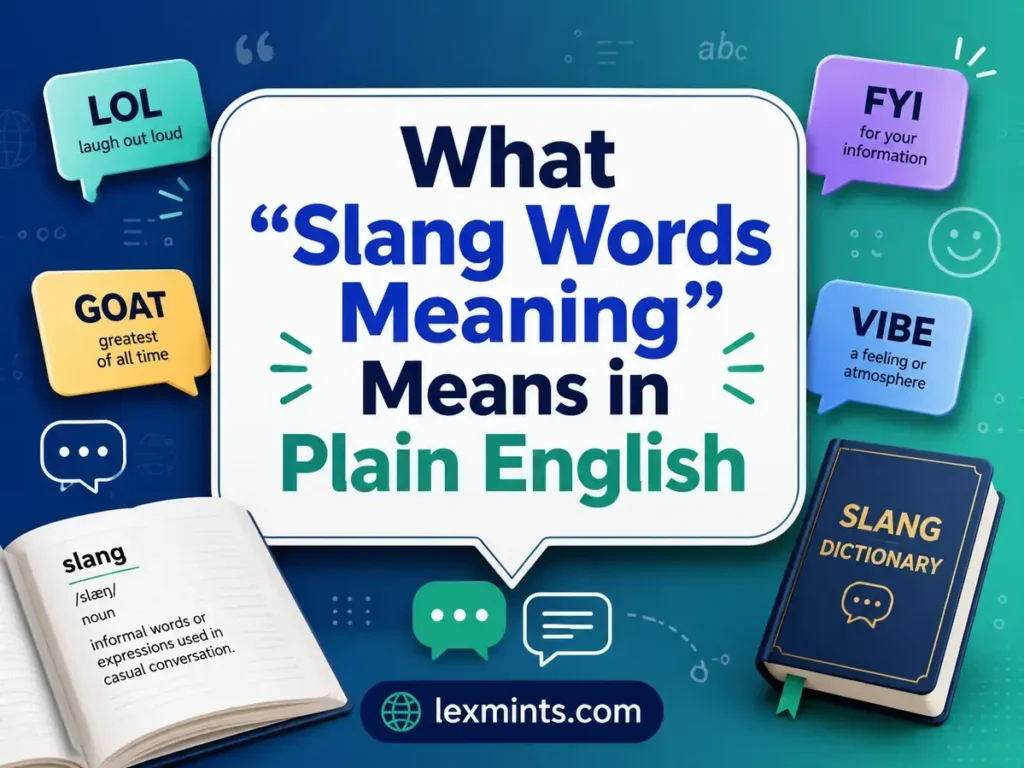
The phrase “slang words meaning” usually refers to understanding informal English expressions. People search this phrase when they want simple explanations for modern words they hear online or in conversation.
Many slang terms have meanings different from standard dictionary definitions.
For example:
• “Cooked” may mean exhausted or in trouble
• “Fire” can mean excellent
• “Cap” can mean a lie
Without context, slang can feel confusing for English learners and non-native speakers.
Are Slang Words Formal or Informal?
Slang is almost always informal. It fits relaxed situations better than professional or academic settings.
You can usually use slang with:
• Friends
• Family
• Online communities
• Casual chats
You should usually avoid slang in:
• Job interviews
• Business emails
• School essays
• Legal writing
A common mistake is using trendy slang in professional communication.
Incorrect:
“Your presentation was bussin.”
Better:
“Your presentation was excellent.”
Common Types of Slang Words
Different kinds of slang appear in modern English.
Internet Slang
Internet slang is popular online and on social media.
Examples:
• LOL — laughing out loud
• AFK — away from keyboard
• IMO — in my opinion
Texting Slang
Texting slang shortens words or phrases.
Examples:
• BRB — be right back
• IDK — I don’t know
• TBH — to be honest
Gen Z Slang
Many modern slang terms come from younger online communities.
Examples:
• Rizz — charm or flirting ability
• Delulu — unrealistic or overly hopeful
• Slay — perform very well
Regional Slang
Some slang belongs to certain places or groups.
For example, American slang may sound unfamiliar in other English-speaking countries.
Popular Slang Words and Meanings
Here are some common modern slang words in the US.
| Slang Word | Meaning | Example |
| Rizz | Romantic charm | “He has serious rizz.” |
| No cap | No lie | “That movie was amazing, no cap.” |
| Slay | Do something very well | “You slayed that performance.” |
| Ghosting | Suddenly stopping communication | “He ghosted me last week.” |
| Bet | Okay or agreed | “Bet, I’ll see you later.” |
Many slang words change meaning over time. A word popular today may disappear next year.
How to Use Slang Words Correctly
The best way to use slang is naturally and carefully. Pay attention to who you are speaking with.
Helpful tips:
• Learn the meaning before using a term
• Watch how native speakers use it
• Avoid overusing trendy phrases
• Match the tone of the conversation
Example:
Natural:
“That outfit is fire.”
Unnatural:
“Greetings, teacher. Your lesson was fire.”
Context matters more than the slang itself.
When Not to Use Slang
Slang can sound confusing or unprofessional in some situations.
Avoid slang when:
• Writing formal emails
• Speaking in serious meetings
• Talking with people unfamiliar with the term
• Completing school assignments
Another problem is outdated slang. Some older phrases may sound strange today.
For example, younger speakers may not use expressions popular in the early 2000s.
Pronunciation and Part of Speech
The word “slang” is usually a noun.
Simple pronunciation:
/slang/
Example:
“That word is slang.”
Sometimes people also use “slang” as an adjective.
Example:
“That’s a slang term.”
Many slang expressions function as phrases instead of single words.
Examples:
• “No cap” — phrase
• “Lowkey” — adverb or adjective in casual use
• “GOAT” — noun
Synonyms, Related Terms, and Common Confusion
Some words relate closely to slang, but they are not exactly the same.
Related Terms
• Informal language
• Colloquial speech
• Street language
• Chat abbreviations
Similar but Different
• Idiom — a phrase with a special meaning
• Jargon — specialized language used by a profession
• Acronym — initials forming a word or phrase
Not every informal phrase counts as slang.
Antonyms
There is no perfect opposite of “slang,” but these are close:
• Formal language
• Standard English
Common Mistakes With Slang Words
People often misuse slang because meanings change quickly.
Mistake 1: Using slang formally
Incorrect:
“The client meeting was lit.”
Better:
“The client meeting went very well.”
Mistake 2: Copying slang without understanding it
Some slang has cultural or social meaning. Always learn the context first.
Mistake 3: Overusing trendy words
Too much slang can sound forced or unnatural.
Small Comparison Table
| Context | Best Choice | Why |
| Texting friends | Slang | Sounds casual and natural |
| Business email | Standard English | More professional |
| Social media comments | Light slang | Fits online tone |
| School essay | Standard English | Clear and formal |
Mini Quiz
1. Is slang formal or informal?
Answer: Informal.
2. What does “no cap” usually mean?
Answer: No lie or seriously.
3. Should you use slang in a job interview?
Answer: Usually no.
4. What does “ghosting” mean?
Answer: Suddenly ending communication.
5. Is “LOL” internet slang?
Answer: Yes.
FAQ
What are slang words in English?
Slang words are informal expressions used in casual speech and online communication. They often belong to specific groups, generations, or communities.
Why do people use slang?
People use slang to sound natural, relaxed, funny, or connected to a group. Slang can also make communication faster.
Is slang bad English?
No. Slang is a normal part of language development. However, it may sound inappropriate in formal situations.
What is the difference between slang and jargon?
Slang is casual informal language. Jargon is specialized language used in jobs or industries.
Are texting abbreviations slang?
Some are. Terms like “LOL” and “BRB” are common examples of internet slang.
Why does slang change so quickly?
Online culture and social media spread new expressions rapidly. Some phrases become popular for only a short time.
Can non-native speakers use slang?
Yes, but they should learn the meaning and context carefully first.
Conclusion
Learning slang words meaning can help you understand modern English conversations more easily. Slang appears everywhere online, in texting, and in daily speech.
Keep listening to real conversations, notice context, and use slang naturally when appropriate.

[…] In modern online usage, people often say something is aesthetic to mean visually appealing or […]