
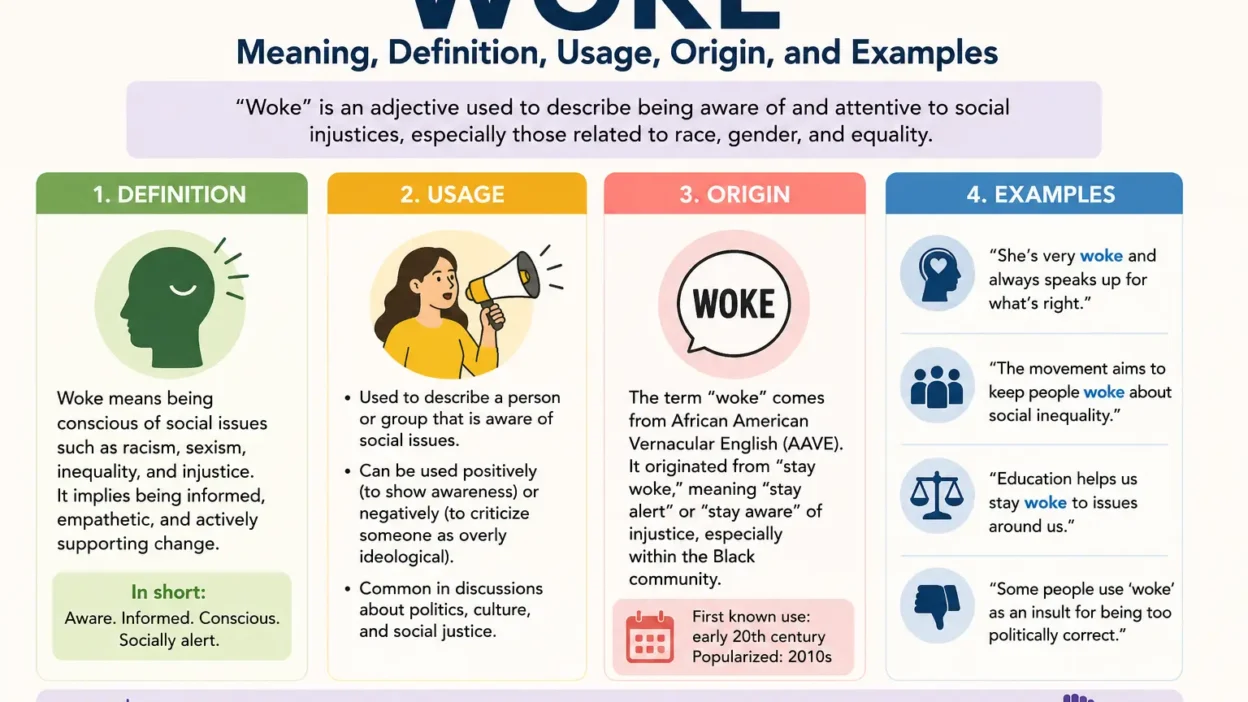
You may see the word “woke” online, in news stories, or on social media. Some people use it seriously. Others use it as criticism or sarcasm. That can make the meaning confusing, especially for English learners.
The word has changed over time. It began as slang connected to awareness and social issues. Today, it can carry political or cultural meaning depending on the speaker and situation.
This guide explains what “woke” means in plain English. You will also learn how people use it, where it came from, how to pronounce it, and when to be careful using it.
Quick Answer
“Woke” usually means socially aware, especially about racism or unfair treatment. The word often describes someone who pays attention to social justice issues.
Today, some people also use “woke” in a negative or sarcastic way.
TL;DR
• “Woke” means socially aware or alert.
• It started in African American English.
• “Stay woke” means stay aware and careful.
• The word is often political today.
• “Woke” can sound positive or negative.
• It is also the past tense of “wake.”
What Does “Woke” Mean?
In modern English, “woke” usually means aware of social problems or unfair treatment. It often relates to racism, discrimination, equality, or political issues.
People may describe someone as “woke” if they support social change or speak about fairness.
Example:
• “She became more woke after learning about civil rights history.”
The meaning can change based on tone and context.
What Does “Stay Woke” Mean?
“Stay woke” is a phrase that means “stay alert” or “stay aware.” It originally encouraged people to notice unfair treatment and social problems.
The phrase became popular in music, online culture, and activism.
Example:
• “Stay woke and pay attention to what is happening around you.”
Today, people may also use the phrase jokingly or sarcastically.
Is “Woke” Positive or Negative?
The word can be positive, neutral, or negative.
Some people use “woke” positively to praise awareness and fairness.
Example:
• “The documentary helped viewers become more woke about inequality.”
Others use it negatively to criticize ideas they see as too political or extreme.
Example:
• “He complained that the movie was too woke.”
Because the word is politically sensitive, it is smart to understand the audience before using it.
Part of Speech and Grammar
“Woke” most commonly works as an adjective in modern slang.
Example:
• “That company wants to appear woke.”
It is also the past tense of the verb “wake.”
Example:
• “I woke up early today.”
Here is a quick breakdown:
| Use | Example | Function |
| “She is woke.” | adjective | socially aware |
| “I woke up.” | verb | past tense of wake |
Pronunciation of “Woke”
“Woke” is pronounced like:
/wo0˘28ak/\text{/wo\u028ak/}/wo0˘28ak/
It sounds similar to “broke” or “smoke.”
Common mistake:
• Incorrect: “wahk”
• Correct: “wohk”
How People Use “Woke” Today
In modern English, woke appears in many different settings. People use it on social media, in political debates, in entertainment reviews, and in news stories. You may also see it in internet slang, where the tone can change based on context.
Common places where the word appears include:
• social media posts
• political discussions
• entertainment reviews
• news stories
• internet slang
Some people use it seriously. Others use it sarcastically. Because of this, context matters a lot.
Example:
• “The brand tried to look woke in its advertising.”
In some conversations, the word may sound argumentative or political.
If you want to explore more trending terms like “woke,” check our complete guide on 👉 Internet Slang Words Meaning Explained (Updated List) where we break down modern Gen Z and social media vocabulary in simple language.
Examples of “Woke” in Sentences
Here are some natural examples in American English:
Here are some natural examples in American English:
• After college, my brother became more woke about social issues.
• That comedian often jokes about woke culture.
• In the article, readers were encouraged to stay woke.
• Some viewers said the show felt too woke.
• Be careful: “I woke up late this morning” uses woke as the past tense of wake, not as slang.
Notice that the final example uses “woke” as a verb, not slang.
Many internet expressions evolve quickly through social media culture, memes, and online communities. If you want to understand more digital terms and viral expressions, explore our complete guide to Internet Slang Meaning
Common Mistakes With “Woke”
Many learners misunderstand this word because it has more than one meaning.
Common mistakes include:
• Using “woke” when you only mean “awake”
• Assuming it is always positive
• Using it jokingly in serious conversations
• Confusing “woke” with formal academic language
Correction example:
• Incorrect: “I am woke since 6 a.m.”
• Correct: “I have been awake since 6 a.m.”
Many modern internet expressions used alongside “woke” come from younger online communities and evolving digital culture. If you want to understand the latest youth vocabulary and trending internet phrases, explore our complete guide to Gen Z slang meanings.
Synonyms and Related Terms
Some close or related terms include:
• aware
• socially conscious
• progressive
• informed
These words are not always exact matches. “Woke” has stronger cultural and political meaning.
There is no perfect opposite word, but people sometimes use:
• unaware
• insensitive
• ignorant
Use these carefully because they may sound insulting.
Origin and History of “Woke”
The modern slang meaning of “woke” likely came from African American English. Early uses appeared in the early 1900s.
The phrase “stay woke” became more widely known through music, activism, and discussions about racial justice.
Later, the word spread into mainstream American culture and politics. Over time, some people began using it sarcastically or critically.
The exact meaning now depends heavily on context and speaker tone.
Quick Comparison Table
| Context | Best Choice | Why |
| Social awareness | woke | cultural meaning fits |
| General knowledge | aware | more neutral |
| Political discussion | woke | commonly used today |
| Formal writing | socially conscious | sounds more professional |
Mini Quiz
1. What does “woke” usually mean today?
A. Sleepy
B. Socially aware
C. Angry
2. Is “woke” always positive?
A. Yes
B. No
3. Which sentence uses “woke” as a verb?
A. “They seem woke.”
B. “I woke up early.”
4. What does “stay woke” suggest?
A. Stay asleep
B. Stay alert and aware
Answer Key
- B
- B
- B
- B
FAQ
What does woke mean in slang?
In slang, “woke” means socially aware, especially about unfair treatment or inequality. The word often appears in political or cultural discussions.
Is woke a real English word?
Yes. “Woke” is both a standard past tense form of “wake” and a modern slang adjective.
Why do people say “stay woke”?
The phrase means “stay aware” or “stay alert.” It originally encouraged awareness about social injustice.
Is woke offensive?
Not always. However, some people use it sarcastically or negatively. Tone and context matter.
What part of speech is woke?
It can work as:
• an adjective in slang use
• a verb as the past tense of “wake”
How do you pronounce woke?
It is pronounced like “wohk.” It rhymes with “broke.”
Does woke only relate to politics?
No. The word often relates to social awareness in general. Still, political discussions commonly use it today.
Conclusion
The meaning of “woke” has changed over time. Today, it usually describes social awareness, especially around fairness and inequality.
Because the word carries cultural and political meaning, context matters. Learning how people use “woke” can help you understand modern English more naturally.
[…] height and heighth, show how to use height correctly, examine why heighth appears, and provide clear examples so you can avoid this spelling […]